
Animal Careers, Courses and Apprenticeships
Neutral, factual information about working with animals across the UK: veterinary and veterinary-nursing careers, veterinary-care assistants, animal-care work, kennels and catteries, pet retail, dog grooming, dog walking and pet sitting, equine work and farriery, farming, zoos, wildlife and conservation, laboratory animal technicians, training and behaviour work, apprenticeships and college courses, work experience and volunteering, and how to check a course before you pay.
Last reviewed: 14 August 2026. Qualifications, apprenticeship standards, funding, entry requirements and licensing change over time and differ between England, Scotland, Wales and Northern Ireland — always confirm current details with the official body, awarding organisation, college or employer concerned.
About this page
Sixpence Support UK provides general careers information only. Sixpence Support UK does not provide veterinary advice, qualifications, employment or placements, and does not inspect, recommend or endorse any employer, course or training provider.
Education, apprenticeships and funding are organised separately in England, Scotland, Wales and Northern Ireland. Where something below applies to only one nation, that is stated. Veterinary surgeons and veterinary nurses are regulated across the UK by the Royal College of Veterinary Surgeons.1
Careers working with animals
Animal careers include far more than becoming a veterinary surgeon. Most people who work with animals are not vets, and many well-paid, skilled and secure animal jobs are entered through college courses, apprenticeships or direct employment rather than a university degree.
Areas of work include:
- Veterinary care — veterinary surgeons, Registered Veterinary Nurses, student nurses and clinical support staff.
- Animal welfare — rescue centres, rehoming, welfare advice, inspection and enforcement support.
- Kennels and catteries — boarding, day care and animal-hotel work.
- Pet retail — animal care and customer service in shops and garden centres.
- Dog grooming — salon, mobile and assistant roles.
- Equine care — grooms, yard staff, riding schools, racing yards, coaching and farriery.
- Farming and livestock — dairy, poultry, shepherding, general farm and technician work.
- Zoos and wildlife parks — keepers, education, visitor services, grounds and records.
- Conservation — habitat management, rangers, surveying and wildlife rehabilitation.
- Laboratories and research — regulated animal technician and technologist roles.
- Training and behaviour — assistance-dog training, instruction and clinical behaviour work.
- Administration and customer service — reception, records, finance, fundraising and communications within animal organisations.
Qualifications, responsibilities, pay and working conditions vary considerably between these areas, and between individual employers. Two jobs with similar titles can involve very different duties, training and levels of responsibility.6
Is working with animals right for you?
Enjoying animals is helpful, but on its own it is not enough. Animal work is practical, physical and often unglamorous, and much of the day may involve cleaning and routine tasks rather than time spent playing with animals.
Depending on the setting, the work may involve:
- cleaning cages, kennels, stables, pens or equipment;
- handling waste, unpleasant smells and bodily fluids;
- working outdoors in cold, wet or windy weather;
- early mornings, evenings, weekends and public holidays, because animals need care every day;
- physical lifting, carrying and repetitive tasks;
- animals that are frightened, aggressive, sick or injured;
- bites, scratches, kicks and allergies;
- following strict hygiene, infection-control and welfare procedures;
- communicating calmly with worried, upset or angry owners;
- coping with animal illness, suffering, euthanasia and death.
None of this means the work is unsuitable for you. Many people find animal work rewarding and build long careers in it. It is simply better to know what the job actually involves before committing time or money to training.
Veterinary surgeon
Veterinary surgeons diagnose and treat sick or injured animals, carry out surgery, prescribe medicines, advise owners and take overall clinical responsibility for the animals in their care. Vets work in companion-animal, farm, equine and mixed practice, and also in research, public health, government services, industry and academia.
Becoming a veterinary surgeon in the UK requires:
- a veterinary degree approved or recognised by the Royal College of Veterinary Surgeons;2
- competitive university entry, with limited places;
- relevant academic qualifications, normally including sciences;
- a practical understanding of what the profession involves;
- registration with the Royal College of Veterinary Surgeons before practising.5
No short cut to becoming a vet
A short private course, a general animal-care course or an ordinary animal-care apprenticeship does not qualify anybody to work as a veterinary surgeon. Only an RCVS-approved or recognised veterinary degree, followed by RCVS registration, allows somebody to practise veterinary surgery in the UK. Treat any advertisement suggesting otherwise as a serious warning sign.
Preparing to apply for veterinary medicine
Universities set their own entry requirements, and they differ between institutions and between the four UK nations. Check each university's current published requirements through UCAS and the university's own admissions pages.7
Preparation may include:
- studying the science subjects each university requires;
- gaining relevant animal-handling or veterinary experience where it is available to you;
- understanding animal welfare, husbandry and the law that applies to it;
- researching different areas of veterinary work, including farm, equine and non-clinical roles;
- preparing for interviews, multiple mini-interviews or admissions assessments where these are used;
- checking whether a foundation, gateway or pre-veterinary year is available and who is eligible.
Meeting the minimum grades or obtaining work experience does not guarantee a place. Veterinary courses receive far more applications than they have places, and admissions decisions rest entirely with each university.
Veterinary nurse
Veterinary nurses support veterinary surgeons and provide skilled nursing care to sick, injured and recovering animals. Their work can include monitoring patients, assisting in theatre, nursing inpatients, administering treatment under veterinary direction, running nurse clinics, laboratory work, radiography and advising owners.
“Veterinary nurse” is a regulated professional role. To work as a Registered Veterinary Nurse, a person must complete an RCVS-accredited qualification and register with the Royal College of Veterinary Surgeons. Registration brings professional standards, continuing professional development and accountability.35
Veterinary-nursing training routes
There are two principal routes to becoming a Registered Veterinary Nurse:
- an RCVS-accredited further-education qualification, which in some cases can be completed through an employed, apprenticeship-style route while working in practice; and
- an RCVS-accredited foundation degree or degree in veterinary nursing at a university or college.
Whichever route is used, the practical clinical training must take place through approved arrangements, usually in an RCVS Approved Training Practice or an equivalent approved placement, with recorded clinical skills and supervision.4
England: a veterinary-nursing apprenticeship route may be offered by employers, and the underlying qualification must still be RCVS-accredited. Scotland, Wales and Northern Ireland: employed and college routes exist but are funded and arranged through each nation's own system — check with the RCVS and with colleges in your nation before enrolling.
Only accredited courses lead to registration
An unaccredited “veterinary nursing” or “vet nursing” course, however it is marketed, does not lead to registration as a Registered Veterinary Nurse. Always check the exact course against the RCVS lists below before you pay anything.
Veterinary-care assistant and practice-support roles
Veterinary practices employ many people who are not vets or Registered Veterinary Nurses, including:
- veterinary-care assistants;
- animal nursing assistants;
- receptionists;
- administrators and practice-management staff;
- cleaners and domestic staff;
- kennel assistants;
- customer-service and client-care roles.
Responsibilities differ between practices. Veterinary-care assistants are not Registered Veterinary Nurses: they support the clinical team with animal care, cleaning, preparation, handling and stock, within the training and competence they have, and they are not on the RCVS register.
Possible entry routes include a college animal-care course, an animal-care apprenticeship with a practice, direct application to a vacancy, or moving from relevant experience elsewhere. Some assistants later go on to accredited veterinary-nursing training.
Animal-care worker
Animal-care workers may be employed in:
- kennels;
- catteries;
- rescue and rehoming centres;
- animal boarding establishments;
- pet shops;
- sanctuaries;
- wildlife parks;
- animal day-care settings.
Typical duties may include:
- feeding and providing fresh water;
- cleaning and disinfecting accommodation;
- exercising animals;
- grooming;
- monitoring behaviour and wellbeing;
- keeping accurate records;
- speaking with owners or visitors;
- reporting possible health or welfare concerns promptly.
Workers must follow their employer's welfare, hygiene, infection-control and health-and-safety procedures, and must work within their own training and competence.21
Animal-care courses and apprenticeships
People often mix these up, and they are not the same thing:
- A full-time college course — you are a student, you are not paid, and you study a qualification, often with placements.
- An apprenticeship — a genuine paid job with an employer that includes training and off-the-job study. You apply for it as a vacancy; you do not simply enrol on it.824
- Direct employment — a paid job where any training is provided by the employer.
- Volunteering — unpaid, usually flexible, and not employment.
- Work experience — a short, usually unpaid placement to see what the work involves.
- A private training course — bought from a commercial provider; quality, recognition and practical content vary enormously.
Animal-care and animal-welfare apprenticeships exist at different levels, and school leavers can apply where an employer is recruiting. Availability depends entirely on employers advertising vacancies in your area at the time you are looking.
Where to look in each UK nation
England only: apprenticeship standards (for example animal-care and welfare assistant roles) are published for England, and vacancies are advertised through Find an Apprenticeship.
Scotland: Modern Apprenticeships and college routes through Apprenticeships.scot and My World of Work. Wales: Welsh Government apprenticeships and Careers Wales. Northern Ireland: ApprenticeshipsNI through nidirect and the Careers Service.
Pet-shop and pet-retail careers
Pet-shop and pet-retail work may involve:
- animal care and welfare tasks;
- cleaning animal accommodation;
- monitoring temperature, lighting and water quality;
- customer service and advice within the limits of your training;
- stock control and ordering;
- receiving deliveries and lifting stock;
- product displays and merchandising;
- handling payments and till work;
- record keeping.
Pet-shop work is not solely playing with or caring for animals. Much of the day is retail work, and staff must know when to refer a customer's animal-health question to a veterinary practice rather than answering it themselves.
Businesses that sell animals may need a licence from the local authority and must meet animal-welfare conditions, which staff are expected to follow.2023 Licensing arrangements differ between England, Scotland, Wales and Northern Ireland, so check your own local council or the relevant devolved guidance.
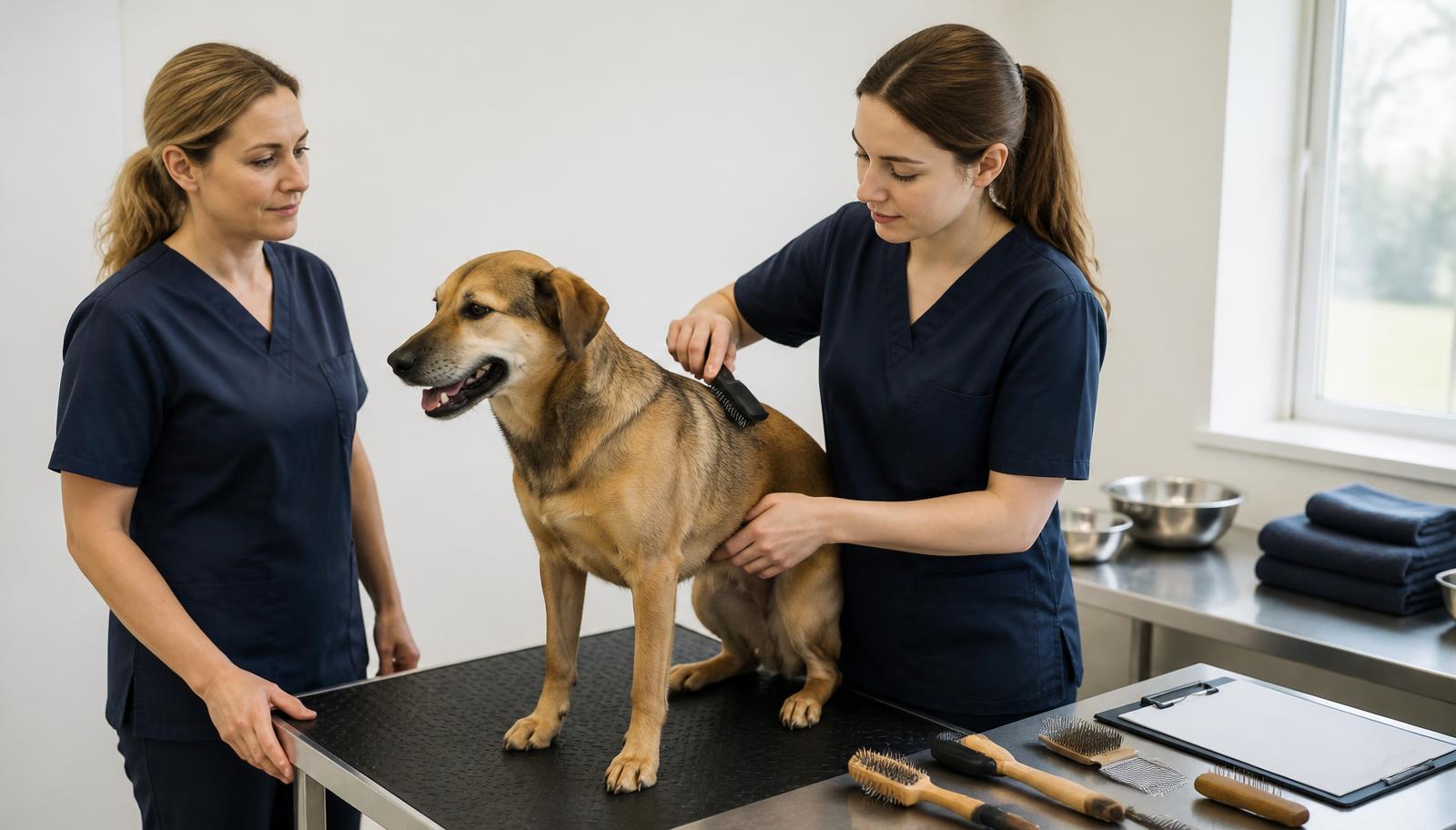
Dog grooming
Dog groomers may:
- wash and dry dogs;
- brush out loose or matted coat;
- trim, clip and style coats;
- check for visible skin or coat problems and advise the owner to seek veterinary attention where needed;
- clean and maintain equipment;
- keep records of each dog and its treatment;
- speak with owners about requirements and coat condition;
- handle nervous, elderly or difficult dogs safely and calmly.
Routes in include a college grooming qualification, a grooming apprenticeship where an employer offers one (apprenticeship standards are published separately in England, Scotland, Wales and Northern Ireland), or starting as a grooming assistant or bather and training on the job.
Before you pay for a private grooming course
Check the exact qualification title and level, the awarding organisation, how many hours of supervised practical grooming on real dogs are included, what equipment you must buy, the total cost including assessment fees, whether insurers and employers accept the qualification, and the refund terms.
An online-only course cannot provide the supervised practical handling and clipping experience that competent grooming requires. Treat “become a groomer in a weekend” style claims with caution.
Dog walking and pet sitting
Dog walking and pet sitting mean taking responsibility for somebody else's animal, and often for their home. Before offering a service, think carefully about:
- reliability, in all weather and at fixed times;
- safe handling, lead use and recall, and knowing which dogs you can manage;
- keys, alarm codes and home security;
- emergency contact arrangements, including the owner's veterinary practice;
- insurance, including public liability and care, custody and control cover;
- transporting animals safely and legally;
- written records, contracts and consent for treatment in an emergency;
- local business requirements, which may include local-authority licensing for boarding or day care;20
- managing several animals at once safely;
- being clear about what your service does and does not include.
Self-employment is not risk free and does not guarantee income. You are responsible for tax, insurance, cancellations, quiet periods, holidays and sickness cover, and for the consequences if an animal is injured or lost in your care.
Kennel, cattery and animal-boarding work
Duties in kennels, catteries and boarding establishments commonly include:
- feeding to individual instructions;
- cleaning, disinfecting and laundry;
- exercise and enrichment;
- monitoring behaviour, appetite and wellbeing;
- giving medication only when properly authorised, recorded and trained to do so;
- accurate record keeping;
- customer handovers at drop-off and collection;
- infection-control and isolation procedures.
Boarding businesses may require a local-authority licence and must meet animal-welfare conditions covering accommodation, staffing, records and emergency arrangements.2023 Staff are expected to work within those conditions and to report concerns.
Equine careers
Equine work includes:
- equine groom;
- stable worker;
- yard assistant and head-of-yard roles;
- riding-school work;
- equine veterinary nursing (an RCVS-accredited route);
- farriery;
- coaching and instruction;
- racing-yard roles, including stable staff and work riders.
The work commonly involves very early mornings, outdoor conditions in all weather, heavy lifting, mucking out, and the real risks of handling large, powerful animals. Riding ability is essential for some roles and irrelevant for others.
Equine apprenticeships
Equine-groom and related apprenticeships exist where employers offer them. In England these follow published apprenticeship standards and are advertised as vacancies through Find an Apprenticeship; Scotland, Wales and Northern Ireland run their own apprenticeship frameworks and funding through the services listed above.
Availability depends on employers and location. Rural areas may have more yards but fewer advertised apprenticeships, and some yards recruit informally. Accommodation is sometimes offered with equine jobs; if it is, check what is included, what is deducted from pay and what happens if the job ends.
Farrier
Farriers care for horses' feet, trim hooves, and make and fit horseshoes. It is skilled, physically hard work combining metalwork, anatomy and horse handling.
Great Britain (England, Scotland and Wales): farriery is a regulated occupation. Training is through a recognised apprenticeship with an Approved Training Farrier leading to the required qualification, followed by registration with the Farriers Registration Council. It is unlawful for an unregistered person to shoe a horse in Great Britain.17 Northern Ireland: arrangements differ, so check the current position before training or practising there.
An ordinary short course does not permit somebody to work independently as a farrier, and no private provider can grant registration.
Zoo and wildlife-park careers
Zoos and wildlife parks employ people in roles including:
- zookeeper or animal keeper;
- education officer and learning staff;
- conservation and field-project workers;
- grounds, horticulture and maintenance roles;
- administration, finance and HR;
- visitor services, catering and retail;
- veterinary and veterinary-nursing roles;
- research, records and registrar work.
Animal-keeper vacancies are often highly competitive, with many applicants for each post. Employers commonly expect a relevant animal-management, animal-science or zoology qualification together with substantial practical animal experience.
Most work in a zoo does not involve direct contact with animals. Visitor services, education, grounds, maintenance and office roles make up a large part of the workforce, and are genuine careers in their own right.
Wildlife and conservation careers
Wildlife and conservation work includes:
- wildlife rehabilitation and rescue;
- countryside and estate work;
- habitat management;
- ranger and warden roles;
- conservation projects and practical volunteering programmes;
- ecological surveying and monitoring;
- wildlife education and community engagement;
- marine and freshwater conservation.
Some roles, particularly ecology and surveying, usually require a degree and sometimes protected-species licences. Others can be entered through a college course, an apprenticeship, practical land-management experience or supervised volunteering.
Be clear about the difference between paid employment and unpaid volunteering. Conservation organisations rely heavily on volunteers, and a volunteering placement — however demanding — is not a job and does not guarantee one.
Farm and livestock careers
Farming and livestock roles include:
- general farm worker;
- livestock worker;
- dairy work and milking;
- poultry work;
- shepherding;
- agricultural technician and machinery roles;
- farm supervision and management;
- animal-health and welfare roles, including work linked to official animal-health services.19
Farm work is physically demanding, often starts very early, continues at weekends and in bad weather, and involves machinery and large animals — both of which carry real safety risks. Livestock workers also carry day-to-day responsibility for animal welfare and for meeting legal welfare standards.1821
Animal trainer and behaviour roles
Job titles and standards vary widely in this area, and some titles are not protected, which means anybody can use them. Roles include:
- assistance-dog training and puppy socialising;
- animal training in visitor attractions, film or working-animal settings;
- dog-training class instruction;
- animal-behaviour work with owners and rescue organisations;
- rehabilitation support for animals with behaviour problems, working alongside veterinary surgeons.
An online certificate alone may not demonstrate professional competence. Advanced clinical animal-behaviour roles usually require substantial academic study, supervised casework and recognition by a body with a clear professional or official basis, and behaviour cases with a possible medical cause must be referred to a veterinary surgeon.
Animal-welfare and inspector roles
Animal-welfare work may include:
- inspecting premises and conditions;
- investigating welfare concerns;
- educating and advising owners;
- gathering and recording evidence;
- writing reports and statements;
- working with local authorities, government agencies or enforcement services;1923
- caring for and rehoming rescued animals.
Job titles, legal powers and entry requirements differ considerably between employers, and between the four UK nations. Some inspection and enforcement powers sit with local authorities or government agencies; others rest with particular officers under specific legislation.
Volunteers and charity staff do not automatically have enforcement powers. Anybody concerned about an animal should report it to the appropriate organisation rather than intervening themselves.
Animal technicians and research roles
Animal technicians care for animals kept for scientific, veterinary or medical research. This work is regulated by law, and premises, projects and individuals must hold the necessary licences and follow strict conditions.22
The role can involve:
- daily animal care, feeding and housing;
- monitoring health, behaviour and welfare, and reporting concerns;
- keeping accurate, auditable records;
- strict hygiene and biosecurity;
- following legal and ethical procedures precisely;
- working with scientific and veterinary teams.
Some people find this work rewarding because of the welfare responsibility it carries; others would not feel comfortable in this environment. Both views are reasonable, and it is worth thinking honestly about it before applying.
Work experience
Relevant experience can help you understand what animal work is really like, and it may strengthen an application. It does not guarantee a course place or a job.
Possible settings include:
- veterinary practices;
- kennels and catteries;
- farms;
- riding stables and yards;
- animal-rescue organisations;
- wildlife and conservation projects;
- pet shops;
- grooming businesses.
Age limits, insurance, safeguarding, infection control and animal-welfare rules may restrict what you are allowed to do. You may spend much of a placement observing, cleaning and helping rather than handling animals.
Contact organisations politely, explain what you would like to learn and how much time you can offer, and accept it gracefully if they cannot help. Many small businesses genuinely cannot take placements.
Volunteering
Suitable volunteering can provide experience and a reference, but it must not be confused with paid employment or an apprenticeship. Before starting, check:
- the minimum age requirement;
- who supervises you and how;
- safeguarding arrangements, especially for under-18s;
- insurance cover;
- whether travel costs are reimbursed;
- the actual duties;
- the time commitment expected;
- whether direct animal contact is genuinely included, or whether the role is fundraising, shop or admin work.
Volunteering should never involve paying an organisation for the chance to work, other than genuine, clearly explained costs such as travel or an organised residential project.
Qualifications and missing GCSEs
Entry requirements vary by role, employer and course level. Not getting the results you hoped for does not close off every animal career, though it may change the order in which you do things.
- If your grades were lower than expected — colleges offer courses at several levels, and you can often progress upwards year by year. Ask a college or careers adviser what level suits you now.
- If you need to continue English or maths — this is normal on many courses and apprenticeships, and support is built into the programme. Requirements differ between England, Scotland, Wales and Northern Ireland.
- If you have dyslexia — ask about assessment arrangements, extra time, coloured overlays, screen readers, note-taking help and practical assessment options.
- If you have ADHD, autism or SEND — ask about support plans, quieter induction, clear written instructions, routine and predictable structure, and named support staff.
- If you need a lower-level starting course — entry-level and Level 1 animal-care courses exist specifically for this.
- If you need reasonable adjustments — ask before you enrol or accept a job, so that arrangements are agreed in advance.
- If you have practical strengths but little formal experience — reliability, punctuality, calmness around animals and willingness to clean are genuinely valued by animal employers.
Disability, health and reasonable adjustments
You can ask a college, university, training provider or employer about reasonable adjustments to applications, interviews, assessments, teaching and the workplace. Asking early usually produces better arrangements than asking after a problem arises.
Some roles do have genuine physical, safety or professional requirements — for example lifting, restraint, working at height, driving or infection-control rules — and these apply to everyone doing that job.
Sixpence Support UK cannot tell you whether a particular disability or health condition makes you eligible for a particular role. That is a matter for you, the employer or training provider, and where relevant an occupational-health or medical professional.
Checking a course before you pay
Before paying anything for an animal course, verify:
- the complete qualification title, not a marketing name;
- the qualification level;
- the awarding organisation;
- any regulator or professional recognition where the career requires it;
- how much practical, supervised animal handling is included;
- how work placements are arranged, and whether you must find your own;
- equipment, uniform, insurance and examination costs on top of the fee;
- insurance implications for working afterwards;
- cancellation and refund terms in writing;
- whether employers in your area actually recognise the qualification.
For veterinary and veterinary-nursing courses, check the course against the RCVS approved and accredited lists before paying.23
Treat these as warning signs:
- guaranteed-job or guaranteed-placement claims;
- pressure to pay immediately, or a “today only” discount;
- any course claiming you can become a veterinary surgeon through a short programme;
- veterinary-nursing courses that are not RCVS-accredited;
- online-only qualifications presented as practical training with no supervised animal handling;
- misleading claims about professional registration or “licensing”.
Animal welfare and professional responsibility
Anybody working with animals has a responsibility to:
- treat animals humanely at all times;
- follow animal-welfare law and their employer's welfare policies;21
- use safe, appropriate handling and restraint;
- report welfare, health or safety concerns through the correct procedure;
- maintain hygiene, biosecurity and infection control;
- keep accurate records;
- work within their training and competence;
- avoid giving veterinary advice, diagnosis or treatment when not qualified to do so.
Finding courses, apprenticeships and vacancies
Use official sources. Availability changes constantly, and a career existing does not mean a vacancy exists near you.
College course searches are run separately in each nation, and individual colleges publish their own prospectuses. Local authorities hold information about licensed animal businesses in their area, which can help you identify genuine local employers.2023
Preparing an application
- Write a simple, clearly laid out CV with your education, any experience and two referees.
- Describe animal-care experience honestly — say what you actually did, including cleaning and routine tasks.
- Explain reliability and practical skills: punctuality, early starts, weekend availability, physical work, driving if relevant.
- Record volunteering and work experience with dates, the organisation and your duties.
- Ask for reasonable adjustments at application or interview stage if you need them.
- Prepare for interview by reading about the employer's animals, services and welfare standards.
- Avoid exaggerated claims: employers will check what you can actually do, and animal work is unforgiving of bluffing.
- Check travel arrangements and working hours before accepting — many animal jobs start very early and are hard to reach by public transport.
If you need help writing a letter, requesting adjustments, appealing a decision or complaining about a training provider, Sixpence Support UK offers free letter and complaint support.
Frequently asked questions
Do I need a degree to become a vet?
Yes. To work as a veterinary surgeon in the UK you must hold a veterinary degree that is approved or recognised by the Royal College of Veterinary Surgeons, and you must be registered with the RCVS before you practise. There is no short course, private diploma or general animal-care qualification that makes somebody a veterinary surgeon.
Can I become a vet through an apprenticeship?
No. Veterinary surgeons qualify through an RCVS-approved veterinary degree at a university, not through an animal-care apprenticeship. Some universities offer a foundation, gateway or pre-veterinary year for applicants who do not yet meet the standard entry requirements — check directly with each university, because availability and eligibility differ.
What is the difference between a vet and a veterinary nurse?
A veterinary surgeon diagnoses illness, prescribes treatment, carries out surgery and takes overall clinical responsibility. A Registered Veterinary Nurse provides skilled nursing care to sick, injured and recovering animals, assists during procedures and carries out certain tasks under veterinary direction. Both are regulated by the Royal College of Veterinary Surgeons, but they are separate professions with separate training.
Can I become a veterinary nurse through an apprenticeship?
In England there is an apprenticeship route to veterinary nursing where an employer is offering it, and the qualification studied must still be RCVS-accredited and the clinical training must take place through approved arrangements. In Scotland, Wales and Northern Ireland the employed and college routes are arranged differently, so check with the RCVS and with colleges in your nation. Whichever nation you are in, you cannot register as a veterinary nurse using an unaccredited course.
How do I check whether a veterinary-nursing course is approved?
Check the course against the Royal College of Veterinary Surgeons' own lists of accredited veterinary-nursing qualifications and Approved Training Practices. Do not rely on a provider's own marketing wording such as 'recognised', 'professional' or 'industry approved'. If the course does not appear on the RCVS list, it will not lead to registration as a Registered Veterinary Nurse.
What animal careers can I start after leaving school?
Common starting points include animal-care assistant work in kennels, catteries, boarding establishments, rescue centres and day care; veterinary-care assistant, reception and administration roles in practices; pet-retail work; grooming-assistant roles; stable and yard work; and general farm work. Many people start with a college course at a level that matches their current qualifications, or with an animal-care apprenticeship where an employer is recruiting.
Can I work with animals without high GCSE grades?
Yes, for many roles. Entry requirements vary by employer and by course level, and colleges offer courses from entry level upwards, often alongside continued English and maths study. Some regulated careers, including veterinary surgeon and Registered Veterinary Nurse, do have set academic requirements, so if that is your goal you may need to gain particular qualifications first.
Are animal-care apprenticeships paid?
Yes. An apprenticeship is a real job with an employer that includes training and study, and apprentices are paid at least the relevant national minimum wage for their age and apprenticeship year. That is different from a college course you enrol on yourself, and different from unpaid volunteering.
Is pet-shop work mainly caring for animals?
No. Pet-retail work usually combines animal care and welfare tasks with customer service, stock control, deliveries, cleaning, displays, handling payments and record keeping. Businesses selling animals may also be subject to local-authority licensing and animal-welfare conditions that staff must follow.
Do I need qualifications to become a dog groomer?
There is no single legally required qualification to groom dogs in the UK, but employers, insurers and clients commonly expect recognised training and supervised practical experience. Grooming can be entered through a college course, an apprenticeship where one is available, or working as a grooming assistant. Check the exact qualification title, the practical hours included and the total cost before paying for any private course.
Can I obtain animal work experience?
Often, but not always. Veterinary practices, kennels, catteries, farms, stables, rescue organisations, wildlife projects, pet shops and grooming businesses sometimes offer placements. Age limits, insurance, safeguarding, infection control and animal-welfare rules may restrict what you are allowed to do, and some organisations cannot offer placements at all.
Does volunteering guarantee a job?
No. Volunteering can help you understand the work, build practical skills and obtain a reference, but it is not employment and it does not guarantee a job, an apprenticeship or a course place. Check before you start what the duties, supervision, age requirements, insurance and time commitment are, and whether direct animal contact is actually included.
How do I become a zookeeper?
Zoos and wildlife parks recruit their own staff and vacancies are usually very competitive. Employers commonly look for relevant qualifications such as an animal-management or animal-science course or degree, together with substantial practical animal-handling experience. Many people build experience in other animal settings, or in zoo roles such as visitor services, grounds or education, before a keeper post becomes available.
How do I become a farrier?
Farriery is a regulated occupation in Great Britain. In practice this means training through a recognised apprenticeship with an Approved Training Farrier and completing the required qualification before registering with the Farriers Registration Council. It is against the law in Great Britain for an unregistered person to shoe a horse, so a short private course does not allow somebody to work independently as a farrier.
Are there animal careers that do not involve direct animal handling?
Yes. Reception, administration, customer service, finance, retail, laboratory and records work, education and visitor services, conservation project support, animal-charity fundraising and communications, transport and maintenance roles all exist within organisations that work with animals.
Can I ask for reasonable adjustments?
Yes. You can ask a college, university, training provider or employer about reasonable adjustments to applications, assessments, teaching and the workplace. Some roles also have genuine physical, safety or professional requirements that apply to everyone, so discuss the specific role or course with the organisation concerned rather than assuming either way.
How can I avoid poor-quality private courses?
Check the full qualification title, level, awarding organisation and any professional recognition; check what practical, supervised animal handling is included and where placements happen; check total cost including equipment and exams; and check the refund terms. Be cautious about guaranteed-job claims, pressure to pay immediately, online-only 'practical' qualifications, and any course suggesting you can become a veterinary surgeon or Registered Veterinary Nurse without an RCVS-approved or accredited programme.
Related pages
What Sixpence Support UK can and cannot do
Sixpence Support UK provides general careers information only. Sixpence Support UK does not provide veterinary advice, qualifications, employment or placements, and does not inspect, recommend or endorse any employer, course or training provider.
Always confirm current entry requirements, course accreditation, apprenticeship availability, funding and licensing with the official body, awarding organisation, college or employer concerned in your UK nation.
- [1] Royal College of Veterinary Surgeons. Regulating veterinary surgeons and veterinary nurses · 2026
- [2] Royal College of Veterinary Surgeons. Approved veterinary degrees · 2026
- [3] Royal College of Veterinary Surgeons. Accredited veterinary-nursing qualifications · 2026
- [4] Royal College of Veterinary Surgeons. Approved Training Practices · 2026
- [5] Royal College of Veterinary Surgeons. Registration information · 2026
- [6] National Careers Service. Explore careers: job profiles (England) · 2026
- [7] UCAS. University and college applications · 2026
- [8] GOV.UK. Find an apprenticeship (England) · 2026
- [9] Apprenticeships.gov.uk. Apprenticeships in England · 2026
- [10] Skills Development Scotland. Apprenticeships in Scotland · 2026
- [11] My World of Work. Careers information (Scotland) · 2026
- [12] Welsh Government. Apprenticeships in Wales · 2026
- [13] Careers Wales. Careers information (Wales) · 2026
- [14] nidirect. Apprenticeships in Northern Ireland · 2026
- [15] nidirect. Careers Service (Northern Ireland) · 2026
- [16] GOV.UK. Find a Job vacancy service · 2026
- [17] Farriers Registration Council. Farriery training and registration (Great Britain) · 2026
- [18] Department for Environment, Food and Rural Affairs. Animal welfare and agriculture policy · 2026
- [19] Animal and Plant Health Agency. Animal health and welfare · 2026
- [20] GOV.UK. Animal activities licensing: guidance for local authorities (England) · 2026
- [21] GOV.UK. Animal welfare guidance · 2026
- [22] GOV.UK. Research and testing using animals (regulated work) · 2026
- [23] GOV.UK. Find your local council (animal licensing) · 2026
- [24] GOV.UK. National Minimum Wage and apprentice rates · 2026
- [25] Citizens Advice. Check if something might be a scam · 2026