
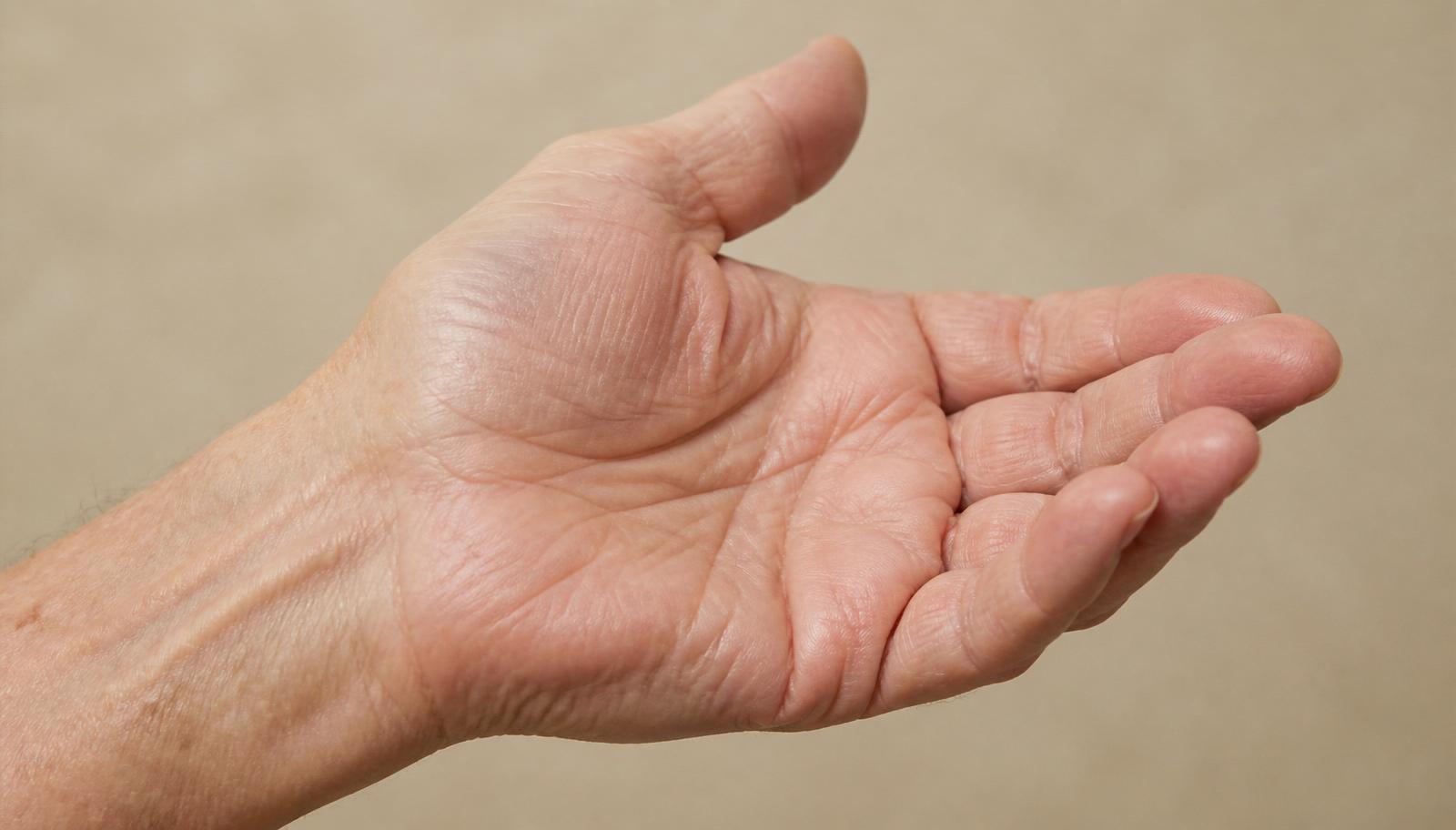
Dupuytren's Contracture
Dupuytren's contracture is a condition in which tissue under the skin of the palm thickens over time, so that one or more fingers gradually bend in towards the palm. This page explains the early signs, how it can affect everyday tasks, when to speak to a GP, and the NHS treatment options including needle fasciotomy and surgery.
- About 4%
of the UK population are affected by Dupuytren's disease. It is a long-term condition, so this is the proportion of people living with it rather than a yearly number of new cases.
Source: NICE Clinical Knowledge Summaries — Dupuytren's disease: Prevalence
- More than 2 million
people in the UK are thought to have Dupuytren's disease.
Source: NICE Clinical Knowledge Summaries — Dupuytren's disease: Prevalence
- About 20%
of people aged over 65 are affected — the condition becomes more common with increasing age.
Source: NICE Clinical Knowledge Summaries — Dupuytren's disease: Prevalence
What is Dupuytren's contracture?
Dupuytren’s contracture (sometimes called Dupuytren’s disease) affects a layer of tissue called the fascia, which lies under the skin of the palm. In this condition the fascia slowly thickens and tightens, forming firm lumps and cords. As the cords tighten, they can pull one or more fingers inward so they no longer straighten fully.
It usually develops slowly, often over years. It most commonly affects the ring finger and little finger, and both hands may be involved, though often not to the same degree. It is usually painless, although some people notice tenderness in the early stages.
The exact cause is not known. It is more common as people get older, is more common in men, and can run in families. It has also been associated with diabetes, epilepsy, smoking and drinking a lot of alcohol. It is not caused by anything a person has done wrong.
Lumps, dimples and firm cords in the palm
The first changes are usually in the palm, and may include:
- A small, firm lump or nodule in the palm, often near the base of a finger.
- Dimpling, puckering or a pitted appearance of the skin over the lump.
- Thickened skin that feels tougher than the surrounding palm.
- Ridges or firm cords running from the palm towards a finger.
- Occasional tenderness or itching in the early stages, which often settles.
A useful check is the “table-top test”: place your hand flat, palm down, on a table. If your hand will not lie completely flat, it is worth mentioning this to a GP.
How fingers may gradually bend inward
Over months or years the cords can shorten and tighten. This pulls the affected finger, or fingers, in towards the palm — a bend that cannot be straightened out, known as a contracture.
Progress varies a great deal between people. For some, the condition stays mild for many years and never needs treatment. For others, the bend increases and begins to interfere with the use of the hand. It is not possible to predict for any one person how quickly it will change.
Symptoms do not usually go away on their own, and the finger will not straighten with stretching or exercises alone.
How it can affect everyday tasks
Because it is generally painless, it is often the practical effects that people notice most:
- Difficulty laying the hand flat on a table or a bed.
- Trouble putting a hand into a pocket or a glove.
- Awkwardness washing the face, or catching the finger when getting dressed.
- Difficulty gripping a steering wheel, tools, a walking frame or handrails.
- Problems holding cutlery, a cup, a comb or a razor.
- Difficulty shaking hands, typing or using a phone.
- Catching the bent finger on clothing or bedding.
An occupational therapist can often suggest practical aids and adaptations, and a GP can advise on referral. Our GP Services page explains how appointments and referrals usually work.
When to speak to a GP
Make an appointment with a GP if:
- You have a lump, dimple or thickened area in the palm of your hand.
- One or more fingers are starting to bend towards the palm and will not straighten.
- You can no longer lay your hand flat, palm down, on a table.
- Everyday tasks such as washing, dressing, shaking hands or putting a hand in a pocket are becoming difficult.
- The hand is painful, or the changes are getting worse quickly.
Dupuytren’s contracture is not usually an emergency, but it is worth getting checked so that any change can be monitored and treatment discussed at the right time.
Get medical advice sooner if
- A lump in the hand is painful, hot, red or growing quickly.
- You have numbness, tingling or loss of feeling in the fingers.
- A finger becomes cold, pale or blue.
- You have had hand surgery and the wound becomes red, swollen, hot or begins to leak fluid.
If you are unsure how urgent something is, call NHS 111. In an emergency, call 999.
Treatment options
Not everyone needs treatment. If the condition is mild and the hand still works well, a GP or hand specialist may simply monitor it. Treatment is usually considered when the bend in the finger is affecting daily activities.
NHS England publishes a shared decision-making guide so that patients and clinicians can weigh up the options together, including the benefits, risks and likely recovery of each approach.
Watchful waiting
If the changes are mild, the usual advice is to keep an eye on the hand and return if the finger bends further or the hand becomes harder to use. Treating too early does not stop the condition returning.
Needle fasciotomy (needle aponeurotomy)
A fine needle is used, under local anaesthetic, to cut and divide the tight cord through the skin, allowing the finger to be straightened. It is a quick procedure, usually done as an outpatient, with no surgical wound to heal and a fast return to everyday activities.
It is generally suited to a well-defined cord in the palm. The condition is more likely to come back sooner after needle fasciotomy than after open surgery, and it may not be suitable for every type of contracture. There is a small risk of injury to nerves, blood vessels, tendons or the skin.
Surgery (fasciectomy)
Surgery involves an incision in the palm or finger to remove the thickened tissue. It is usually done under local, regional or general anaesthetic as a day case. In more severe or recurrent cases, the surgeon may also remove the overlying skin and use a skin graft (dermofasciectomy).
Surgery generally gives a longer-lasting correction than needle treatment, but it involves a wound, a longer recovery and hand therapy afterwards. Possible risks include infection, scarring, stiffness, numbness, nerve or blood vessel injury, and rarely a persistent painful, stiff hand.
A hand surgeon will explain which options are appropriate for your hand, and what each would involve. There is no obligation to decide at the first appointment.
Recovery and the possibility of it returning
After needle fasciotomy, most people can use the hand for light activities within a few days. After surgery, recovery takes longer — the wound needs time to heal and hand exercises, often guided by a hand therapist, are important to regain movement.
Recovery commonly involves:
- Keeping the hand raised at first to reduce swelling.
- Wound care and dressing changes as advised by the hospital team.
- Exercises taught by a hand therapist or physiotherapist.
- Sometimes a splint, especially at night, for a period after surgery.
- Gradually building back to driving, work and hobbies as advised by the team.
Recovery times vary from person to person. Some stiffness, tenderness or altered sensation may take several months to settle, and full hand function is not guaranteed.
Dupuytren’s contracture can come back. No treatment cures the underlying condition — treatment corrects the bend that has already developed. The tissue can thicken again in the same finger, or the condition can appear in another finger or the other hand. Recurrence tends to happen sooner after needle fasciotomy than after surgery, and is more likely in people who developed the condition at a younger age or who have a strong family history. If it returns, further treatment can usually be discussed.
Useful trusted information
- NHS — Dupuytren’s contracture
- NHS England — Dupuytren’s contracture decision-making support tool
- NHS inform (Scotland) — Dupuytren’s contracture
- nidirect (Northern Ireland) — Dupuytren’s contracture
- NHS — Find a GP
- Versus Arthritis — Dupuytren’s contracture
- NICE Clinical Knowledge Summaries — Dupuytren’s disease: Prevalence
- British Society for Surgery of the Hand — Dupuytren’s disease
Important notice: This page provides general information only. It is not a diagnosis, medical advice, or a substitute for assessment and treatment by a qualified healthcare professional. Always speak to a GP or another qualified health provider about your own symptoms and circumstances. In an emergency, call 999.
- [1] NHS. Dupuytren's contracture · 2025
- [2] NHS England. Dupuytren's contracture: decision-making support tool · 2024
- [3] NHS inform (Scotland). Dupuytren's contracture · 2025
- [4] nidirect (Northern Ireland). Dupuytren's contracture · 2025
- [5] NHS. Find a GP · 2025
- [6] Versus Arthritis. Dupuytren's contracture · 2025
- [7] NICE Clinical Knowledge Summaries. Dupuytren's disease — Background information: Prevalence · 2025
- [8] British Society for Surgery of the Hand. Dupuytren's disease — patient information · 2025