
Armed Forces Careers: Royal Navy, Army and Royal Air Force
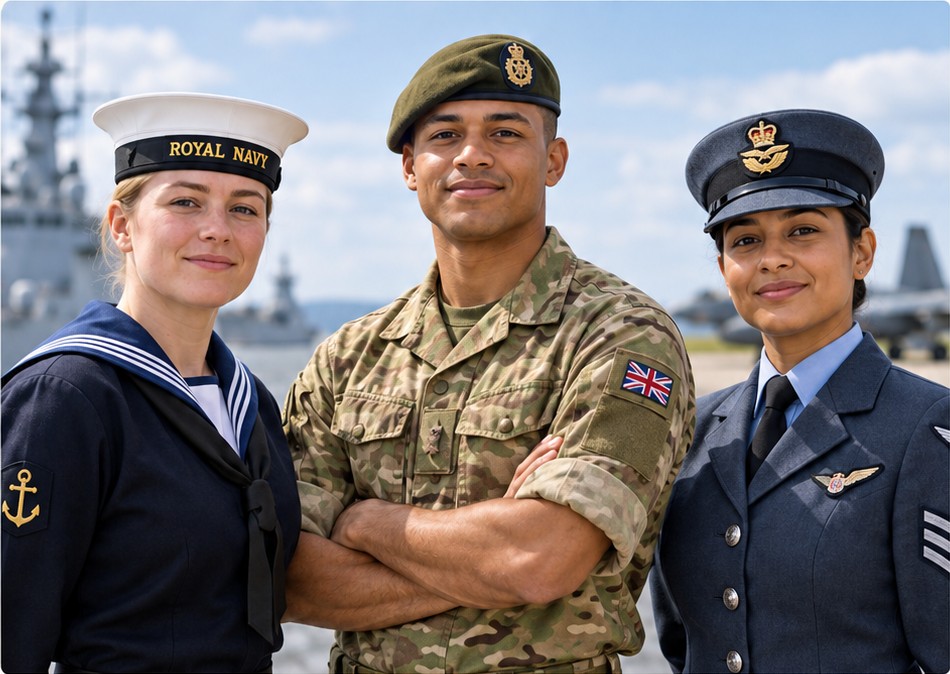
Neutral, factual information about work in the UK Armed Forces: which services exist, the range of occupations within each, regular and reserve service, officer and other routes, apprenticeships, eligibility, medical and fitness assessments, recruitment stages, training, the legal commitment involved, cadet organisations, Ministry of Defence civilian jobs and leaving the Armed Forces.
Last reviewed: 14 August 2026. Entry ages, nationality and residency rules, medical and fitness standards, qualifications and terms of service change and differ between each service — always confirm current details on the official recruitment website for the service and role concerned.
About this page
Sixpence Support UK provides general information only. Sixpence Support UK is independent of the Ministry of Defence and the Armed Forces, does not recruit for any service, and does not recommend or endorse military service. This page is written to help someone understand what an Armed Forces career involves, including its obligations and risks, so that they can make their own informed decision.
Understanding an Armed Forces career
The UK Armed Forces consist principally of the Royal Navy, the Royal Marines, the British Army and the Royal Air Force. They are part of defence under the Ministry of Defence.12
Each service contains many different occupations — not only combat roles. Engineering, healthcare, logistics, communications, catering, administration, policing, music and technical trades all exist within the services, and the day-to-day work in many of these roles resembles the equivalent civilian job in parts, but is carried out under military conditions.
Military service is not an ordinary job. It involves legal responsibilities under service law, discipline, a period of training with restrictions on personal freedom, the possibility of being moved between locations in the UK or overseas, and the possibility of deployment to dangerous situations. Personnel can be required to work long hours, to spend extended periods away from home, and to follow lawful orders.
At a glance
- Four principal services: Royal Navy, Royal Marines, British Army, Royal Air Force.
- Most roles are not combat roles, but all service personnel can be required to deploy.
- Age, nationality, medical, fitness and qualification rules differ by service and by role.
- Applicants under 18 need consent from a parent or guardian.
- Reservists undertake military training and can be mobilised.
- Cadets are youth organisations — cadets are not members of the Armed Forces.
- Joining is a binding legal commitment. Read the written terms before signing.
Royal Marines
The Royal Marines are part of the Naval Service, not the British Army. They are an amphibious and commando force, and their selection and training carry demanding physical and operational requirements.4
- Selection is strict, and a significant proportion of applicants do not pass the physical and aptitude standards.
- Training is long, physically arduous and continues to test endurance, load carrying and resilience.
- Injury during training and service is a realistic possibility.
- Roles are deployable, including to hostile or dangerous environments, at short notice.
- There are also specialist and support occupations within the Naval Service, including the Royal Marines Band Service, with their own requirements.
Anyone considering this route should look carefully at the published physical standards, the length of training, and what happens if they do not complete it, rather than relying on informal accounts.
British Army
The British Army works primarily on land and contains a very broad range of career areas.78 These include:
- Combat roles — infantry, armoured and other operational roles.
- Engineering — combat engineering, construction, electrical and technical engineering.
- Mechanical and vehicle maintenance — repairing vehicles, weapons and equipment.
- Communications and cyber — signals, networks and cyber defence roles.
- Intelligence — analysis, imagery and linguistic work.
- Medical and healthcare — combat medical technicians, nurses, doctors, dentists and allied health professionals.
- Logistics and transport — supply, driving, movement control and fuel handling.
- Administration — human resources, pay and unit administration.
- Music — professional musicians in the Corps of Army Music.
- Catering — chefs working in barracks and in the field.
- Construction and technical trades — carpentry, plumbing, electrical, plant operation and surveying.
Entry requirements and levels of risk differ considerably between these roles. A technical or administrative trade will have different qualification requirements and a different day-to-day working pattern from an infantry role, although all personnel remain deployable and subject to service law.
Royal Air Force
The Royal Air Force works primarily in the air and space domain, and most of its people work on the ground.1112 Career areas include:
- Aviation — aircrew roles such as pilot, weapon systems officer and aircrew specialist.
- Aircraft engineering — avionics, mechanical and survival equipment work.
- Air operations — air traffic control, flight operations and air surveillance.
- Intelligence — analysis and imagery roles.
- Cyber and communications — networks, cyberspace operations and communications systems.
- Logistics — supply, movements and driver roles.
- Medical and healthcare — medics, nurses, doctors and allied health roles.
- Firefighting — aircraft and domestic fire and rescue.
- Policing and security — RAF Police, security and dog handling.
- Administration — personnel support and administrative functions.
- Catering — chefs and hospitality roles.
Only a limited number of RAF roles involve flying aircraft, and those roles are highly competitive with strict aptitude, medical and eyesight standards. Many roles are technical or ground based, and are still deployable.
Regular service and reserves
Full-time regular service is a full-time occupation. You are employed by the service, live under military terms of service, can be posted anywhere the service requires, and are available for duty and deployment.
Part-time reserve service is undertaken alongside civilian work or study. Reservists are not casual volunteers: they undertake military training, attend regular training evenings or weekends and annual training periods, are subject to service requirements while on duty, and may be mobilised for full-time service, including on operations overseas.5913
Minimum training commitments, available roles, eligibility, employer notification arrangements and mobilisation rules differ between the Royal Naval Reserve, the Royal Marines Reserve, the Army Reserve and the RAF Reserves, and between individual occupations. They must be checked on the official recruitment website for the service concerned.
Officer and non-officer careers
Armed Forces careers are generally divided between commissioned officer roles and other service roles — ratings in the Royal Navy, soldiers in the British Army, and aviators in the Royal Air Force. Neither route is more valuable than the other: services depend on both, and people in each carry serious responsibility.
- Officer roles usually involve leadership and management responsibility for people and resources from an early stage, planning and decision-making, and accountability for others.
- Other service roles usually begin with occupational training in a specific trade, with responsibility and supervisory duties increasing through promotion. Many senior specialists and warrant officers hold considerable expertise and authority.
- Selection differs. Officer entry commonly involves a longer and more demanding selection process, and may have different educational requirements, sometimes including a degree.
- Movement between the two is possible. Each service has routes for experienced personnel to commission later in their career, subject to selection.
Check the officer and non-officer entry requirements for the specific service and role, as they differ.
Apprenticeships and qualifications
Some Armed Forces roles include a recognised apprenticeship, professional training or a qualification that is also used in civilian employment. This is genuinely useful for some people, but it needs to be checked carefully rather than assumed.
- Available qualifications depend on the role, and on the service.
- Not every role provides the same qualification, or any civilian qualification at all.
- Training is tied to military service — it forms part of your service, not a standalone course you can walk away from.
- Check exactly what you would receive: the qualification title, its level, the awarding or accrediting body, and when it is awarded.
- Completing initial training does not remove your service commitment. Terms of service continue to apply.
If you are comparing this against civilian options such as college courses, apprenticeships with an employer, T Levels in England or supported internships, our separate page sets those out.
Entry ages and parental consent
There is no single minimum or maximum age that applies to all Armed Forces careers. Age requirements vary between:
- the Royal Navy;
- the Royal Marines;
- the British Army;
- the Royal Air Force;
- regular service and reserve service;
- individual occupations, including officer and specialist entry.
Applicants under 18 require the consent of a parent or guardian. Check the current published age rules for each service and role on its official recruitment page before relying on any figure — including figures quoted on other websites.61014
If you are considering joining under 18
Take your time. Before signing anything, make sure you fully understand what you are agreeing to: the length and terms of service, the training you will undertake, where you may live and work, the restrictions that apply while serving, and the process and time limits for leaving if you change your mind.
Ask the recruitment team to explain the written terms in plain language, take the paperwork away, and go through it with a parent, guardian or another adult you trust. A recruitment team should be willing to answer questions and give you time — nobody should be pressured into signing.
Nationality and residency
Nationality and residency requirements vary by service and by role, and they change from time to time. Some positions require additional security clearance, and clearance requirements can bring stricter nationality or residency conditions — for example in intelligence, cyber, aviation and certain technical posts.
Sixpence Support UK does not publish a simplified nationality list, because a summary would quickly become inaccurate and could mislead someone into applying or not applying. Use the current official eligibility pages for the service you are interested in.
Qualifications
Some occupations require no specific formal qualifications at entry. Others — particularly technical, medical, aviation and officer roles — may require particular GCSEs or equivalents, A Levels or equivalents, a degree, or professional registration with a UK regulator.
Requirements are set per occupation, not across the Armed Forces as a whole, and they differ between the services for broadly similar trades. Check the exact role you are interested in rather than assuming that one set of requirements applies throughout. If you do not currently meet a requirement, the official recruitment team can explain whether alternative qualifications, functional skills or a different entry route may be accepted.
Medical and fitness requirements
Applicants may need to complete:
- a medical assessment;
- an eyesight assessment;
- hearing checks;
- fitness tests appropriate to the service and role;
- a review of medical history, which may include information from your GP records.
Sixpence Support UK cannot tell you whether a particular health condition will make you eligible or ineligible, and neither can an unofficial website or forum. Those decisions must be made by the relevant Armed Forces medical and recruitment teams, using the current medical standards for that service and role.
If you are disabled, have a long-term condition, or have a history of mental-health difficulties, you are entitled to ask the official recruitment team directly what the current standards are and how your circumstances would be assessed. Standards exist because of the physical and operational demands of service, and some conditions do affect eligibility — but assumptions in either direction are unhelpful, and false reassurance would not be fair to you. Whatever the outcome, there are many other careers, including Ministry of Defence civilian roles described below.
Recruitment and selection
The process differs between services and roles, but usually involves stages along these lines:
- choosing a role and checking its published requirements;
- submitting an application through the official recruitment website;
- identity and eligibility checks;
- interviews, aptitude tests or assessment days;
- medical and fitness assessments;
- security and background checks;
- selection and an offer for a specific role and entry date;
- initial training.
Applying does not guarantee acceptance. Some roles are heavily oversubscribed, waiting times vary, and an application can be unsuccessful at any stage. Armed Forces Careers Offices and official recruitment teams can explain where an application has reached.15
Training
Initial military training may involve:
- living away from home, usually in shared accommodation;
- physical training and fitness testing;
- strict daily routines, inspections and standards of dress and behaviour;
- following lawful orders;
- limited personal freedom during parts of training, including restrictions on leave and phone use;
- working closely within a team, sometimes under pressure and while tired;
- learning military standards, service law and your responsibilities as a member of the Armed Forces.
Specialist occupational training usually follows initial training, and may last from a few weeks to a considerable period for technical, medical or aircrew roles. Some training is assessed, and not passing can mean re-training, a change of role, or discharge — ask what happens in each case before you join.
Pay, accommodation and other benefits
Pay in the Armed Forces is set nationally and reviewed annually, and rates depend on rank, role, skills and length of service. Sixpence Support UK does not publish salary figures here, because they date quickly. Use the official pay information and the Ministry of Defence benefits tool.1617
The overall package may include:
- salary and, for some roles, additional pay for specific skills or conditions;
- pension arrangements under an Armed Forces pension scheme;
- single or family service accommodation, subject to eligibility;
- food arrangements, which may be provided or charged;
- healthcare and dental care while serving;
- training, qualifications and learning credits for some personnel;
- paid leave, travel entitlements and welfare support.
Deductions and charges apply — for example for accommodation, food and, in some cases, other services — so take-home pay is not the same as the headline figure. These arrangements form part of a binding employment and service commitment, not a set of benefits you can keep while withdrawing from the obligations. Ask for a written breakdown of pay, charges and deductions for the specific role before accepting an offer.
Life in the Armed Forces
Experiences vary widely between services, roles and individuals. A balanced picture includes both the parts people commonly value and the parts they find hard.
What daily life can involve
- Teamwork and structured routines — clear expectations, a defined chain of command, and close working relationships.
- Moving between locations — postings can change every few years, which affects partners, children and schooling.
- Time away from home — exercises, courses, sea time and deployments, sometimes at short notice.
- Exercises and deployments — including overseas, in difficult conditions or hostile environments.
- Living in service accommodation — shared quarters in single accommodation, or family accommodation where eligible.
- Relationships and family life — absence, relocation and unpredictable schedules place real strain on families; welfare support exists but does not remove that.
- Restrictions under military discipline — service law applies to conduct on and off duty, with penalties that do not exist in civilian employment.
- Physical and emotional demands — fitness requirements, fatigue, and exposure to stressful or distressing situations.
- Possibility of injury, trauma or death — this risk is real, varies significantly by role, and should be considered seriously before applying.
Understanding the commitment
Joining the Armed Forces is a serious legal commitment, not a job you can simply resign from at any time. Before accepting an offer, make sure you understand:
- the length and terms of service you are being offered;
- whether a minimum period of service applies, and how long it lasts;
- the rules for withdrawing during initial training, and any time limits on them;
- the notice you must give to leave, and when that notice period can start;
- the possibility of deployment, including overseas and at short notice;
- the restrictions that apply to you under service law, on and off duty;
- what happens if you change your mind after signing, or if you do not pass training.
Ask for the official written terms of service, read them, and ask the recruitment team to explain anything you do not understand before signing. Sixpence Support UK does not give legal advice and cannot interpret an individual service contract. If you need independent advice about a contract or a discharge issue, seek qualified legal help.
Questions to ask before joining
- What will my daily work actually involve in this role?
- Is this a combat or deployable role?
- Where could I be based, and how often do postings change?
- How often might I be away from home, and for how long?
- What qualifications will I receive, and at what level?
- Are those qualifications recognised by civilian employers or regulators?
- How long is the commitment, including any minimum service period?
- When can I leave if I change my mind, and what notice applies?
- What are the medical and fitness requirements, now and ongoing?
- What pay applies, and what charges and deductions will be taken?
- What support is available during service, and after leaving?
Write the answers down, and ask for anything important in writing.
Cadet organisations
Cadet organisations are youth organisations. The main ones are:
- Sea Cadets — nautical youth activities based on Royal Navy customs and training.24
- Royal Marines Cadets — a section within Sea Cadets units, with a more physically focused programme.24
- Army Cadets — community-based detachments offering fieldcraft, adventurous training and qualifications.25
- Royal Air Force Air Cadets — squadrons offering aviation-themed activities, including flying and gliding experience where available.26
- Combined Cadet Forces — school-based contingents that may include Navy, Army and RAF sections.27
Cadets are not members of the Armed Forces
Cadets and adult cadet volunteers are members of youth organisations. They are not members of the Armed Forces, are not enlisted, cannot be deployed, and are not subject to military service obligations. Taking part does not create any requirement to enlist later and does not guarantee acceptance into an Armed Forces career — every applicant goes through the normal selection process.
MOD civilian careers
People can work in defence without joining the Armed Forces. The Ministry of Defence is a large civilian employer, recruiting mainly through Civil Service Jobs.2223 Examples include:
- Civil Service administration and policy work;
- engineering;
- digital and cyber roles;
- project and programme management;
- procurement and commercial work;
- finance;
- science, research and technical work;
- estates and facilities roles.
Civilian MOD employees are not military personnel. They are not subject to service law, are not deployed in the military sense, and hold ordinary civilian employment rights — although certain jobs require security clearance, involve work at defence sites, or have specific nationality or residency requirements.
Leaving the Armed Forces
People leaving the Armed Forces often gain transferable skills, qualifications and experience that employers value. The move into civilian employment is not automatically easy, though: civilian recruitment, housing, healthcare and finances all work differently, and it helps to plan early.
- Resettlement support — the Career Transition Partnership provides resettlement advice, training and job-finding support for eligible service leavers.20
- Translating military experience — describe responsibilities, budgets, team sizes, qualifications and outcomes in civilian language rather than trade names and abbreviations.
- Housing and financial planning — leaving service accommodation, budgeting for rent or a mortgage, council tax and utilities, and understanding pension arrangements.
- Continuing healthcare — registering with a GP and NHS dentist, and transferring ongoing treatment.
- Employment and training — the National Careers Service and its equivalents in Scotland, Wales and Northern Ireland offer free careers advice.21
- Service-related injuries or mental-health difficulties — Veterans UK administers compensation and welfare schemes, and the Office for Veterans' Affairs signposts wider support, including dedicated NHS veterans' mental-health services.181929
Avoiding recruitment scams
Warning signs
- unofficial "recruitment" accounts on social media offering places or fast-tracking;
- any request for payment to secure a place, a role or an interview;
- promises that acceptance is guaranteed, or that medical or fitness standards can be bypassed;
- requests for identity documents, National Insurance numbers or bank details through social media or messaging apps;
- fake military-investment schemes, paid "preparation" programmes or bogus training courses;
- messages from free email addresses rather than official service domains.
Genuine applications begin through the official recruitment website for the service concerned, or through an Armed Forces Careers Office. The services do not charge to apply. If you think you have been targeted, report it to Action Fraud (England, Wales and Northern Ireland) or Police Scotland on 101 in Scotland.28
Careers across the Armed Forces
These cards give a general picture only. Availability, entry requirements and risks differ between the Royal Navy, Royal Marines, British Army and Royal Air Force, and between individual roles within each service — always check the official role page.
Engineering and technical trades
What the work involves: Maintaining, repairing and testing ships, submarines, aircraft, vehicles, weapons systems, propulsion, electrical systems, avionics and support equipment, often to strict safety and inspection standards.
Where it exists: Royal Navy (marine and weapons engineering), British Army (REME and other trades), Royal Air Force (aircraft and communications engineering).
Entry requirements: Often requires particular GCSEs or equivalent in maths, English and a science or technical subject; some routes include an apprenticeship or technical training.
Demands and risks: Work may take place at sea, on deployed operations or on airfields. Availability, entry requirements and exposure to risk differ between the services — check the individual role page.
Availability, entry requirements and risks differ between the services — confirm on the official Royal Navy, British Army or Royal Air Force recruitment page.
Medical and healthcare
What the work involves: Nursing, medical support, combat medical technician work, dentistry, pharmacy, laboratory science, rehabilitation, environmental health and mental-health roles, in the UK and on deployment.
Where it exists: All three services employ healthcare personnel, and some roles are open to qualified professionals joining directly.
Entry requirements: Many roles require existing professional registration or specific academic qualifications; others train you from entry.
Demands and risks: May include deployment to operational or humanitarian settings, and exposure to distressing situations. Availability, entry requirements and risks differ between the services.
Availability, entry requirements and risks differ between the services — confirm on the official Royal Navy, British Army or Royal Air Force recruitment page.
Digital, cyber and communications
What the work involves: Operating and protecting communication and information systems, networks, satellite and radio links, cyber defence tasks, data handling and signals work.
Where it exists: Royal Navy communications and information systems, Royal Corps of Signals and Army cyber roles, RAF cyber and communications specialisms.
Entry requirements: Usually requires specified GCSEs or equivalent; some specialist and officer routes require higher qualifications. Security clearance is normal.
Demands and risks: Roles can be deployable and may involve shift work and restrictions on what you can discuss. Requirements differ between the services.
Availability, entry requirements and risks differ between the services — confirm on the official Royal Navy, British Army or Royal Air Force recruitment page.
Logistics and transport
What the work involves: Supply chain, stores, movement of equipment and personnel, driving and vehicle operation, fuel handling, port and air movements, and support to operations.
Where it exists: Royal Navy logistics, Royal Logistic Corps, RAF logistics and movements.
Entry requirements: Entry requirements are often lower than for technical trades, but vary; driving and specialist licences may be gained in service.
Demands and risks: Deployable roles that may operate in demanding or hostile environments. Check the specific role and service.
Availability, entry requirements and risks differ between the services — confirm on the official Royal Navy, British Army or Royal Air Force recruitment page.
Intelligence
What the work involves: Gathering, analysing and reporting information to support decisions, including imagery, linguistic and analytical work.
Where it exists: Intelligence roles exist in each service, with different structures and specialisms.
Entry requirements: Analytical and language aptitude tests are common; higher security clearance and stricter nationality or residency requirements often apply.
Demands and risks: Deployment is possible; work is often classified and carries lasting confidentiality obligations.
Availability, entry requirements and risks differ between the services — confirm on the official Royal Navy, British Army or Royal Air Force recruitment page.
Aviation
What the work involves: Aircrew roles such as pilot, weapon systems officer and aircrew specialist, plus air traffic and flight operations support. Only a limited number of roles involve flying.
Where it exists: Royal Navy (Fleet Air Arm), British Army (Army Air Corps), Royal Air Force.
Entry requirements: Aircrew selection is highly competitive with strict aptitude, medical, eyesight and academic requirements, and usually a longer minimum service commitment.
Demands and risks: Flying duties carry inherent risk and deployment is expected. Requirements and available aircraft types differ between the services.
Availability, entry requirements and risks differ between the services — confirm on the official Royal Navy, British Army or Royal Air Force recruitment page.
Administration and finance
What the work involves: Personnel administration, pay and records, human resources support, secretariat work, accounting and unit business functions.
Where it exists: All three services, with different trade titles.
Entry requirements: Typically requires basic GCSEs or equivalent, with in-service training and qualifications for some roles.
Demands and risks: Personnel in these roles remain deployable and must meet military standards. Requirements differ between the services.
Availability, entry requirements and risks differ between the services — confirm on the official Royal Navy, British Army or Royal Air Force recruitment page.
Catering and hospitality
What the work involves: Preparing and serving food in shore establishments, ships, submarines, field kitchens and deployed locations, including food safety and stores management.
Where it exists: All three services employ chefs, stewards and hospitality staff.
Entry requirements: Often no specific qualifications required at entry; professional catering qualifications may be gained in service.
Demands and risks: Long hours, deployment and periods at sea are common in some services. Check the individual role.
Availability, entry requirements and risks differ between the services — confirm on the official Royal Navy, British Army or Royal Air Force recruitment page.
Construction
What the work involves: Building and repairing infrastructure, runways, bridges, water and power supply, plant operation, carpentry, plumbing, electrical and surveying work.
Where it exists: Primarily the Royal Engineers in the British Army and RAF infrastructure roles.
Entry requirements: Varies widely; some roles are open with no formal qualifications, others require technical qualifications. Trade qualifications may be gained in service.
Demands and risks: Work is frequently deployed, outdoors and physically demanding, sometimes in hazardous environments.
Availability, entry requirements and risks differ between the services — confirm on the official Royal Navy, British Army or Royal Air Force recruitment page.
Combat and operational roles
What the work involves: Roles whose primary purpose is operational and combat capability on land, at sea or in the air.
Where it exists: Present in each service, including infantry and armoured roles in the British Army and Royal Marines commando roles in the Naval Service.
Entry requirements: Formal academic requirements may be limited, but physical, medical and selection standards are demanding and differ between roles.
Demands and risks: These roles carry the highest likelihood of deployment to dangerous environments and of physical and psychological harm, including serious injury or death.
Availability, entry requirements and risks differ between the services — confirm on the official Royal Navy, British Army or Royal Air Force recruitment page.
Music
What the work involves: Performing as a professional musician in a service band at ceremonial, state, public and unit events, alongside other service duties.
Where it exists: Royal Marines Band Service, Corps of Army Music, RAF Music Services.
Entry requirements: Requires a demonstrated musical standard, usually with an audition, and specified instruments vary by vacancy.
Demands and risks: Musicians remain service personnel with additional operational duties, which historically have included medical support tasks. Requirements differ between the services.
Availability, entry requirements and risks differ between the services — confirm on the official Royal Navy, British Army or Royal Air Force recruitment page.
Policing, firefighting and security
What the work involves: Service police work, investigations, guarding and access control, dog handling, and aircraft and domestic firefighting and rescue.
Where it exists: Royal Navy Police, Royal Military Police, RAF Police and RAF firefighters, plus service security roles.
Entry requirements: Usually specified GCSEs or equivalent, additional selection and enhanced security checks.
Demands and risks: Shift work, deployment and exposure to incidents and distressing scenes. Availability and entry requirements differ between the services.
Availability, entry requirements and risks differ between the services — confirm on the official Royal Navy, British Army or Royal Air Force recruitment page.
Frequently asked questions
Are the Royal Marines part of the Army?
No. The Royal Marines are part of the Naval Service, alongside the Royal Navy. They are not part of the British Army.
Do all Armed Forces careers involve combat?
No. Each service contains engineering, medical, logistics, communications, catering, administrative, technical and other roles. However, service personnel are members of the Armed Forces first and can be required to deploy, to work in demanding or dangerous environments, and to meet military standards, whatever their trade. The level of exposure differs considerably between roles and should be checked for the specific occupation.
Can I join without GCSEs?
Some occupations have no specific formal qualification requirement, while technical, medical, aviation and officer roles often require particular GCSEs, A Levels, a degree or professional registration. Requirements are set per role and per service, so check the entry requirements listed on the official recruitment page for the exact occupation.
Can I complete an apprenticeship?
Some Armed Forces roles include a recognised apprenticeship, professional training or a civilian-recognised qualification, but this depends entirely on the role and service. Ask the recruitment team exactly which qualification or accreditation you would receive, at what level, from which awarding body, and at what point in your service.
Do I need parental consent if I am under 18?
Applicants under 18 require the consent of a parent or guardian. Minimum and maximum ages themselves vary between the Royal Navy, Royal Marines, British Army and Royal Air Force, between regular and reserve service, and between individual occupations, so check the current age rules on the official recruitment page for the service and role concerned.
Can I join if I have a medical condition?
That is not something Sixpence Support UK, or any unofficial website, can tell you. Applicants complete a medical assessment and a review of medical history, and decisions are made by the relevant Armed Forces medical and recruitment teams using current medical standards. If you have a health condition or a mental-health history, ask the official recruitment team directly rather than relying on what anybody says online.
What fitness tests will I need to complete?
Fitness testing forms part of selection, and the standards differ between the services and between roles — some roles, including the Royal Marines, have particularly demanding physical requirements. Check the current published test and standard for the specific service and occupation on its official recruitment page.
Can I choose where I am based?
Not generally. Postings are decided by the service according to its requirements, and personnel can be moved between locations, including overseas. Some roles involve long periods away from home or at sea. Ask the recruitment team what is realistic for the role you are considering.
Can I leave if I change my mind?
There are formal rules covering discharge during initial training, minimum periods of service and notice requirements, and they differ between services, roles and entry routes. They are set out in the written terms of service. Read those terms before signing and ask the recruitment team to explain anything you do not understand.
Could I be sent overseas?
Yes. Service personnel can be posted or deployed overseas, including on operations and exercises, and can be required to work in dangerous environments. This applies to reservists who are mobilised as well as to regulars.
Are cadets members of the Armed Forces?
No. Sea Cadets, Royal Marines Cadets, Army Cadets, RAF Air Cadets and school-based Combined Cadet Forces are youth organisations. Their members are not members of the Armed Forces, are not subject to military service obligations, and cannot be deployed.
Does being a cadet guarantee that I can join?
No. Taking part in a cadet organisation does not create any requirement to enlist and does not guarantee acceptance into an Armed Forces career. Every applicant goes through the normal selection process.
Can I work for the Ministry of Defence without joining the military?
Yes. The Ministry of Defence employs civil servants and other civilian staff in administration, engineering, digital and cyber, project management, procurement, finance, science and technical work, and estates and facilities roles. Civilian MOD employees are not military personnel, although some posts involve security clearance or work at defence sites. These vacancies are advertised through Civil Service Jobs.
Will military qualifications be recognised in civilian employment?
Some are directly recognised, particularly regulated trades, engineering qualifications and healthcare registrations. Others describe military-specific skills that need to be translated for civilian employers. Check the exact qualification title and awarding or accrediting body, and use resettlement services such as the Career Transition Partnership when leaving.
What Sixpence Support UK can and cannot do
Sixpence Support UK provides general information only. Sixpence Support UK is independent of the Ministry of Defence and the Armed Forces, does not recruit for any service, and does not recommend or endorse military service. We do not give legal, medical or careers advice, and we cannot tell you whether you will be accepted.
Always confirm current age, nationality, residency, medical, fitness, qualification and terms-of-service rules with the official recruitment service for the service and role you are considering.
- [1] GOV.UK. Working in the Armed Forces · 2026
- [2] Ministry of Defence. About the Ministry of Defence · 2026
- [3] Royal Navy. Royal Navy careers and roles · 2026
- [4] Royal Navy. Royal Marines careers · 2026
- [5] Royal Navy. Royal Naval Reserve · 2026
- [6] Royal Navy. Joining: eligibility and requirements · 2026
- [7] British Army. British Army jobs · 2026
- [8] British Army. Army roles and trades · 2026
- [9] British Army. Army Reserve · 2026
- [10] British Army. Can I join? Eligibility and entry requirements · 2026
- [11] Royal Air Force. RAF recruitment · 2026
- [12] Royal Air Force. RAF roles · 2026
- [13] Royal Air Force. RAF Reserves · 2026
- [14] Royal Air Force. Am I eligible? RAF entry requirements · 2026
- [15] GOV.UK. Armed Forces Careers Offices · 2026
- [16] Ministry of Defence. Discover My Benefits · 2026
- [17] GOV.UK. Armed Forces Pay Review Body reports · 2026
- [18] Veterans UK. Veterans UK: support for veterans and families · 2026
- [19] Office for Veterans' Affairs. Office for Veterans' Affairs · 2026
- [20] Career Transition Partnership. Resettlement support for service leavers · 2026
- [21] National Careers Service. Explore careers: job profiles · 2026
- [22] Civil Service. Civil Service Jobs · 2026
- [23] Civil Service Careers. Working for the Ministry of Defence · 2026
- [24] Sea Cadets. Sea Cadets and Royal Marines Cadets · 2026
- [25] Army Cadet Force. Army Cadets · 2026
- [26] RAF Air Cadets. Royal Air Force Air Cadets · 2026
- [27] GOV.UK. Combined Cadet Force · 2026
- [28] Action Fraud. Reporting fraud and cyber crime · 2026
- [29] GOV.UK. Veterans support collection · 2026
- [30] Ministry of Defence. Defence Business Services · 2026