
Emergency Services Careers: Police, Fire and Ambulance
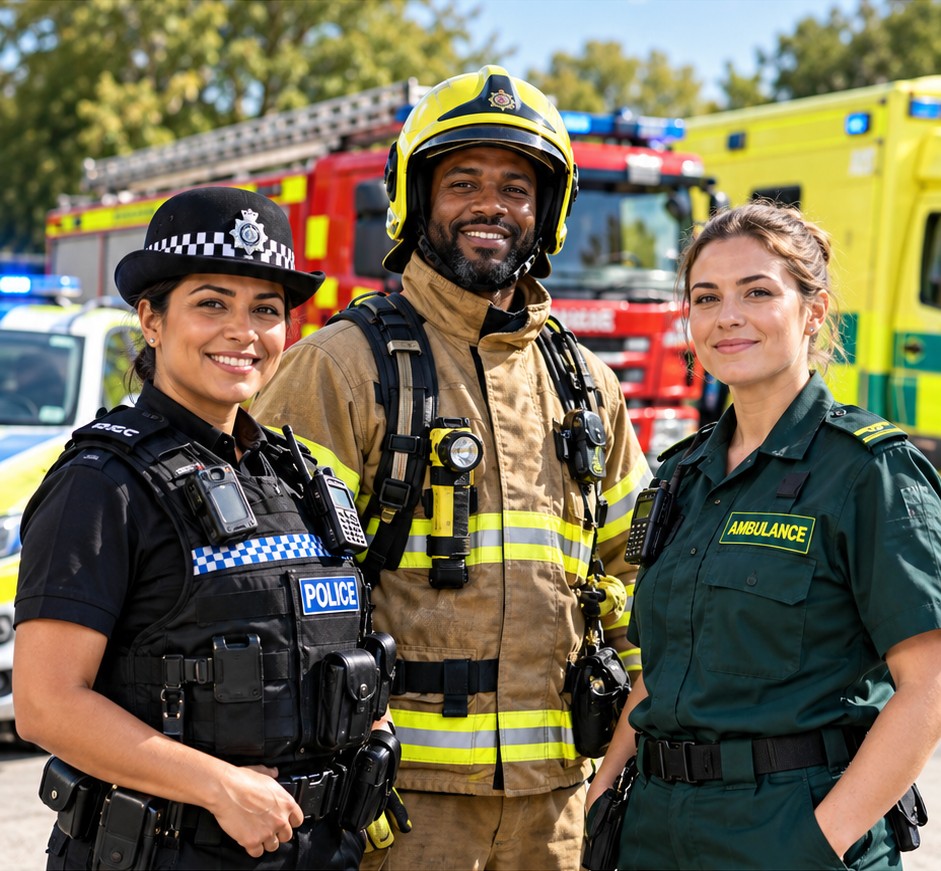
Neutral, factual information about working for the police, fire and rescue and ambulance services across the UK: the frontline, control-room and support roles that exist, the different entry routes and apprenticeships, qualifications, vetting, medical and fitness standards, reasonable adjustments, work experience, pay, the application process and where to find genuine vacancies.
Last reviewed: 14 August 2026. Entry routes, eligibility rules, vetting, medical, eyesight and fitness standards, qualifications and pay change over time and differ between individual employers and between England, Wales, Scotland and Northern Ireland — always confirm current details on the official recruitment page of the police force, fire and rescue service or ambulance service concerned.
About this page
Sixpence Support UK provides general information only. Sixpence Support UK is independent of the police, fire and rescue and ambulance services. We do not recruit for, inspect, recommend or endorse any service, employer, course or applicant, and we cannot tell you whether you would be accepted.
Recruitment is run by individual employers. In policing, England and Wales, Scotland and Northern Ireland use different systems. Fire and rescue services and NHS ambulance services recruit separately in each area. Where information below applies to only some UK nations, that is stated.
Careers in the emergency services
Emergency-service careers include far more than the most visible frontline roles. For every person attending an incident there are others answering calls, sending resources, maintaining vehicles and equipment, analysing information, teaching, transporting patients and keeping records and systems running.
Roles across the three services include:
- police officers;
- detectives;
- Police Community Support Officers;
- police staff;
- emergency call handlers and dispatchers;
- firefighters;
- fire-control operators;
- fire-prevention and community-safety roles;
- paramedics;
- emergency care assistants;
- ambulance care assistants;
- patient-transport roles;
- ambulance control-room staff;
- technical, administrative and support roles, including fleet, logistics, IT, training and finance.
Entry routes, qualifications and recruitment processes differ between services, between individual employers and between the four UK nations.129 A role title used by one employer may not exist, or may mean something different, elsewhere.
Choosing the right type of role
Before applying, it helps to think honestly about what the day-to-day work would involve:
- Frontline or support work — attending incidents, or enabling those who do.
- Direct contact with the public — including people who are frightened, unwell, upset or hostile.
- Physical demands — lifting, moving-and-handling, working in confined or awkward spaces, long periods standing.
- Shift work — nights, weekends and public holidays are normal in operational and control-room roles.
- Driving requirements — some roles need a particular licence category or response driver training.
- Exposure to emergencies or distressing situations — including injury, death and bereaved or distressed people.
- Working in a control room — screen-based, high-concentration work with recorded calls and strict procedures.
- Technical or administrative work — engineering, digital, analytical, training, finance and business support.
- Training and qualification requirements — from none specified, through apprenticeships, to degrees and professional registration.
Somebody can contribute a great deal to the emergency services without working in a frontline role. Control-room, technical, patient-transport, prevention and support roles are permanent, skilled careers in their own right, not a consolation prize.
Police careers
Policing contains a broad range of career options, including:
- police constable;
- detective;
- Police Community Support Officer;
- special constable;
- police call handler;
- dispatcher;
- crime-scene and forensic roles;
- intelligence and analyst roles;
- digital and cyber roles;
- custody and detention roles;
- administration and support.
A special constable is a volunteer police officer. Special constables hold police powers and receive training, but the role is unpaid volunteering with a minimum hours commitment — it is different from paid employment as a regular police constable, and it does not guarantee later acceptance as one.2
Becoming a police constable
Policing is organised separately across the UK, and the three recruitment systems are not interchangeable.
England and Wales
Forces in England and Wales recruit individually, but police-constable entry routes are set nationally and supported by the College of Policing.23 The current routes are:
- Police Constable Entry Programme — a non-degree route in which you are employed and trained as a police constable by the force.
- Police Constable Degree Apprenticeship — paid employment as a police constable combined with operational training and university-level study leading to a degree.
- Degree Holder Entry Programme — for people who already hold a degree in any subject, combining employment with a professional policing qualification.
- Professional Policing Degree — a pre-join degree studied at a university at your own cost, followed by a separate application to a force.
Completing a Professional Policing Degree does not guarantee a police job. You must still apply to a force, meet its eligibility rules, pass vetting and succeed at selection, and forces recruit only when they have vacancies. Not every force offers every route.
Scotland
Police Scotland is a single national service and runs its own recruitment, selection and probationer training system, with initial training delivered at the Scottish Police College. The entry routes, tests and standards are not the same as those used in England and Wales — check Police Scotland's own recruitment pages.5
Northern Ireland
The Police Service of Northern Ireland runs its own recruitment campaigns, which open at particular times rather than continuously, and has its own eligibility rules, vetting and training arrangements. Check the PSNI careers pages for current campaigns.6
The recruitment process in England and Wales
Forces in England and Wales currently use a standard four-stage national process for police-constable applications:23
- National application form — completed through the force you are applying to.
- Online sifting tests — behavioural and situational questions used to filter applications.
- Online assessment — exercises, written work and an interview element assessing policing competencies and values.
- Force interview — run by the individual force.
Additional force checks and assessments still apply, including vetting, medical and eyesight checks, fitness testing, references and pre-employment paperwork. Timescales vary considerably.
Police eligibility and vetting
Whichever route or nation, applicants for police roles may face:
- age requirements;
- nationality and residency rules;
- background and security vetting;
- criminal-record and financial checks, including debt and bankruptcy;
- medical assessments;
- eyesight requirements;
- fitness assessments;
- reference checks;
- checks concerning tattoos, previous conduct, business interests or conflicts of interest.
Sixpence Support UK cannot tell you whether you would pass vetting, and neither can any unofficial website or forum. Vetting decisions are made by the force concerned against its current standards, taking account of the full circumstances. Read the official recruitment and vetting information published by the force you want to join, and ask its recruitment team if anything is unclear.
Honesty matters. Vetting involves detailed checks, and applications are assessed on integrity as well as eligibility. Withholding or misrepresenting relevant information — about convictions, cautions, debts, associations or employment history — can damage or end an application, sometimes more seriously than the original matter would have done.
Police apprenticeships and training
Some police forces offer paid apprenticeship routes, but availability differs between forces and over time. No force offers every entry route, and a route that is open in one area may be closed in the next.
The Police Constable Degree Apprenticeship (England and Wales) combines employment as a police constable with operational training and university-level study, normally over about three years, leading to a degree in professional policing practice. Apprentices are paid employees of the force from the start, carry out real policing duties under supervision, and have study time built into the programme. You apply for an advertised apprenticeship vacancy with a force; you do not enrol on it yourself at a college.314
Police staff apprenticeships also exist in some forces in areas such as business administration, digital and customer service. Arrangements in Scotland and Northern Ireland differ, so check Police Scotland and the PSNI directly.56
Other police roles
These cards give a general picture only. Job titles, duties, pay and entry requirements vary between forces and between the UK nations — always check the vacancy published by the force concerned.
Police Community Support Officer
What the work involves: Uniformed police staff who work in neighbourhoods on visible patrol, community engagement, antisocial behaviour, crime prevention, reassurance visits and supporting officers at incidents. PCSOs have more limited powers than police constables and the powers available differ between forces and UK nations.
Paid or voluntary: Paid employment as police staff, not a police officer post.
Entry requirements: Entry requirements vary between forces. Vetting, background checks and, in most forces, medical and fitness elements apply. Check the recruiting force's own vacancy page.
Entry requirements vary between forces — confirm on the official recruitment page of the force you are applying to.
Police staff
What the work involves: Non-warranted employees working in areas such as case files, criminal justice units, human resources, finance, procurement, communications, fleet, estates, training, licensing and victim contact. Police staff keep the service running alongside officers.
Paid or voluntary: Paid employment.
Entry requirements: Requirements depend entirely on the post — some need professional qualifications or experience, others do not. Vetting applies to all police posts.
Entry requirements vary between forces — confirm on the official recruitment page of the force you are applying to.
Call handler and dispatcher
What the work involves: Answering 999 and non-emergency calls, gathering and recording information accurately, assessing risk against force policy, giving approved advice and instructions, creating incident logs and dispatching or updating officers by radio.
Paid or voluntary: Paid employment as police staff.
Entry requirements: Typically requires strong communication, accurate typing and computer skills. Shift work is normal, and applicants are told that they will hear distressing calls. Requirements vary by force.
Entry requirements vary between forces — confirm on the official recruitment page of the force you are applying to.
Digital and cyber work
What the work involves: Digital forensics, examining devices, supporting cybercrime investigations, online intelligence work, data protection and maintaining police IT and systems.
Paid or voluntary: Paid employment; some posts are officer roles and some are police staff roles.
Entry requirements: Some posts require relevant qualifications or experience; others train from entry. Enhanced vetting is usual. Availability differs between forces and regional units.
Entry requirements vary between forces — confirm on the official recruitment page of the force you are applying to.
Intelligence analyst
What the work involves: Collating and analysing information from many sources, identifying patterns and links, producing written products and briefings to support investigations and decisions about resources.
Paid or voluntary: Paid employment, usually police staff.
Entry requirements: Analytical, written and data skills are usually required, and some posts ask for a relevant degree or experience. Requirements vary by force.
Entry requirements vary between forces — confirm on the official recruitment page of the force you are applying to.
Forensic and crime-scene roles
What the work involves: Attending scenes, recovering and packaging evidence, fingerprint and photographic work, laboratory support and presenting findings, working to strict continuity and quality standards.
Paid or voluntary: Paid employment, usually police staff.
Entry requirements: Some posts require a relevant science qualification or prior experience; others provide training. Driving may be required. Requirements vary by force.
Entry requirements vary between forces — confirm on the official recruitment page of the force you are applying to.
Special constable
What the work involves: A volunteer police officer who holds the same core powers as a regular constable and works alongside them for an agreed minimum number of hours, typically around evenings and weekends alongside other employment or study.
Paid or voluntary: Voluntary and unpaid, although reasonable expenses are normally reimbursed. It is not paid employment and is not the same as being a regular police constable.
Entry requirements: Applicants complete an application, vetting, medical and fitness elements and initial training. Serving as a special constable does not guarantee acceptance as a regular officer.
Entry requirements vary between forces — confirm on the official recruitment page of the force you are applying to.
Fire and rescue careers
Fire and rescue services employ far more than operational firefighters. Roles include:
- operational firefighters, whole-time and on-call;
- fire-control operators, who answer 999 calls and mobilise crews;
- community fire-safety staff, including home fire-safety visits and education work;
- fire-protection and inspection staff working with building owners on fire-safety law;
- mechanics and technicians maintaining appliances, equipment and breathing apparatus;
- administrative and support staff in HR, finance, training, IT and estates.
Individual fire and rescue services recruit separately. In England, Wales and Scotland services are organised differently — the Scottish Fire and Rescue Service is a single national service, and the Northern Ireland Fire and Rescue Service covers Northern Ireland, while England and Wales have many local services. Most services open firefighter recruitment only at certain times, so vacancies may not be open in your area today.78
Becoming a firefighter
Possible routes into operational firefighting include:
- applying directly to a local fire and rescue service when it advertises vacancies;
- an Operational Firefighter Level 3 Advanced Apprenticeship with a recruiting service in England;
- relevant college courses that build knowledge and study skills before applying;
- fire-service training routes offered by some services, including on-call firefighter recruitment;
- experience gained through appropriate community, support or control-room roles.
A college public-services or uniformed-services course is not essential and does not guarantee employment. It is a study programme, not a job, and services do not give places to applicants because they hold one.
Firefighters ordinarily need to pass a selection process, which may include application screening, online or written tests, interviews, role-related practical tests such as ladder, equipment-carry and confined-space exercises, fitness assessments, medical checks, eyesight checks and background checks. Requirements vary between services, so check the process published by your local fire and rescue service.7
Firefighter apprenticeships
An Operational Firefighter Level 3 Advanced Apprenticeship may be available through recruiting fire and rescue services in England. It combines paid employment as a trainee firefighter with structured training and assessment.1415
You apply for an apprenticeship vacancy with an employer — the fire and rescue service — in the same way as any other job. You do not simply enrol independently on the apprenticeship at a college. Sixpence Support UK cannot promise that vacancies are open in your area; check your local service's recruitment page and, in England, Find an Apprenticeship. Apprenticeship arrangements differ in Scotland, Wales and Northern Ireland.161718
Fire Cadets and youth programmes
Some fire and rescue services run Fire Cadet or youth programmes, commonly for teenagers, often alongside schools or youth services.
What taking part does and does not mean
- it is not employment and is not paid work;
- it does not make somebody a firefighter;
- it does not guarantee future recruitment or give any advantage in selection;
- it may help young people understand fire safety, teamwork, discipline and how the service works, and build confidence.
Ambulance-service careers
Ambulance services employ clinicians, patient-care staff, control-room staff and a large support workforce. Titles and responsibilities can vary between ambulance services, so always read the vacancy rather than assuming a title means the same thing everywhere.9
- Paramedic — a registered healthcare professional who assesses, treats and refers patients within their scope of practice.
- Emergency care assistant — supports paramedics and clinicians at emergencies and during transport; not a registered paramedic.
- Associate ambulance practitioner or emergency medical technician — where these titles are used, roles that work between assistant and paramedic level with additional clinical training.
- Ambulance care assistant — patient-care role supporting non-emergency journeys.
- Patient-transport-service roles — planning and delivering transport for patients attending appointments or treatment.
- Emergency call handler — answers 999 calls, records information and gives approved instructions.
- Dispatcher — allocates and monitors ambulance resources.
- Fleet, logistics, administration and support — vehicle maintenance, equipment preparation, stores, training, HR, finance and IT.
Note on terminology: "ambulance driver" is included on this page only because people search for it. It is not the job title for ambulance work, and it does not describe the clinical and patient-care responsibilities these roles carry.
Becoming a paramedic
Paramedic is a regulated healthcare profession. The title is protected, and you must be registered with the Health and Care Professions Council (HCPC) to practise as a paramedic anywhere in the UK.13
The principal routes are:
- an approved paramedic-science degree at a university;
- a Paramedic Level 6 Degree Apprenticeship, where an employer is offering one;
- progression through an ambulance-service training route, where a service offers a structured pathway from a support or technician role.
Whichever route is taken, the programme must meet HCPC requirements and be an approved programme, because registration depends on it.12 An ordinary first-aid course, a "medical response" short course or an ambulance-driving course does not qualify anybody as a paramedic.
Paramedic degrees and apprenticeships
Full-time paramedic-science degrees commonly take around three years, but course length, structure, placement arrangements and entry requirements vary between universities and between the UK nations, including differences in tuition-fee and student-funding arrangements.
A paramedic degree apprenticeship combines paid employment with university-level study and workplace training. Apprentices are employees, usually of an ambulance service. Vacancies are limited and competitive, are not offered everywhere, and typically expect relevant prior experience.
Check approval before you apply or pay
Before applying for, or paying fees towards, any paramedic programme, confirm that it is HCPC approved using the official approved-programme search. A course that is not approved will not lead to registration as a paramedic, however it is advertised.12
Emergency care assistants
Emergency care assistants support paramedics and other clinicians at emergencies and during patient transport. The work commonly includes driving emergency vehicles, assisting with patient assessment and treatment under direction, moving and handling patients, preparing and checking equipment, and recording information.
Possible routes in may include:
- an Ambulance Support Worker Level 3 Advanced Apprenticeship, where offered (England);
- relevant health and social-care study;
- direct recruitment by an ambulance service, with training provided.
Requirements may include previous patient-care or caring experience, first-aid knowledge, a driving licence of a specified category, fitness and manual-handling standards, occupational-health clearance and background checks including a DBS check (or Disclosure Scotland or AccessNI equivalent). Requirements are not identical across ambulance services, so read the specific vacancy.911
Ambulance care assistants and patient transport
Ambulance care assistant and patient-transport roles commonly involve transporting and supporting patients attending appointments, treatment such as dialysis or oncology, hospital admissions and discharges. The work typically includes:
- helping patients enter and leave vehicles safely, including wheelchair and stretcher work;
- protecting patient dignity, privacy and confidentiality, and communicating clearly and kindly;
- daily vehicle and equipment checks, including cleanliness and infection control;
- accurate record keeping;
- regular contact with the control room about timings, delays and changes;
- supporting older, disabled, frail, anxious or unwell passengers, including people living with dementia.
This is a patient-care role, not simply driving. Staff are often the only NHS contact a patient has that day, and are expected to notice and report concerns about a patient's condition or home situation.
Driving-licence requirements
Some ambulance roles require a full driving licence, and some require additional entitlement depending on the weight of the vehicle and when your licence was issued. Drivers who passed a car test before 1 January 1997 often hold Category C1 entitlement already; those who passed later usually do not and may need to gain it.25
- some vacancies require full Category C1 entitlement at the point of application;
- some accept provisional C1 entitlement, with training provided by the employer;
- some require only a standard full car licence, sometimes with a limit on penalty points;
- emergency-response driving requires additional employer-provided training and assessment.
Check the exact vacancy and the ambulance service's requirements before paying for any additional driver training. Not every ambulance role requires the same licence, and commercial training is expensive.
Emergency call handlers and dispatchers
Police, fire and ambulance control rooms employ people who answer emergency and non-emergency calls and coordinate the response. The work typically involves:
- answering 999 and non-emergency calls, including 101 and NHS 111 where relevant;
- gathering essential information quickly and calmly, often from distressed callers;
- assessing and recording incidents against structured triage systems and service policy;
- giving approved instructions, which in ambulance services can include life-saving advice before crews arrive;
- dispatching appropriate resources and reallocating them as demand changes;
- monitoring developing situations and updating logs accurately;
- communicating with frontline teams and other agencies by radio and system messaging.
These jobs require calm communication, accurate typing and computer skills, decision-making under pressure, and the ability to hear distressing information and keep working. Shift patterns cover nights, weekends and public holidays, and calls are recorded and reviewed.
Related non-emergency roles include contact-centre work, 101 and 111 call handling, patient-transport booking, and control-room support and supervisory posts. These are often a realistic route into an emergency service for people who do not want, or cannot meet the requirements of, a frontline role.
Apprenticeships and college routes
An apprenticeship is a real paid job with training, applied for as a vacancy with an employer. A college course is study that may prepare somebody to apply, but it is not employment and does not guarantee a job. Both are different again from applying directly to a service as an ordinary employee.
Police apprenticeships
The Police Constable Degree Apprenticeship (England and Wales) is paid employment as a police constable with study built in. Some forces also offer police-staff apprenticeships. Availability differs by force and by year; Police Scotland and the PSNI have their own arrangements.
Operational-firefighter apprenticeships
The Operational Firefighter Level 3 Advanced Apprenticeship may be offered by recruiting fire and rescue services in England. You apply for the vacancy with the service; it is paid employment, not a college enrolment. Arrangements differ in Scotland, Wales and Northern Ireland.
Ambulance-support-worker apprenticeships
An Ambulance Support Worker Level 3 Advanced Apprenticeship may be offered by ambulance services in England for emergency care assistant and patient-transport roles. It is paid employment with structured training and assessment.
Paramedic degree apprenticeships
A Paramedic Level 6 Degree Apprenticeship combines paid employment with university-level study leading to HCPC registration. Vacancies are limited, competitive and not available everywhere, and the programme must be HCPC approved.
College and T Level routes in England
Health, healthcare science, public-services and protective-services courses, and T Levels in areas such as health and healthcare science, can build knowledge, study skills and industry placement experience. They are useful preparation for some routes and are sometimes accepted towards entry requirements, but they are not a requirement for the emergency services and do not guarantee employment. T Levels are an England-only qualification; Scotland, Wales and Northern Ireland have their own college qualifications.
University courses
Paramedic science requires an approved degree-level programme. Degrees in other subjects, including Professional Policing, may support an application to some routes but never guarantee a job. Check approval and recognition before committing to fees.
Direct applications
Many roles — police constable entry programmes, firefighter vacancies, emergency care assistant, ambulance care assistant, call handler and support posts — are applied for directly as jobs, with training provided by the employer after appointment.
Support and control-room roles
Control-room, administrative, fleet, technical and analytical posts are advertised as ordinary vacancies with their own entry requirements. They are permanent careers and can also lead to internal progression within the service.
Qualifications and entry requirements
Requirements vary widely between services, employers, roles and UK nations. Depending on the post, an employer may require:
- GCSEs or equivalent, often including English and maths;
- A Levels or equivalent;
- a degree, for some routes and professions;
- a recognised apprenticeship;
- a driving licence, sometimes with a specified category;
- professional registration, such as HCPC registration for paramedics;
- relevant work or volunteering experience.
Other support roles may have quite different entry requirements, and some specify none beyond the ability to do the job and pass the necessary checks.
Always check the actual vacancy rather than relying on general career descriptions, including this page. Requirements change, and two neighbouring employers can differ.
Medical, eyesight and fitness standards
Frontline police, fire and ambulance roles may involve medical assessments, eyesight checks and fitness testing, because the work can be physically demanding and safety-critical. Control-room and many support roles have different requirements, often limited to an occupational-health questionnaire.
Sixpence Support UK does not state that any particular medical condition, disability or mental-health history automatically qualifies or disqualifies somebody. Assessments should consider the specific role and the current official standards used by that employer, and decisions are made by its occupational health and recruitment teams.
Reasonable adjustments may be available during recruitment — for example to tests, timings or communication — but an adjustment does not remove a genuine occupational requirement of the job itself. Ask the recruiting service what the standards are and how adjustments are handled.
Disability, dyslexia and reasonable adjustments
Applicants can ask the recruiting service about reasonable adjustments during recruitment, including for:
- dyslexia and other specific learning difficulties;
- ADHD;
- autism;
- hearing or visual impairments;
- mobility difficulties;
- other disabilities or long-term physical or mental-health conditions.
Possible adjustments may relate to:
- application forms, including alternative formats or extra time;
- online and written tests, such as extra time, screen-reader compatibility or coloured overlays;
- interviews, including advance information about the format or questions in writing;
- communication preferences and a named contact.
Ask early — ideally at application stage — because adjustments are easier to arrange in advance. Operational roles may still have genuine occupational requirements that apply to everybody, and asking for an adjustment does not change those requirements.
Work experience and volunteering
Direct emergency-response work experience is usually restricted for safety, confidentiality and safeguarding reasons. You are unlikely to be able to shadow an ambulance crew or ride along on patrol, and services are clear about this.
Relevant experience can still be built in other ways, including:
- school or college placements in suitable support departments;
- Fire Cadets and similar service-run youth programmes;
- police youth-engagement programmes and volunteer schemes;
- NHS volunteering, including hospital and community roles;
- St John Ambulance youth or volunteering programmes;23
- community-safety and neighbourhood projects;
- paid or voluntary health or social-care work;
- appropriate customer-service employment, which builds communication and de-escalation skills.
Volunteering can strengthen an application and helps people decide whether the work suits them, but it does not guarantee recruitment and is never a substitute for meeting the published entry requirements.
The realities of emergency-service work
These are rewarding careers for many people, but they are demanding, and it is worth understanding what is involved before applying.
- Shift work, often on rotating patterns of days and nights.
- Nights, weekends and public holidays, including Christmas and family occasions.
- Working outdoors or in difficult environments, in all weather, and in homes and places that may be dirty, cramped or unsafe.
- Exposure to trauma, injury, death and distressed people, including incidents involving children.
- Physical demands, including lifting, carrying and moving people and equipment.
- Responsibility for accurate decisions and records, which may later be reviewed, audited or used in court.
- Public scrutiny, including body-worn video, recorded calls, complaints processes and media interest.
- Teamwork and professional conduct, on and off duty, including standards of behaviour and confidentiality.
- Possible effects on mental wellbeing and family life, including tiredness, missed events and the cumulative effect of difficult incidents.
Employers provide occupational health and staff support, and many have peer-support and trauma-support arrangements. If reading this raises worries about your own mental health, support is available.
Pay and conditions
Pay in the emergency services is set by national pay arrangements and by individual employers, and it changes each year. Rather than repeating figures that quickly go out of date, check the pay stated on the actual vacancy, and the current official pay information published by the police force, fire and rescue service or NHS employer concerned. NHS ambulance roles are normally advertised with an Agenda for Change pay band on NHS Jobs.11
Pay varies according to:
- the service and employer;
- the role and its level of responsibility;
- location, including any regional or high-cost-area allowance;
- training status — trainee, probationary or qualified;
- experience and time in role;
- shift, unsocial-hours, overtime and on-call allowance arrangements, which can form a significant part of total earnings.
Sixpence Support UK does not publish salary figures for these roles, because they change and differ by employer and nation. Use the vacancy and official employer information as your source.
Application process
- Research the exact role — read the job description and person specification, not just the job title.
- Check the correct national or local recruitment service — the individual police force, Police Scotland, the PSNI, your local fire and rescue service, NHS Jobs or the ambulance service directly.
- Read the complete eligibility rules — age, nationality and residency, licence, qualifications, vetting and health requirements.
- Gather your qualification and employment information — certificates, dates, addresses and references, which vetting will require in full.
- Prepare examples showing relevant skills — from work, study, caring, volunteering or daily life, using clear situation-action-result examples.
- Request reasonable adjustments if needed — as early as possible in the process.
- Complete the application honestly — including convictions, cautions and financial matters where asked.
- Prepare for tests and interviews — using the official guidance published by the recruiting service, which is free.
- Respond only through verified recruitment channels — official websites and organisational email addresses.
Skills employers may look for
- remaining calm under pressure;
- clear communication, including with people who are upset, unwell or angry;
- teamwork;
- reliability and good attendance;
- respect for different people and communities;
- accurate record keeping;
- problem solving and quick, sensible decisions;
- following procedures, including when inconvenient;
- physical resilience where the role requires it;
- emotional resilience and knowing when to ask for support;
- digital skills and confident use of systems;
- professional conduct, integrity and confidentiality.
Having these skills does not guarantee acceptance. Recruitment is competitive, and services appoint against the standards and vacancies they have at the time.
Avoiding recruitment and training scams
Warning signs
- payments demanded to secure an emergency-services job, an interview or a place on a course;
- guaranteed-job claims, or promises of fast-tracking, insider help or bypassing vetting;
- fake recruitment emails or social-media accounts using service names and logos;
- expensive courses falsely claiming to guarantee entry to the police, fire or ambulance service;
- requests for bank details, National Insurance numbers or identity documents through unofficial channels such as messaging apps;
- unrecognised paramedic, "emergency medical" or ambulance-training qualifications that are not HCPC approved or recognised by employers.
Genuine vacancies should be checked through official police-force, Police Scotland, PSNI, fire and rescue service, NHS Jobs, ambulance-service or government recruitment pages. Genuine services do not charge you to apply. If you think you have been targeted, report it to Action Fraud (England, Wales and Northern Ireland) or to Police Scotland on 101 in Scotland.24
If an application is unsuccessful
Being turned down for one role does not necessarily mean somebody is unsuitable for every emergency-service career. Services recruit against fixed vacancy numbers, and strong applicants are often unsuccessful simply because there were more candidates than places.
Depending on the service, you may be able to:
- request feedback, where the service offers it;
- address a missing qualification, such as English or maths;
- gain appropriate experience in caring, customer-facing or community work;
- apply for a different role, including control-room, patient-transport, support or technical posts;
- reapply after the stated waiting period, which is commonly several months;
- explore support, control-room or technical careers as a long-term route in.
Reapplying does not guarantee acceptance, and each application is assessed on its own merits at the time.
Finding genuine vacancies
Use official sources only:
- Police (England and Wales) — the recruitment pages of individual police forces, and College of Policing guidance on joining.24
- Police (Scotland) — Police Scotland recruitment.5
- Police (Northern Ireland) — Police Service of Northern Ireland careers.6
- Fire and rescue — your local fire and rescue service's own website, and the National Fire Chiefs Council for general information.78
- Ambulance and NHS — NHS Jobs and the websites of individual NHS ambulance services.911
- Apprenticeships — Find an Apprenticeship (England), Apprenticeships.scot, the Welsh Government apprenticeship pages and nidirect apprenticeships.14161718
- Careers advice — National Careers Service (England), My World of Work (Scotland), Careers Wales and the nidirect Careers Service (Northern Ireland).19202122
Frequently asked questions
Do I need a degree to become a police officer?
Not necessarily. In England and Wales there are several entry routes, including the Police Constable Entry Programme, the Police Constable Degree Apprenticeship and the Degree Holder Entry Programme, and forces choose which routes they offer. Police Scotland and the Police Service of Northern Ireland run their own separate recruitment systems with their own requirements. Check the current entry routes published by the force you want to join.
What is a police degree apprenticeship?
The Police Constable Degree Apprenticeship is a paid job with a police force in England and Wales that combines employment and operational policing duties with university-level study leading to a degree. You apply for an apprenticeship vacancy with a force; you do not enrol on it independently at a college. Not every force offers it, and vacancies open at particular times.
Does a policing degree guarantee a job?
No. A pre-join Professional Policing Degree is studied at a university before applying, and completing it does not guarantee a police job. You still have to apply to a force, meet its eligibility rules, pass vetting and complete its recruitment process, and forces recruit only when they have vacancies.
How do I become a firefighter?
Individual fire and rescue services recruit their own firefighters, so you apply to a specific service when it opens recruitment. Some services in England advertise an Operational Firefighter Level 3 Advanced Apprenticeship. Selection commonly includes application screening, tests, interviews, role-related practical tests, fitness assessments, medical and eyesight checks and background checks, but the exact process varies, so check your local service.
Can I complete a firefighter apprenticeship?
Where a fire and rescue service in England is recruiting on the Operational Firefighter Level 3 Advanced Apprenticeship, you apply for that vacancy as a job with the service. You cannot simply sign up for the apprenticeship at a college, and there is no guarantee that a vacancy is currently open near you. Arrangements differ in Scotland, Wales and Northern Ireland.
Is a public-services college course required?
No. A uniformed or public-services college course is not an entry requirement for the police, fire and rescue or ambulance services, and it does not guarantee employment. It may help someone build knowledge, confidence and study skills, but recruitment is based on the service's own eligibility rules and selection process.
Is an ambulance care assistant just a driver?
No. Ambulance care assistant and patient-transport work is a patient-care role. It involves helping patients in and out of vehicles safely, moving-and-handling, dignity and communication, observing and reporting changes, vehicle and equipment checks, record keeping and contact with the control room, alongside driving.
What is the difference between a paramedic and an emergency care assistant?
A paramedic is a registered healthcare professional who must be registered with the Health and Care Professions Council and who assesses and treats patients within their scope of practice. An emergency care assistant supports paramedics and clinicians at emergencies and during transport, and is not a registered paramedic. Titles, duties and training differ between ambulance services.
Do paramedics need a degree?
Paramedics qualify through an approved paramedic-science degree, a paramedic degree apprenticeship where available, or an ambulance-service training route where one is offered. Whichever route is used, the programme must be approved by the Health and Care Professions Council so that you can register on completion.
Are paramedic apprenticeships paid?
A paramedic degree apprenticeship is a paid job with an ambulance service or other employer that combines employment with university-level study and workplace training. Vacancies are limited and competitive, and are not open in every area at any given time.
Do ambulance roles require a C1 driving licence?
Not all of them, and the requirement depends on the role, the vehicle and when your licence was issued. Some vacancies require full Category C1 entitlement, some accept provisional C1 with training provided, and some require only a standard full car licence. Check the exact vacancy and the ambulance service's requirements before paying for additional driver training.
Can I work in an emergency control room?
Yes. Police, fire and ambulance control rooms recruit call handlers, dispatchers and support staff, and there are also non-emergency call-centre roles such as 101, 111 and patient-transport booking lines. These posts are advertised by individual forces, fire and rescue services, ambulance services and NHS Jobs, and have their own entry requirements and checks.
Can I apply if I have dyslexia, SEND or a disability?
You can apply, and you can ask the recruiting service about reasonable adjustments to application forms, online tests, interviews and communication. Operational roles may still have genuine occupational requirements that apply to everyone, so ask the service directly what the requirements are for the specific role.
Will a medical condition prevent me from applying?
That is not something Sixpence Support UK, or any unofficial website, can tell you. Frontline roles involve medical, eyesight and fitness assessments, and decisions are made by the service's occupational-health and recruitment teams against the current standards for that specific role. Ask the official recruitment team rather than relying on what anyone says online.
Can I obtain work experience?
Direct experience of emergency response is usually restricted for safety, confidentiality and safeguarding reasons. People often build relevant experience through school or college placements in suitable support departments, cadet or youth-engagement programmes, NHS volunteering, St John Ambulance youth or volunteering programmes, community-safety projects, health or social-care work, or customer-service employment.
Do cadet programmes guarantee employment?
No. Fire Cadets, police youth-engagement schemes and similar programmes are youth activities, not employment. Taking part does not make somebody a firefighter or police officer and does not guarantee future recruitment, although it can help a young person understand the service and develop teamwork and confidence.
Where can I find genuine vacancies?
Use official sources: individual police force recruitment pages, College of Policing guidance, Police Scotland, the Police Service of Northern Ireland, local fire and rescue service websites, NHS Jobs, individual NHS ambulance service websites, Find an Apprenticeship in England and the official apprenticeship services in Scotland, Wales and Northern Ireland. Genuine services do not charge you to apply.
What happens if my application is unsuccessful?
It does not necessarily mean you are unsuitable for every emergency-service career. Depending on the service you may be able to request feedback, gain a missing qualification or experience, apply for a different role such as control-room, support or technical work, or reapply after the stated waiting period. Reapplying does not guarantee acceptance.
What Sixpence Support UK can and cannot do
Sixpence Support UK provides general information only. Sixpence Support UK is independent of the police, fire and rescue and ambulance services, and does not recruit for, inspect, recommend or endorse any service, employer, course or applicant. We cannot tell you whether you will pass vetting, meet medical or fitness standards, or be accepted.
Always confirm current entry routes, eligibility rules, health standards, qualifications and pay with the official recruitment service for the employer and role you are considering.
- [1] Joining the Police. Joining the police · 2026
- [2] College of Policing. Joining the police · 2026
- [3] Joining the Police. Ways in to policing — explore entry routes · 2026
- [4] Police.uk. List of UK police forces · 2026
- [5] Police Scotland. Police Scotland recruitment · 2026
- [6] Police Service of Northern Ireland. PSNI careers · 2026
- [7] National Fire Chiefs Council. National Fire Chiefs Council · 2026
- [8] GOV.UK. Find your local council (to locate your fire and rescue service) · 2026
- [9] NHS Health Careers. The ambulance service team · 2026
- [10] NHS Health Careers. Paramedic · 2026
- [11] NHS Jobs. NHS Jobs vacancy search · 2026
- [12] Health and Care Professions Council. Approved programmes search · 2026
- [13] Health and Care Professions Council. HCPC regulation of paramedics · 2026
- [14] GOV.UK. Find an apprenticeship (England) · 2026
- [15] Apprenticeships.gov.uk. Apprenticeships in England · 2026
- [16] Skills Development Scotland. Apprenticeships in Scotland · 2026
- [17] Welsh Government. Apprenticeships in Wales · 2026
- [18] nidirect. Apprenticeships in Northern Ireland · 2026
- [19] National Careers Service. Explore careers: job profiles (England) · 2026
- [20] My World of Work. Careers information (Scotland) · 2026
- [21] Careers Wales. Careers information (Wales) · 2026
- [22] nidirect. Careers Service (Northern Ireland) · 2026
- [23] St John Ambulance. Volunteering and youth programmes · 2026
- [24] Action Fraud. Reporting fraud and cyber crime · 2026
- [25] GOV.UK. Driving licence categories · 2026