
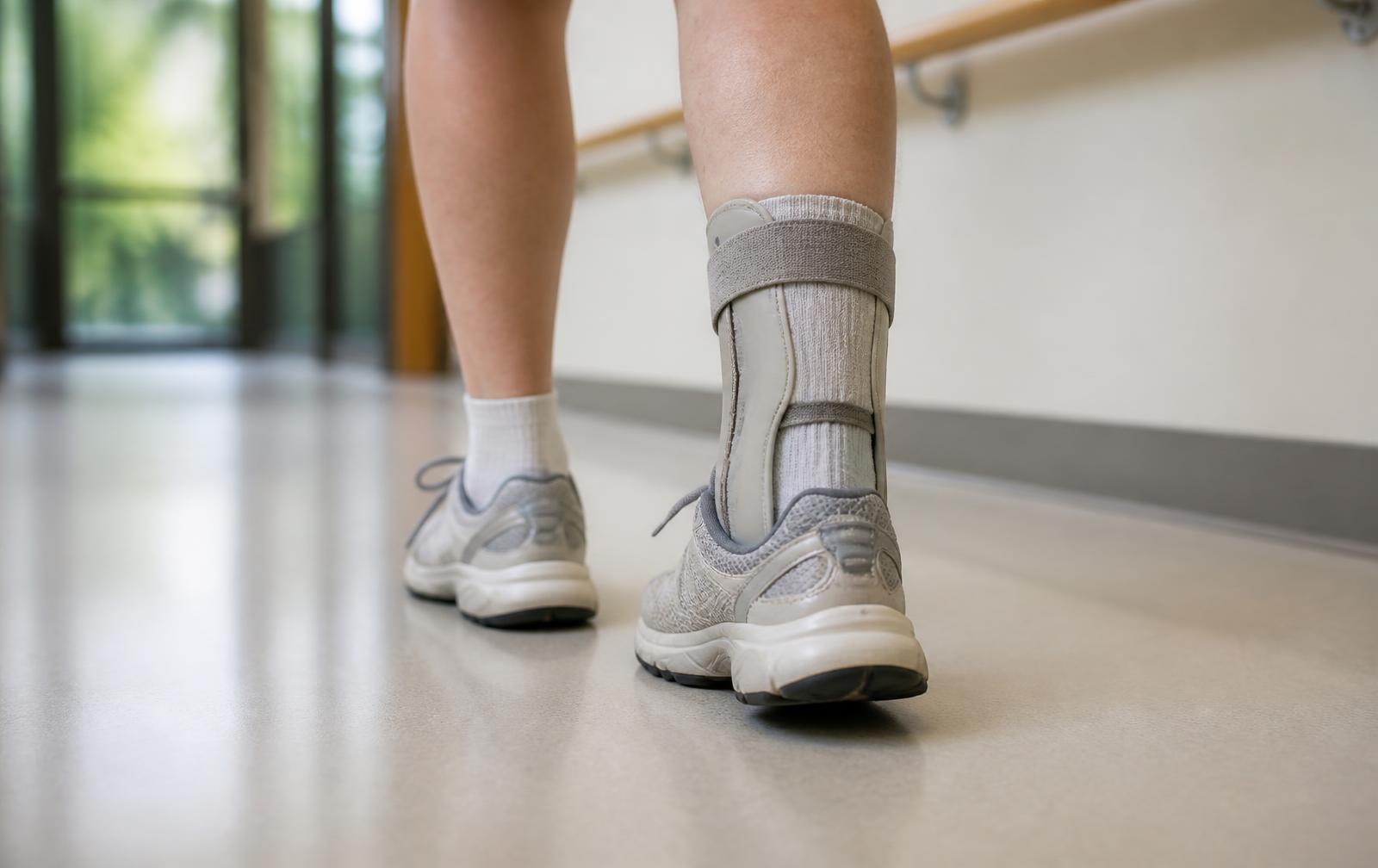
Drop Foot: Causes, Treatment and Walking Support
A plain-English United Kingdom guide to drop foot, also called foot drop — what it feels like, the many possible underlying causes, how it is assessed, the braces and rehabilitation that may help, and how to walk more safely.
What drop foot means
Drop foot, also called foot drop, makes it difficult to lift the front of the foot and the toes. It most often affects one foot.
Because the front of the foot does not lift properly, drop foot can change the way someone walks. The toes may catch or drag along the ground, which increases the risk of tripping and falling.
Drop foot is a symptom of an underlying problem rather than a condition in its own right. Something is affecting the nerves, muscles or the pathway between the brain, spine and leg — and there are many possible reasons for that.
Drop foot can be temporary or long-lasting, depending on the cause and how it responds to treatment. Nobody can promise how it will develop without a proper assessment.
This page gives general information only. Sixpence Support UK does not diagnose drop foot, does not identify the cause and does not give personalised medical advice. Please speak to a GP or another healthcare professional about your own situation.
Call 999 if weakness comes on suddenly
Call 999 immediately if sudden weakness in a foot, leg, arm or face happens with any of these:
- the face has dropped on one side, or the person cannot smile
- they cannot lift or hold up one or both arms
- their speech is slurred or garbled, or they cannot speak or understand
These can be signs of a stroke. A stroke is a medical emergency and treatment is very time-sensitive.
New foot weakness with severe back or bladder symptoms needs urgent assessment
Get urgent medical assessment — go to A&E or call 999 — if new weakness in a foot or leg happens together with:
- severe or worsening back pain
- numbness or tingling around the genitals, bottom or inner thighs
- difficulty passing urine, or loss of bladder or bowel control
- weakness or numbness in both legs
These symptoms together can indicate serious pressure on the nerves at the base of the spine, which needs to be assessed urgently. Please follow current NHS guidance rather than waiting to see whether things settle.
Most drop foot is not an emergency
The warnings above cover a small number of situations. Many people develop drop foot gradually, or after an injury, operation or period of sitting or lying still, and it is dealt with through a normal GP appointment and referral. Please do not assume the worst — but do get it looked at rather than living with it.
1. Signs and symptoms
Drop foot may involve:
- difficulty lifting the front of the foot or the toes
- toes catching, scuffing or dragging on the ground
- lifting the knee or hip higher than usual to clear the foot when walking
- the foot slapping down on the ground with each step
- weakness, numbness, tingling or pain in the foot, ankle or lower leg
- problems with balance or feeling unsteady
- more trips, stumbles, near-falls or falls
- shoes wearing unevenly, especially at the toe
Symptoms can affect one or both feet, and may come on suddenly or build up slowly over weeks or months.
2. When to seek medical help
Contact a GP if you or someone you care for develops difficulty lifting the foot or toes, is dragging a foot, or is tripping more often. This should be checked so that the underlying cause can be looked for.
Please also contact a GP if:
- walking is becoming harder or less safe
- there has been a fall, or several near-falls
- the weakness is spreading or getting worse
- there is new numbness, pain or wasting of the muscles
- an existing brace, insole or shoe no longer fits or is rubbing
If you are unsure how quickly to act in England, NHS 111 can help you decide. Arrangements differ across the UK — see the section on urgent NHS advice below.
3. Possible causes
Drop foot has many possible causes. Some are temporary and settle; others are long-term. Common and recognised causes include:
- injury or pressure affecting the peroneal nerve — the nerve that runs near the outside of the knee and controls lifting the foot
- a slipped disc or another spinal problem pressing on a nerve
- peripheral neuropathy — nerve damage, including the nerve damage that can be associated with diabetes
- hip or knee surgery, where a nerve is stretched or bruised
- prolonged immobility — long periods in bed, in a cast, sitting with crossed legs, or kneeling or squatting for long spells
- stroke, multiple sclerosis, Parkinson's disease or spinal-cord injury
- less commonly, inherited nerve conditions, muscular dystrophy, spinal muscular atrophy or motor neurone disease
Please do not try to work out the cause yourself. Very different conditions can produce the same symptom, and the treatment depends entirely on what is behind it. Only a qualified clinician who can examine the leg and take a full history should decide.
4. Assessment and diagnosis
A GP appointment for drop foot usually involves:
- asking when it started and whether it came on suddenly or gradually
- examining the leg, ankle and foot, testing strength, sensation and reflexes
- watching the person walk
- reviewing medical history, recent surgery, injuries and current medicines
Depending on what is found, a GP may refer someone to:
- neurology — for nerve and brain-related causes
- orthopaedics or spinal services — for bone, joint or spinal causes
- physiotherapy — for strength, movement and walking
- podiatry — for foot health, skin and footwear
- orthotics — for a properly fitted brace, splint or insole
Tests are not always needed, but may include:
- scans, such as an MRI of the spine, or imaging of the knee or leg
- nerve-conduction studies, to see how well nerve signals travel
- electromyography (EMG), to look at electrical activity in the muscles
- blood tests, for example where diabetes or another medical cause is suspected
Waiting times and local arrangements vary. It is reasonable to ask the practice what has been referred, and roughly how long it may take.
5. Treatment and rehabilitation
Treatment depends on the cause. The main aim is usually to treat what is behind the drop foot while helping the person walk more safely in the meantime. Options a clinician may consider include:
- treating the underlying cause — for example relieving pressure on a nerve, or managing diabetes, MS or the effects of a stroke
- physiotherapy, with strengthening, stretching and walking practice suited to the individual
- an ankle-foot orthosis (AFO), brace, splint or shoe insert to hold the foot in a better position
- functional electrical stimulation (FES), which uses small electrical impulses to help lift the foot, where it is clinically suitable and available locally
- help with pain or nerve symptoms, which may include medicine
- surgery in selected cases, for example to relieve pressure on a nerve or to stabilise the foot and ankle
Please do not start exercises, or buy a brace online, before being assessed. The wrong exercise can aggravate some causes, and an ill-fitting brace can rub, cause pressure damage or make walking less safe. Ask a physiotherapist, podiatrist or orthotist what is right for the particular cause.
Recovery varies. Some people regain movement fully, some partly, and for others drop foot is permanent and managed with equipment and support. It is fair to ask a clinician what is realistic in your case.
6. Braces, footwear and foot care
Practical points that often matter day to day:
- Correct professional fitting. A brace, splint or insole should be fitted and checked by an orthotist, physiotherapist or podiatrist, and reviewed if it stops fitting well.
- Supportive, well-fitting footwear. Shoes that fasten securely, have a firm heel and a sole with reasonable grip, and enough room for a brace or insole, are usually easier and safer than loose slippers or backless shoes.
- Check the skin daily. Look for redness, rubbing, blisters, hard skin or any broken skin, especially where a brace or strap sits. Report sores or persistent redness rather than pushing on.
- Extra care with diabetes or reduced sensation. If the foot does not feel pain normally, damage can go unnoticed. Follow the foot-care advice given for your condition and contact your diabetes or podiatry service about any new sore, colour change or swelling.
- Asking about NHS services. A GP can refer to NHS physiotherapy, podiatry and orthotics services. Some areas also accept self-referral for physiotherapy — the practice or the local NHS website will say.
7. Preventing trips and falls
Small changes at home can make a real difference:
- remove or secure loose rugs, mats, trailing cables and clutter
- improve lighting, especially on stairs, landings and the route to the bathroom at night
- use handrails where they are available, and ask about having them fitted if they would help
- consider a walking aid — but only one recommended and fitted by a professional
- take extra care on stairs, uneven pavements, kerbs, wet leaves and ice
- slow down on unfamiliar ground rather than hurrying
- tell a GP about any fall, even if there was no injury
A falls assessment, occupational-therapy visit or home-safety check may be available locally, often arranged through a GP or the council.
8. Everyday life, work and driving
Living with drop foot often means planning a little differently:
- plan routes with even surfaces, seating and fewer steps where possible
- allow extra time so there is no need to rush
- talk to an employer about workplace adjustments — seating, parking, breaks, different duties or working patterns — and ask about occupational-health support
- ask about an occupational-therapy assessment for equipment, home adaptations and mobility aids
- consider how shopping, stairs at home and public transport are managed
Driving. Drop foot can affect how safely someone uses the pedals. If you have any concern about controlling a vehicle safely, stop driving and get professional advice from your GP or specialist before driving again.
Rules about which conditions must be told to the DVLA (or DVA in Northern Ireland) depend on the specific condition and how it affects you. Please check the current official guidance on GOV.UK, and ask your clinician if you are unsure — we cannot tell you what applies in your individual case.
9. Questions to ask a GP or specialist
- What is the likely underlying cause of my drop foot?
- Do I need scans or nerve tests, and when?
- Should I be referred to physiotherapy, podiatry or orthotics?
- Would a brace, splint, insole or functional electrical stimulation help me?
- How can I reduce my risk of falling?
- Are there any activities or exercises I should avoid for now?
- Does this affect my ability to drive safely, and what should I do about it?
- Is this likely to improve, stay the same, or change over time?
- Who should I contact if it gets worse?
10. Preparing for an appointment
It helps to write down, before you go:
- when the problem began
- whether it started suddenly or came on gradually
- which foot is affected, or whether both are
- any pain, numbness, tingling or back symptoms
- any recent surgery, injury, cast, or long periods of sitting or lying still
- any falls or near-falls, and where they happened
- all current medicines, including anything bought over the counter
- existing conditions such as diabetes, MS, Parkinson's disease or a previous stroke
- photos or notes showing uneven shoe wear or walking difficulties, if you think they help
Taking a family member or friend with you can help, especially if there is a lot to remember.
11. Help communicating with services
If writing to a GP practice, hospital department or orthotics service feels difficult, Sixpence Support UK can help you prepare a clear letter or email describing your symptoms, how they affect your walking and daily life, and asking for an assessment or referral.
We cannot diagnose drop foot, identify its cause or give medical advice. What we can do is help you set out the facts clearly so that the people who can assess you have what they need.
12. Trusted information and support
Please use the official sources below for the most up-to-date guidance. Always check the organisation's own website for the latest information.
Urgent NHS advice differs across the UK:
- England: contact NHS 111 by phone on 111, or use NHS 111 online.
- Scotland: contact your GP practice, or phone 111 when the practice is closed.
- Wales: contact NHS 111 Wales by phone on 111.
- Northern Ireland: contact your GP practice, or the GP out-of-hours service when the practice is closed.
In an emergency, or if you think someone is having a stroke, call 999.
Please speak to a healthcare professional
Sixpence Support UK does not diagnose drop foot, identify its cause, provide medical advice or supply braces or treatment. This page explains general information so that people know what to ask about and when to seek help. Drop foot can be temporary or permanent, and only an assessment can say what is likely in an individual case.
- [1] NHS. Foot drop · 2026
- [2] NHS. Stroke · 2026
- [3] NHS. Cauda equina syndrome (this page is no longer available online) · 2026
- [4] NHS. Falls · 2026
- [5] NHS. Physiotherapy · 2026
- [6] NHS. Peripheral neuropathy · 2026
- [7] NHS. Slipped disc · 2026
- [8] GOV.UK. Health conditions and driving · 2026
- [9] NHS 111. Get help for your symptoms (England) · 2026
- [10] NHS inform (Scotland). Preventing falls · 2026
- [11] nidirect (Northern Ireland). Health services · 2026