
Heating, Air Conditioning and Ventilation
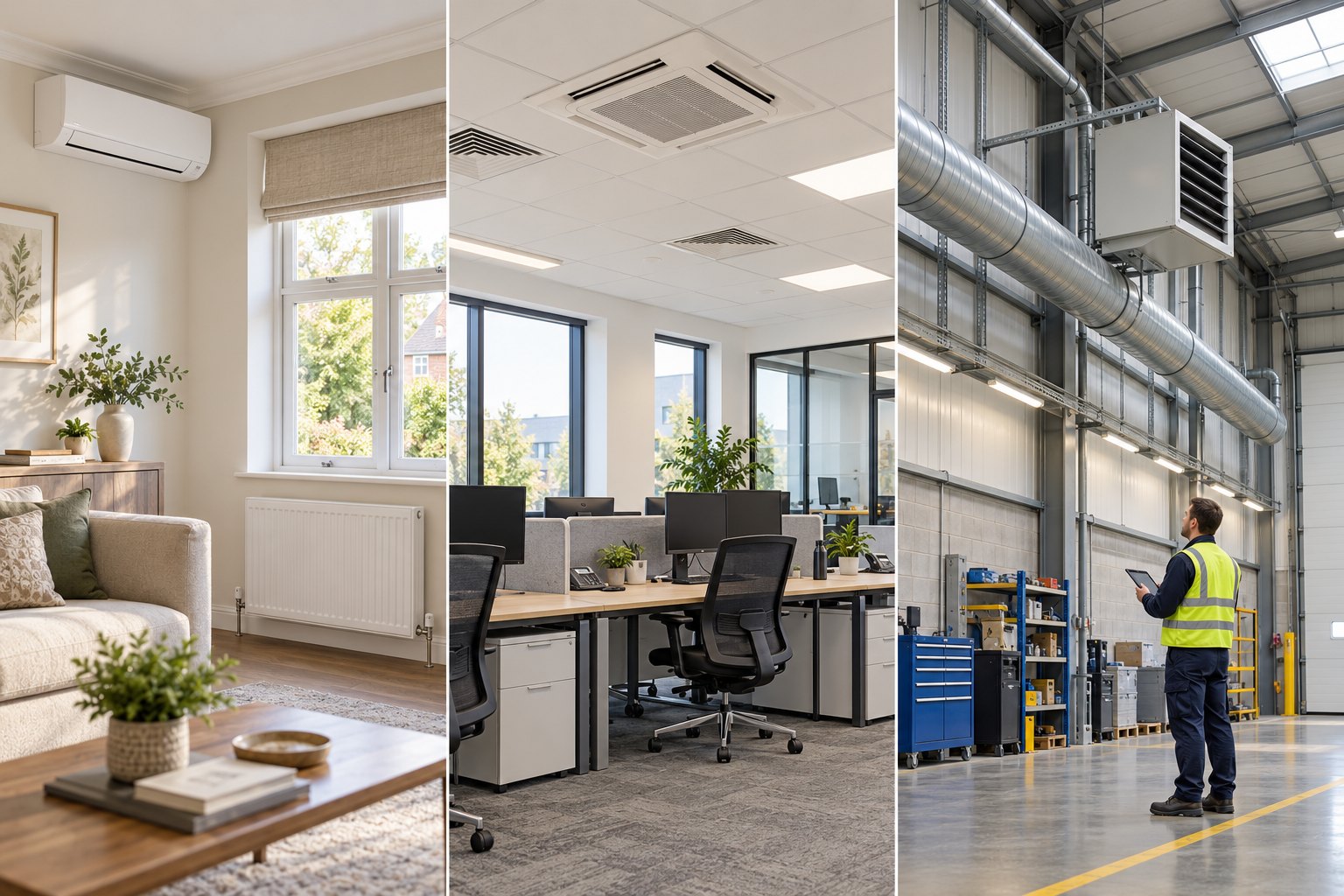
Help for homes, offices, shops, workshops and industrial units. Keeping a space comfortable means choosing equipment that suits the building, the people using it and the running budget. This guide explains common options, links to trusted information and helps you find suitable installers. Browsing Sixpence Support UK is free; products, surveys, installation and servicing are paid services unless the provider states otherwise.
Generated illustrative image — not a real named installer or an endorsement.
1. Home heating and cooling
No one type suits everyone. Compare what each option does and ask how it would work in your property.
| Option | Uses and things to check |
|---|---|
| Portable electric heaters | Temporary or local heating; check power use, positioning and fire safety. |
| Portable air conditioners | Cooling a room without a permanent split installation; many need an exhaust hose vented outside. Check the manufacturer’s drainage, window-kit, noise and room-size guidance. |
| Fitted air conditioning / air-to-air heat pumps | Indoor and outdoor units that can heat and cool rooms. Professional assessment and installation needed; they don’t usually provide domestic hot water. |
| Boilers and radiators | Central heating; gas equipment needs an appropriately registered Gas Safe engineer. |
| Air-to-water or ground-source heat pumps | Heating systems that may supply radiators, underfloor heating and hot water, depending on design. Suitability and running costs need assessing for the property. |
2. Workplaces and industrial units
Offices, shops and industrial buildings have different needs. Ask a competent building-services engineer to assess the size and height of the space, occupancy, insulation, machinery heat, opening doors, existing ventilation and electrical supply.
Options to discuss may include zoned heating, fitted cooling, commercial warm-air heating and mechanical ventilation. These are discussion points for a survey, not a recommendation for an unsurveyed building.
Employers should assess temperature risks and provide suitable conditions for the work. HSE guidance for Great Britain gives usual minimum indoor temperatures of 16°C, or 13°C for strenuous work; these aren’t universal comfort targets for every process. Ask the engineer to assess the actual duties, workforce and environment.
3. Fresh air and ventilation
Cooling a room and bringing in fresh air are different jobs. Do not assume a recirculating air conditioner or desk fan provides sufficient fresh air.
A workplace may need natural ventilation, mechanical ventilation or a combination. Ask how outside air reaches occupied areas and how stale air leaves.
Where work creates dust or welding fumes, general ventilation is not a substitute for suitable local exhaust ventilation and the relevant risk controls.
Official workplace guidance for Great Britain
4. Find and check an installer
For gas heating, check the engineer on the Gas Safe Register and confirm they are qualified for the exact work, including commercial work where applicable.
For installation or refrigerant work on systems containing F-gas, check the relevant company certification and individual qualifications. REFCOM is one register, not the only approved certification body. Other refrigerants can require different specialist competence; don’t assume an F-gas listing covers every task.
For a heat pump, use the MCS installer finder and check the requirements of any funding scheme.
Ask for insurance details, a written survey and quote, commissioning information and clear warranty terms.
5. Running costs and energy use
Compare equipment cost, installation, electricity or fuel use and ongoing maintenance. Ask for estimated annual costs using your actual tariff and the hours you expect to use it.
Hypothetical example — not a current tariff
Equipment drawing 2 kW continuously for one hour uses 2 kWh. At an example rate of 25p per kWh, that is 50p for the hour. This is not today’s tariff or a promised running cost; actual consumption varies with controls and cycling.
Electrical input and heating/cooling output are different figures, especially for heat pumps. Compare like-for-like performance data.
Ask about insulation, shading, draught reduction, zoning, thermostats and timers before buying a larger system. Don’t block ventilation openings in an attempt to save heat.
6. Grants and financial help
The Boiler Upgrade Scheme covers eligible installations in England and Wales and may help with a home or building used for a business. It does not mean every heating or cooling purchase qualifies. Check the exact property and technology rules with the scheme and installer before committing.
Scotland has separate household energy-advice and funding routes through Home Energy Scotland.
Readers elsewhere, including Northern Ireland, should check local energy advice and provider availability. Do not assume a scheme covers all air conditioners or is UK-wide.
7. Using portable heaters safely
- Use a stable level surface and keep the heater at least one metre from combustible materials such as curtains, furniture and paper.
- Keep children and pets away from hot surfaces. Never cover a heater or use it to dry clothes.
- Plug into a suitable wall socket, not an extension lead.
- Don’t leave it running unattended or while asleep. Follow the manufacturer’s instructions and stop using damaged equipment.
Business users also need equipment suitable for their specific environment and risk assessment; a domestic heater isn’t automatically suitable for an industrial unit.
8. Servicing, repairs and permissions
Ask the provider how often servicing is needed, what filters you can safely clean and which tasks need a qualified technician. Keep manuals and service records, and arrange checks if performance falls or leaks appear. Do not attempt refrigerant, gas or electrical repairs yourself.
Before fixed installation, confirm any landlord/freeholder consent, lease restrictions, planning requirements, outdoor-unit noise arrangements and drainage with the relevant parties. Ask who handles these in the quotation.
A maintenance contract should state what’s included, response arrangements, parts costs and exclusions.
9. Questions to ask before buying
- Is this for a single room or the whole building?
- Does it heat, cool, provide fresh air or supply hot water?
- How was its capacity calculated?
- What is the electrical input and estimated running cost?
- What noise and outdoor space does it need?
- Which certification applies?
- What installation, drainage, controls, warranty and servicing are included?
- Are permissions and funding confirmed?
Get comparable written quotes and choose a system on suitability, not only headline price.