
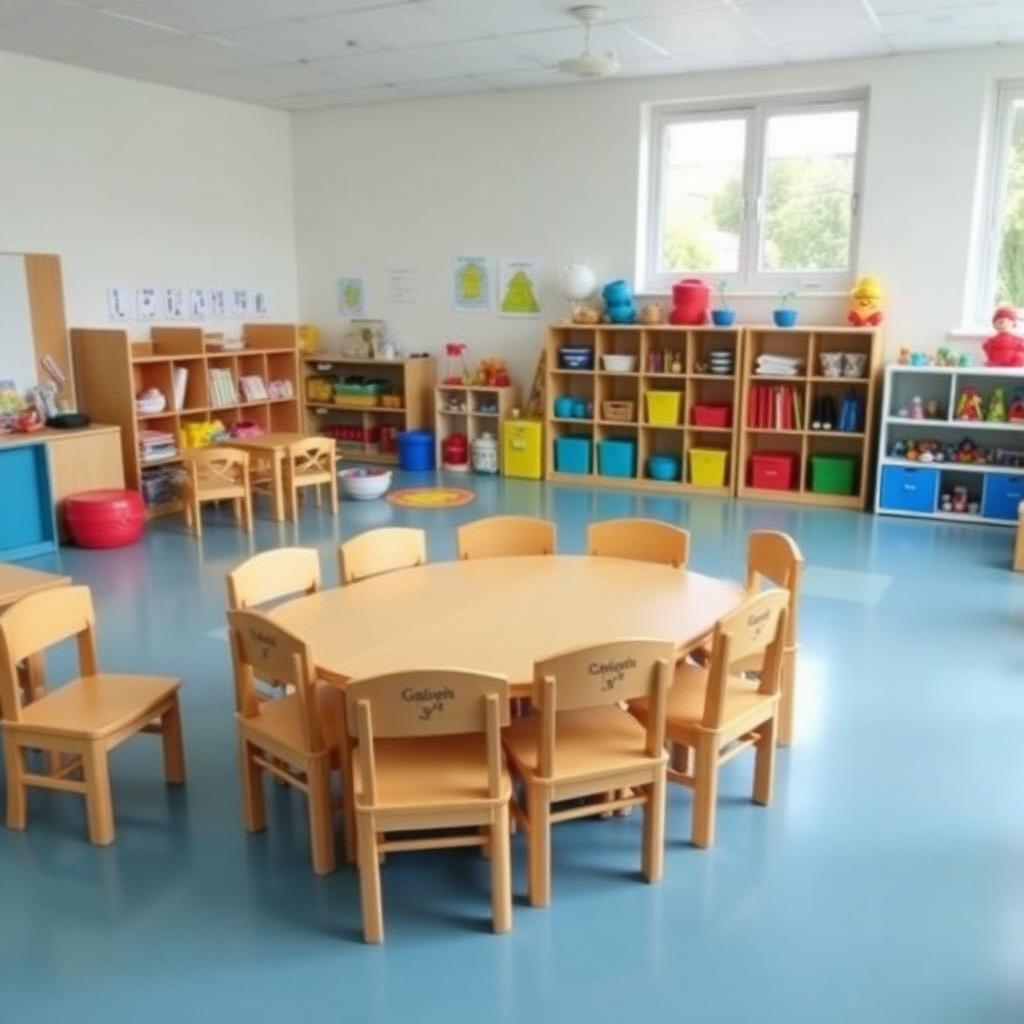
Nursery, Schools, Play Groups & Kindergarten
A practical UK guide to early years education and childcare — nurseries, play groups, childminders, free hours, school admissions, reception, SEND support and your rights.
- 98%
of Ofsted-registered early years providers in England were rated Good or Outstanding at their most recent inspection.
Source: Ofsted, as at 31 Aug 2025
- 15-30
free hours per week may be available for 3 and 4-year-olds, and some 2-year-olds.
Source: GOV.UK, 2024
- 15 Jan
is the usual deadline to apply for a primary school reception place.
Source: GOV.UK, 2024
- 5
is the age by which a child must start school in England.
Source: GOV.UK, 2024
Early years frameworkThe Early Years Foundation Stage (EYFS)
In England, every registered early years provider — nurseries, pre-schools, play groups, childminders and school reception classes — must follow the Early Years Foundation Stage (EYFS) framework. It sets the standards for learning, development and care for children from birth to age 5.[1]DfE
The EYFS covers seven areas of learning: communication and language; physical development; personal, social and emotional development; literacy; mathematics; understanding the world; and expressive arts and design.[2]DfE
Types of careNurseries, pre-schools, play groups and childminders
A nursery typically offers childcare and early education for children from around 3 months up to school age. Nurseries may be privately run, school-run, or run by a charity or local authority. A pre-school or play group usually takes children from 2 to 5, often part-time and term-time only.
Childminders are registered childcare professionals who look after children in their own home. They are inspected by Ofsted and must follow the EYFS.[3]Ofsted
A parent-and-toddler or stay-and-play group is usually run by volunteers or charities. These are not formal childcare and may not be Ofsted-registered, but they can be a good way for children and parents to socialise.
What to check when visiting a setting
- Is the setting registered with Ofsted? Read the latest inspection report.
- What are the staff qualifications and child-to-staff ratios?
- Are meals, nappies, trips and extras included in the fee?
- What are the opening hours, holiday cover and sickness policies?
- Does the setting have experience supporting children with additional needs?
FundingFree childcare hours and help with costs
The UK government offers help with childcare costs through several schemes. The rules differ between England, Scotland, Wales and Northern Ireland.[4]GOV.UK
In England, working families may be able to get:
- 15 hours free childcare for all 3 and 4-year-olds for 38 weeks a year.
- 30 hours free childcare for eligible working families of 3 and 4-year-olds.
- 15 hours for 2-year-olds if you receive certain benefits, or the child has SEND or is looked after by the local authority.
- Tax-Free Childcare — up to £2,000 per child per year (or £4,000 for a disabled child) to help with approved childcare costs.
You can use the government Childcare Calculator to see what support you are entitled to.[5]HMRC
School admissionsApplying for reception and primary school
Children in England usually start reception class in the September after they turn 4. This is the first year of primary school.[6]GOV.UK
Parents must apply for a primary school place, usually by 15 January for entry the following September. The application is made through your local council. You can name several preferred schools, but you are not guaranteed your first choice.[7]DfE
Schools admit pupils according to their published admissions criteria. Common criteria include living in the catchment area, having a sibling already at the school, and faith or grammar-school tests where relevant.[8]GOV.UK
Key dates for reception in England
- Applications open: usually September the year before.
- Deadline: 15 January.
- Offers sent: 16 April (National Offer Day).
- Appeal deadline: usually around 17 May.
Admissions in detailHow school places are decided
You apply to your local council (in Northern Ireland, to the Education Authority), not usually to the school itself, and you can normally name several preferences in order. Naming only one school does not improve your chances.
If more children apply than there are places, the school applies its published oversubscription criteria in order. Common criteria include:
- children in care or previously in care;
- children with an EHC plan, IDP, CSP or Statement naming that school — these are admitted first;
- medical or social need, where evidence is supplied;
- a sibling already at the school;
- distance from home to school, or a defined catchment area;
- faith criteria at church and faith schools;
- a selection test at grammar schools in some areas of England and in Northern Ireland.
Read the criteria for each school before you apply, and check how distance is measured — straight line or walking route makes a real difference.
Where to apply across the UK
- England: apply through your council (deadline 15 January for reception, 31 October for secondary).
- Scotland: catchment schools and placing requests through your council.
- Wales: school admissions through your local authority.
- Northern Ireland: Education Authority admissions and the transfer process.
AppealsIf you do not get the school you wanted
A refusal letter must tell you why, and how to appeal. You can accept a place at one school and still appeal for another, and you can usually ask to go on a waiting list at the same time. Accepting a place does not remove your right to appeal.
- Note the appeal deadline in the letter — it is normally at least 20 school days in England.
- Ask the council for the school’s admission arrangements and how the criteria were applied.
- Write your case around your child: needs, evidence, travel, siblings, medical or social factors.
- Send supporting letters — from a GP, a health professional, a nursery or a social worker if relevant.
- Attend the hearing if you can. Independent panels are used to nervous parents and are not courts.
- You will normally get the decision in writing within about five school days.
Infant class size appeals
For reception, Year 1 and Year 2 in England, classes are capped at 30 pupils per teacher. These appeals can only succeed on narrow grounds — that the decision was unlawful, that the criteria were applied wrongly, or that the decision was unreasonable. It is worth taking free advice before you appeal.
- England: appealing a school decision · complain to the Schools Adjudicator
- Scotland: appeal to the council’s education appeal committee after a refused placing request.
- Wales: school admission appeals.
- Northern Ireland: admissions appeal tribunals through the Education Authority.
Starting and movingDeferring, summer-born children and moving schools
- Deferring: in England you can defer entry until later in the reception year, or ask to start part-time at first. The place is normally held for that academic year.
- Summer-born children: parents of children born between 1 April and 31 August in England can ask to start reception a year later, outside their normal age group. The admission authority decides, and reasons must be given.
- In-year admissions: if you move house or want to change schools mid-year, apply for an in-year place through the council. If no school has a place, the council must still find one, using its fair access protocol where needed.
- Waiting lists: in England, waiting lists for reception must be kept until at least 31 December of that school year. Positions can change when families move in or out.
- School transport: free travel may be available where a child lives beyond the statutory walking distance, cannot walk safely, or has SEND. Rules differ by nation and council, so ask before you accept a place further away.
For learning support at any stage, see our SEND, ALN and ASN page.
What is kindergarten in the UK?
The word "kindergarten" is more commonly used in other countries. In the UK, the equivalent is usually a nursery, pre-school or reception class. Some private schools and international schools may use the term "kindergarten" for their early years class.
In England, children do not have to attend school until they are 5, but they are entitled to start from the term after their 4th birthday. Parents can choose to defer entry until later, but they must still start school by the term after their 5th birthday.[9]GOV.UK
SENDSpecial educational needs and disabilities
If your child has additional needs, early years settings must make reasonable adjustments and support their learning. If they need more help than a nursery or school can normally provide, they may have an Education, Health and Care (EHC) plan or equivalent in other parts of the UK.[10]GOV.UK
Contact your local council's SEND team or a SENDIAS service for free, impartial advice. See the directory below.
Your rightsWhat to do if something goes wrong
- All registered childcare providers must be safe, meet the EYFS standards and have appropriate insurance.
- You can read Ofsted inspection reports and complain to Ofsted if you are worried about a setting.
- If you are refused a school place, you can appeal to an independent admission appeal panel.
- Local councils must publish a "local offer" explaining SEND services and support in your area.
For free advice on your rights, see our Solicitors page or contact Citizens Advice.
Help directoryWhere to get support
- GOV.UK — Childcare calculator
- GOV.UK — Find childcare
- Ofsted — Ofsted inspection reports
- GOV.UK — Find your local council
- Citizens Advice — Childcare advice
- PACEY — Choosing quality childcare
- Contact — Support for families with disabled children
- SENDIAS — Special Educational Needs and Disabilities Information Advice and Support
- [1] Department for Education. Early years foundation stage (EYFS) statutory framework · 2024
- [2] Department for Education. EYFS educational programmes · 2024
- [3] Ofsted. Register as a childminder or nanny · 2024
- [19] Ofsted. Main findings: childcare providers and inspections as at 31 August 2025 · 2025
- [4] GOV.UK. Free Childcare for Working Parents · 2024
- [5] HM Revenue & Customs. Tax-Free Childcare · 2024
- [6] GOV.UK. Apply for a primary school place · 2024
- [7] Department for Education. School admissions code · 2021
- [8] GOV.UK. Find a school in England · 2024
- [9] GOV.UK. School age: when children can start and leave school · 2024
- [10] GOV.UK. Children with special educational needs and disabilities (SEND) · 2024