
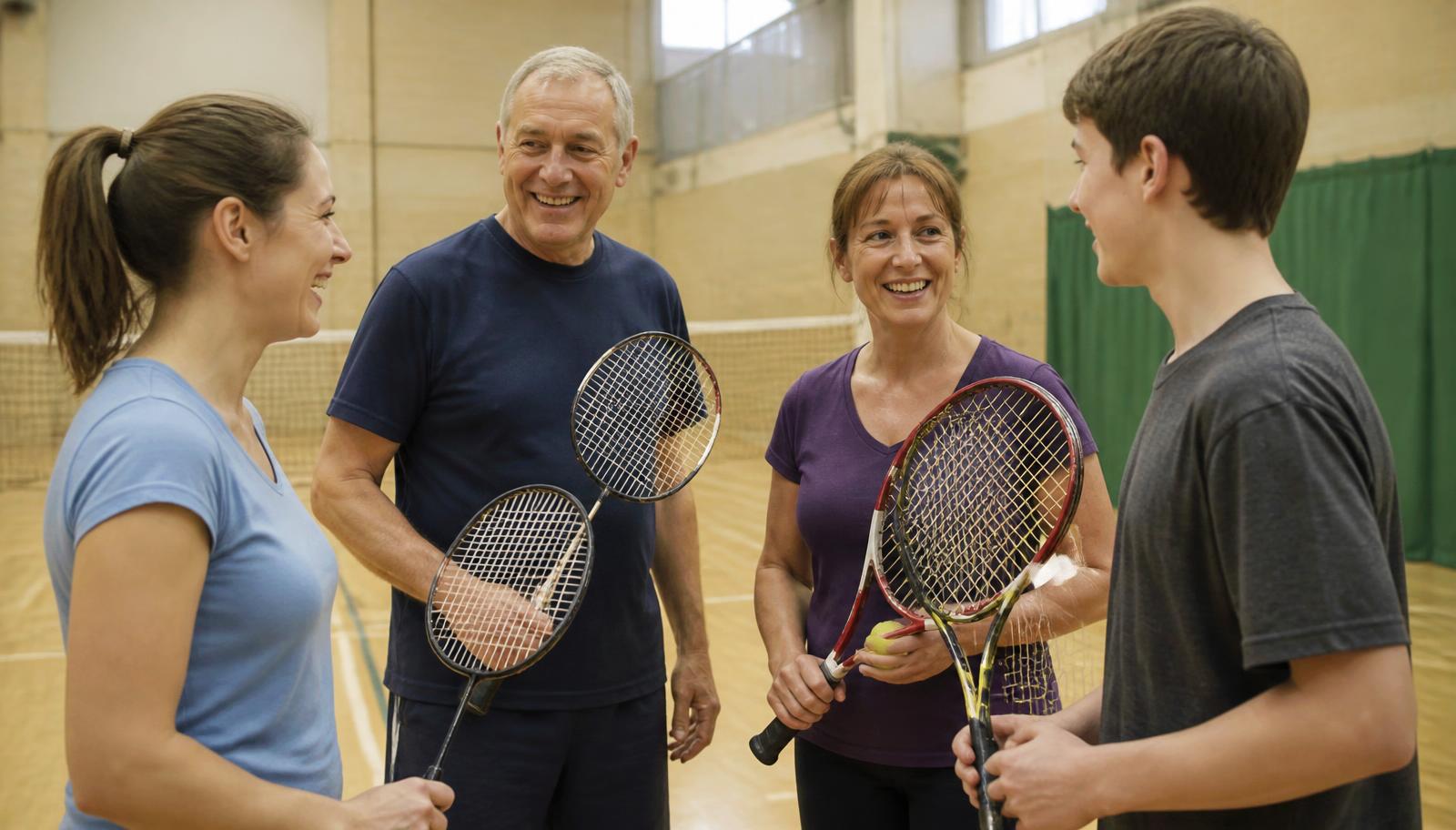
Racket Sports: Padel, Tennis, Squash and Badminton
Racket sports are one of the friendliest ways to get moving in Britain. This page explains how padel, tennis, squash and badminton are played, how to start safely, what they may cost, and how to find somewhere local — whatever your age or fitness.
Choosing a racket sport
Racket sports (sometimes spelled racquet sports) all share the same simple idea: two or four people hit a ball or shuttlecock to each other, and try to win the point. Beyond that, they feel quite different, and most people find one that suits them.
- Tennis — played outdoors or indoors on a full-size court, in singles or doubles. Moderately demanding; doubles involves much less running than singles. Good if you like fresh air, longer rallies and a well-established club scene.
- Padel — played on a smaller enclosed court with glass and mesh walls, almost always as doubles. Usually the quickest of the four to pick up, because rallies start easily and the court is small. Good if you want something sociable and immediately enjoyable.
- Squash — played inside a four-walled court, usually by two people. The most physically demanding of the four for most players, with constant short sprints and turns. Good if you want a hard workout in 40 minutes.
- Badminton — played indoors with light rackets and a shuttlecock, in singles or doubles. It can be gentle and social, or extremely fast at competitive level. Good if you want somewhere warm, dry and cheap to play all year round.
There is no “right” choice. For most people the deciding factors are simply what is nearby, what it costs, and who they would enjoy playing with.
At a glance
- All four sports have beginner sessions in many parts of the UK.
- Rackets can often be hired or borrowed before you buy anything.
- Doubles is usually less demanding than singles.
- Suitable non-marking indoor shoes matter for squash and badminton.
- Adapted formats exist, including walking tennis, wheelchair tennis and para-badminton.
- Build up gradually, especially if you have not been active for a while.
Tennis
The basic idea is straightforward. The court is divided by a net, and players hit the ball over the net and inside the lines. You score points when your opponent cannot return the ball fairly. Games build into sets, and sets into a match — but for social play, you can simply rally and keep score however you like.
Singles is one against one and covers the most ground. Doubles is two against two on a slightly wider court, involves far less running, and is how most club and social tennis is played in Britain.
Equipment: a strung racket, tennis balls, comfortable clothing and trainers with good grip. Softer, lower-compression balls are often used for beginners and children because they travel more slowly and are easier to hit.
Surfaces: most public courts in the UK are hard (tarmac or acrylic). You may also find artificial grass, clay and indoor carpet. Hard courts are quick to dry and low maintenance; clay is gentler on the joints but less common.
Starting out: look for adult beginner courses, cardio-style sessions, pay-and-play council courts, or free and low-cost community sessions. Group coaching is usually cheaper than one-to-one lessons and tends to be more sociable. The Lawn Tennis Association lists venues, coaches and sessions across the country.1
Padel
Padel is normally played as doubles on an enclosed court roughly a third of the size of a tennis court, surrounded by glass and mesh walls. It has grown very quickly in Britain, and is supported here by the Lawn Tennis Association.2
Rackets and balls: padel rackets are solid, with no strings and a perforated face, and have a wrist strap. The balls look like tennis balls but are slightly lower in pressure, so they bounce a little less.
The walls: this is the biggest difference from tennis. After the ball bounces on the floor, it can come off the glass and still be played. Rallies therefore last longer, and clever, softer shots often beat raw power.
How it differs from tennis: the serve is underarm and below waist height, the court is smaller so there is less running, scoring is the same as tennis, and beginners usually manage a proper rally within their first session.
Padel is played at dedicated padel centres, many tennis clubs and a growing number of leisure sites. Courts are normally booked by the hour and shared between four people.
Squash
Squash is played inside an enclosed four-walled court, usually by two people, who take turns hitting a small rubber ball against the front wall. Because you share the same space, there are clear rules about giving your opponent a fair view and swing.
It involves quick movement, sudden stops and frequent changes of direction, so it is demanding on the heart, lungs, knees and ankles. Rallies are short and intense. Many people find a 40-minute game plenty.
Beginner sessions: many clubs and leisure centres run introductory or “squash for all” style sessions, racketball or squash 57 (a slightly slower version with a bigger ball), and box leagues that match you with players of a similar standard. England Squash lists clubs and beginner opportunities.7
Footwear and eye protection: wear proper non-marking indoor court shoes with good side support — running shoes are not designed for sideways movement. Protective eyewear is strongly recommended, and is required for juniors in many settings, because the ball is small, hard and fast.
Badminton
Badminton is played indoors on a marked court with a net, using light rackets and a shuttlecock rather than a ball. You score a point when the shuttle lands in your opponent’s court or they cannot return it fairly.
Singles uses a long, narrow court and involves a lot of covering. Doubles uses the wider court, is faster at the net and is the most common social format.
Equipment: a light racket, shuttlecocks (plastic ones for casual play, feather ones for club and competitive play), and non-marking indoor shoes. Most sports halls and leisure centres have courts to hire by the hour.
Intensity is up to you. There are relaxed social clubs, “no-strings” style pay-and-play sessions, over-50s and beginner groups, and leagues for those who want faster, competitive play. Badminton England can help you find local options.5
Health and wellbeing
Regular physical activity is good for most people. NHS guidance suggests adults aim for at least 150 minutes of moderate activity a week, or 75 minutes of vigorous activity, plus strengthening activities on two days a week.8 Racket sports can contribute to that.
Depending on how you play, they may help with:
- general fitness, and heart and lung health
- balance, coordination and reaction time
- leg, arm and core strength
- maintaining a healthy weight alongside other lifestyle changes
- social contact, which matters for many people as much as the exercise
- mood and mental wellbeing, and a break from everyday worries
We cannot promise particular health outcomes, and no sport prevents or treats illness on its own. What we can say is that being more active, in a way you enjoy and can keep up, is generally worthwhile — and enjoyment is usually what keeps people going.
Starting safely
- Warm up first. Five to ten minutes of gentle movement, easy rallies and some shoulder, hip and ankle mobility before you play properly.
- Begin gradually. One or two shorter sessions a week is a sensible start. Sudden jumps in how hard or how often you play are a common cause of injury.
- Drink water before, during and after play — indoor halls and enclosed courts get hot.
- Wear suitable footwear. Non-marking indoor court shoes for badminton, squash and indoor tennis; proper court shoes outdoors. Good grip and side support reduce ankle and knee injuries.
- Learn the technique. A few group sessions with a qualified coach can prevent months of elbow or shoulder trouble, and make the game much more fun.
- Allow recovery. Leave rest days between hard sessions, cool down gently, and do not play through pain that is getting worse.
- Check first if you are unsure. If you have a heart or lung condition, joint problems, dizziness, or you are pregnant or recovering from illness or surgery, speak to a GP, practice nurse or physiotherapist before starting.
Common injuries and when to get help
Most racket-sport injuries are minor and settle with sensible care. The usual ones are:
- Muscle strains — calf, hamstring, thigh or groin, often from lunging or sprinting cold.
- Sprains — most commonly the ankle, from turning or landing awkwardly.
- Elbow pain — “tennis elbow” on the outside of the elbow or “golfer’s elbow” on the inside, usually from repeated gripping and hitting.11
- Shoulder pain — from serving and overhead shots.
- Knee pain — from repeated bending, twisting and stopping.
- Back discomfort — from twisting, reaching and serving.
- Blisters and sore hands — from new shoes or a worn grip.
For a fresh strain or sprain, NHS advice is to rest the area, use ice wrapped in a cloth for up to 20 minutes every few hours in the first days, support and gently raise the limb, and avoid heat, alcohol and vigorous massage early on.10 A pharmacist can advise on pain relief.
Stop playing and get advice if pain is severe, if you cannot put weight on a leg, if a joint looks out of shape or swells rapidly, if pain keeps returning every time you play, or if it is not improving after a couple of weeks. Contact a GP, physiotherapist, pharmacist or NHS 111 for guidance.12
Urgent warning signs — stop playing straight away
Call 999 if someone has chest pain, tightness or pressure, sudden severe breathlessness, collapses or is unresponsive, has a seizure, becomes confused, has weakness or drooping on one side of the face or body, or has an obvious deformity or heavy bleeding after an injury.
Get urgent medical advice (NHS 111, urgent care or an emergency department) for a sudden “pop” or snap in the calf or Achilles, an inability to bear weight, a rapidly swelling joint, a head knock with drowsiness or vomiting, an eye injury from a ball or shuttle, or fainting and severe dizziness during play.
This page cannot diagnose anything. If you are worried, please get it checked.
Older players and disabled players
Racket sports are not only for the young. NHS guidance for older adults encourages regular activity, including things that improve strength and balance.9 Options that many people find manageable include:
- Walking tennis and walking-pace sessions, where running is not allowed and the ball may bounce twice
- Lower-intensity and social sessions, often aimed at over-50s or over-60s
- Doubles instead of singles, which cuts the amount of ground you cover
- Adapted equipment — lighter rackets, larger grips, softer or slower balls
- Wheelchair tennis, where the ball may bounce twice and sports chairs are often available to borrow at participating venues3
- Para-badminton, with standing and wheelchair classifications and adapted court sizes6
- Visually impaired and seated formats at some clubs, using audible balls or adapted rules
Accessibility varies a great deal between venues — step-free access, changing places facilities, parking, hearing loops and trained coaches are not available everywhere. Please ask the individual club or leisure centre what support they can provide before you book. Activity Alliance has general guidance on inclusive activity.15
Children and young people
- Age-appropriate coaching. Junior programmes use smaller courts, shorter rackets and slower balls or shuttles so children can rally from the start.
- Accredited clubs. Look for venues affiliated to the relevant governing body — the LTA, Badminton England or England Squash — which sets standards for coaching and welfare.
- Safeguarding. Coaches working with children should be suitably qualified and DBS-checked, and the club should have a named welfare officer and a safeguarding policy you can ask to see.4 The NSPCC Child Protection in Sport Unit explains what good practice looks like.14
- Suitable equipment. A racket that is too heavy or too long makes it harder and can strain young joints. Eye protection is strongly advised for junior squash.
- Supervision. Check the club’s policy on dropping off and collecting children, and on who supervises during sessions.
- Keep it enjoyable. Plenty of children stay in sport because it is fun and sociable, not because they are winning.
Finding somewhere to play
Most people start in one of these places:
- Council leisure centres and sports halls — badminton, squash and indoor tennis courts, usually bookable by the hour online or by phone. Search your council’s website for “leisure centres”.
- Public park courts — many local authorities run pay-and-play or free tennis courts, often booked through an app or gate code.
- Clubs — tennis, padel, squash and badminton clubs usually welcome beginners and often run taster evenings.
- Padel centres — standalone venues and tennis clubs with padel courts, booked by the hour for four players.
- Governing body finders — the LTA (tennis and padel), Badminton England and England Squash all list venues, coaches and beginner sessions by area.1, 2, 5, 7
- Community programmes — GP referral and social-prescribing schemes, community centres, faith groups, workplaces and universities sometimes run low-cost sessions.
Searching with your postcode usually gives the best results — for example “badminton courts near SW1A 1AA” or “padel courts near me”. Our own service finder can also help you locate nearby NHS and local services.
Costs and equipment
Racket sports do not have to be expensive, though prices vary widely between areas and venues. Typical things to budget for:
- Court hire — badminton and squash courts are usually hired by the hour and split between players. Padel courts are booked by the hour for four people.
- Club membership — annual or monthly, sometimes with cheaper junior, student, off-peak, concession or family rates.
- Coaching — group beginner courses are normally much cheaper per session than one-to-one lessons.
- Equipment — you can often hire or borrow a racket at leisure centres, padel venues and beginner sessions, so there is no need to buy before you know you enjoy it. A reasonable starter racket and suitable shoes are usually the first purchases; second-hand and end-of- season rackets can be good value.
- Free and lower-cost sessions — some councils, clubs and community schemes run free park tennis, subsidised sessions, or reduced rates for people on certain benefits.
We cannot promise that free or discounted sessions are available everywhere — it depends entirely on your area and venue. It is always worth asking the leisure centre or club directly what concessions they offer.
Frequently asked questions
What is the difference between padel and tennis?
Padel is played on a smaller enclosed court with glass and mesh walls that stay in play, almost always as doubles. Rackets are solid and stringless, balls are slightly lower in pressure, and the serve is underarm. Tennis uses a larger open court, strung rackets, an overarm serve and is played as singles or doubles. Scoring is much the same, and padel usually feels easier at the start.
Is padel sometimes called paddle tennis?
Many people search for “paddle” or “paddle tennis” when they mean padel, and venues often use the words interchangeably in everyday conversation. Strictly speaking they are different sports: padel is the enclosed-court game supported in Britain by the LTA, while paddle tennis and pickleball are separate games with their own courts and rules.
Which racket sport is easiest for a beginner?
Most people find padel and badminton the quickest to enjoy, because the courts are smaller and rallies start easily. Tennis takes a little longer to get going, and squash is the most physically demanding. In practice, the easiest sport is the one with a friendly beginner session near you at a price you can manage.
Can older people take part?
Yes, and many clubs have thriving older membership. Walking tennis, social and lower-intensity sessions, and doubles rather than singles all reduce the physical demand. If you have a health condition, have had a fall, or have not been active for a while, have a word with your GP or practice nurse first, then build up gently.
Are adapted versions available for disabled players?
Adapted formats include wheelchair tennis, para-badminton, visually impaired formats, seated play and inclusive multi-sport sessions. What is actually available depends on the venue and area, so please ask the club or leisure centre directly what accessibility support, equipment and facilities they can offer.
Do I need to buy equipment before my first session?
Usually not. Beginner sessions, leisure centres and padel venues very often lend or hire rackets and provide balls or shuttles. Comfortable clothing, a water bottle and suitable court shoes are normally enough for a first go. Buy your own racket once you know which sport you want to stick with.
Can I play if I have an existing health condition?
Many people with long-term conditions play racket sports safely and enjoy them a great deal, but it depends on your own health. Please speak to your GP, practice nurse, physiotherapist or specialist first — particularly with heart or lung conditions, uncontrolled blood pressure, joint problems, dizziness or balance difficulties, or if you are recovering from surgery. Stop and seek urgent help if you get chest pain, severe breathlessness, dizziness or fainting.
Help getting started or sorting a problem
If it would help, we can write a clear letter or enquiry for you free of charge — for example asking a leisure centre about accessible sessions and equipment, requesting concession rates, or complaining about a facility or booking that has gone wrong.
Please speak to a healthcare professional
Sixpence Support UK provides general information and does not provide medical advice, diagnosis or treatment. Speak to an appropriate healthcare professional if you are concerned about an injury or whether an activity is suitable for you.
- [1] Lawn Tennis Association (LTA). Play tennis: find courts, coaching and sessions · 2026
- [2] Lawn Tennis Association (LTA). Padel: how to play and where to find courts · 2026
- [3] Lawn Tennis Association (LTA). Wheelchair tennis · 2026
- [4] Lawn Tennis Association (LTA). Safeguarding in tennis and padel · 2026
- [5] Badminton England. Ways to play badminton · 2026
- [6] Badminton England. Para-badminton · 2026
- [7] England Squash. Play squash: clubs, courts and beginner sessions · 2026
- [8] NHS. Physical activity guidelines for adults aged 19 to 64 · 2026
- [9] NHS. Physical activity guidelines for older adults · 2026
- [10] NHS. Sprains and strains · 2026
- [11] NHS. Tennis elbow · 2026
- [12] NHS 111. Get help for your symptoms (England) · 2026
- [13] NHS. Find services near you · 2026
- [14] NSPCC Child Protection in Sport Unit. Safeguarding in sport · 2026
- [15] Activity Alliance. Inclusive activity for disabled people · 2026