
Animal-Assisted Therapy and Visiting Animals
Carefully selected animals sometimes visit people in care homes, hospitals, hospices, mental-health services and day centres. This page explains what these visits involve, how consent, dignity, safety and animal welfare are protected, and how to find a reputable programme.
What is animal-assisted support?
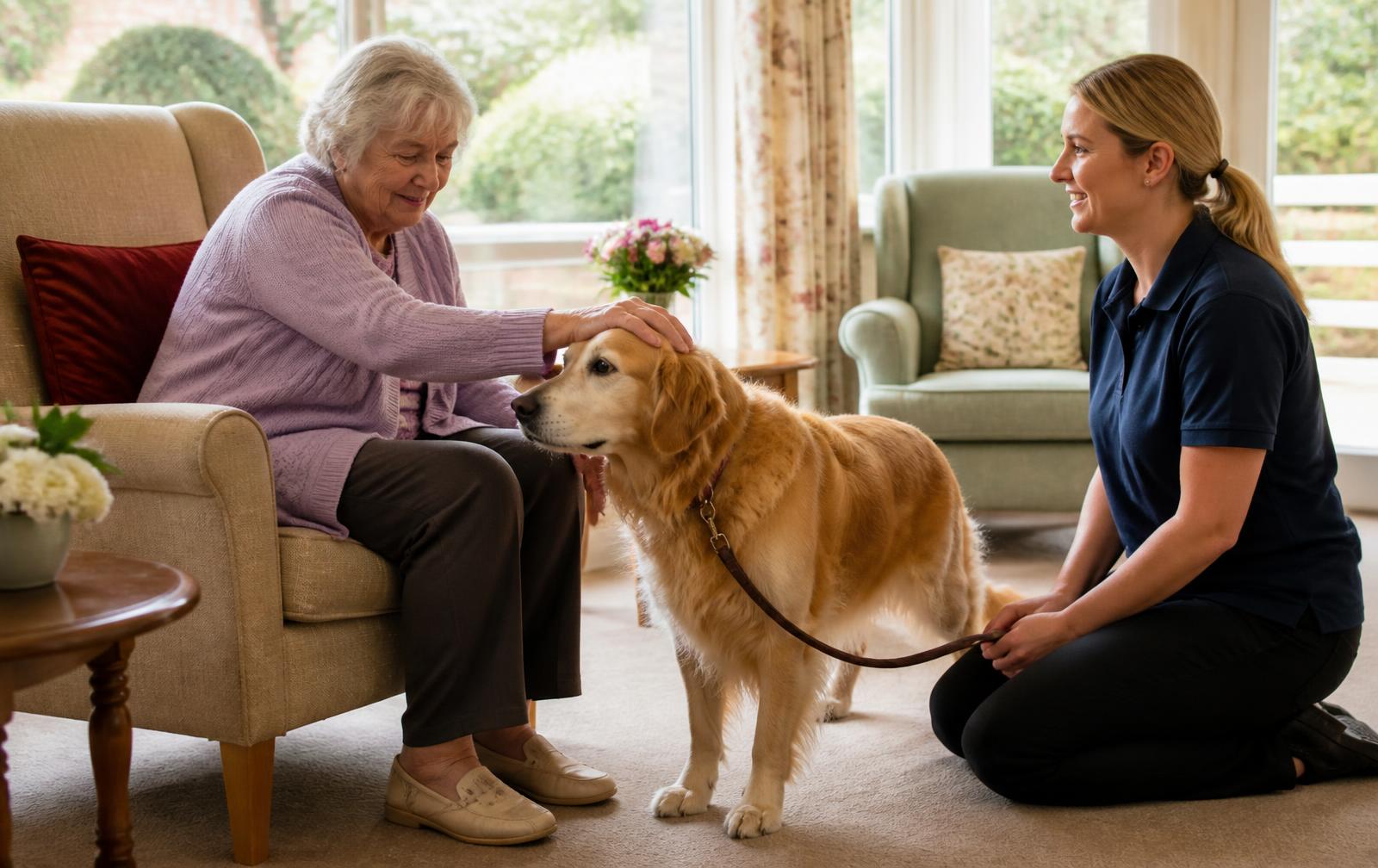
Animal-assisted therapy and visiting-animal programmes involve carefully selected animals spending time with people to support comfort, enjoyment, communication or wellbeing. Visits may take place in care homes, hospitals, hospices, mental-health services, day centres, supported housing and other supported settings.
Dogs are the most common visiting animals, although programmes may sometimes involve cats, rabbits, miniature horses, donkeys, goats or other suitable animals. The type of animal, the setting and the activity vary a great deal between providers.
This kind of support may be offered to people living with dementia, and also to some people experiencing loneliness, poor mental health, learning disabilities, serious illness or other support needs. It is not a cure, a medical treatment or a guaranteed benefit, and it is not suitable for everybody.
Different types of animal support
These terms are sometimes used loosely, so it is worth asking what is actually being offered.
- Visiting-animal or animal-assisted activity. A planned visit intended to provide companionship, enjoyment, gentle stimulation or social interaction. It may be led by a trained volunteer and is not necessarily clinical therapy.
- Animal-assisted therapy. A more structured intervention with agreed aims, normally involving an appropriately qualified health, care or therapy professional alongside a suitable animal and its handler.
- Assistance animals. Assistance dogs are specially trained to help a disabled person with everyday tasks and have particular legal access rights. They are different from visiting therapy animals.
What might happen during a visit?
Depending on the person’s wishes and abilities, and always with their agreement, they may:
- stroke or gently groom an animal
- sit quietly beside it
- talk to the handler about the animal
- remember and discuss animals they previously knew
- give an approved treat under supervision
- walk a short distance with the animal and appropriate support
- watch the animal without touching it
- choose not to take part at all
Possible benefits
A suitable, well-planned visit may:
- offer companionship and enjoyment
- encourage conversation and social interaction
- bring back positive memories
- provide gentle sensory stimulation
- help some people feel calmer or less isolated
- encourage engagement when ordinary conversation is difficult
- give a person something enjoyable to look forward to
- support confidence or a sense of connection
Experiences differ from person to person. The available research does not prove that these visits will help everyone, and some people will not want them at all.
Animal-assisted support and dementia
Familiar animals can sometimes encourage memories, conversation and non-verbal connection for a person living with dementia. Contact with an animal may open a moment of communication when words are difficult.
NICE includes animal-assisted therapy among the activities that services may consider when promoting wellbeing for people living with dementia. It should be chosen according to the person’s individual preferences, life history, abilities and needs.
A person who previously loved animals may greatly enjoy a visit. Someone who fears animals, dislikes them, or does not understand what is happening may find the same visit upsetting. If a person becomes distressed, the visit should stop and staff should follow their usual approach to managing distress.
- 982,000
people are estimated to be living with dementia in the UK.
- More than 70,800
people are estimated to be living with young-onset dementia in the UK.
- 1.4 million
people are projected to be living with dementia in the UK by 2040.
There is no reliable national figure showing how many people receive animal-assisted therapy or visiting-animal support in the UK each year. These figures describe the number of people living with dementia, one of the groups that may be offered this type of support.
Choice, consent and dignity
- Taking part must always be voluntary.
- Explain the visit in a way the person can understand.
- Watch verbal and non-verbal responses throughout the visit.
- Stop immediately if the person appears frightened, distressed, tired or uncomfortable.
- Never place an animal on somebody’s lap or bed without their agreement.
- A person must never be pressured to touch, feed or hold an animal.
- Where a person may lack capacity to decide, staff must follow the Mental Capacity Act, best-interests requirements and the organisation’s safeguarding procedures.
- A relative should not automatically be described as legally able to consent on the person’s behalf.
Safety and infection control
Before any visit is agreed, a care setting should consider:
- allergies and asthma
- fear of animals or a previous traumatic experience
- infection risks
- reduced immunity
- open wounds or fragile skin
- recent vomiting, diarrhoea or infectious illness
- risk of scratches, bites, falls or entanglement with leads
- handwashing before and after appropriate contact
- keeping animals away from food-preparation and clinical-treatment areas
- following the setting’s infection-control and risk-assessment procedures
- ensuring the animal is healthy, clean, calm and suitable for the environment
- protecting the animal from rough handling, overcrowding, stress and excessively long visits
Some hospital wards and clinical areas may not permit visiting animals at all. Local policy and the national infection prevention and control guidance always apply.
Animal welfare matters too
A reputable programme protects both the person and the animal. The animal should have:
- appropriate health and temperament checks
- a responsible handler who understands its behaviour
- suitable insurance and risk-assessment arrangements
- regular rest, water and opportunities to withdraw
- no forced interaction
- protection from stressful noise, handling or surroundings
Finding a reputable service
- Ask the care home, hospital, hospice, dementia service or day centre whether it has an approved visiting-animal programme.
- Ask who assesses the animal and the handler.
- Ask about insurance, safeguarding, infection control and risk assessments.
- Ask whether staff remain present during visits.
- Ask whether the visit is an informal wellbeing activity or a structured therapy session with agreed aims.
- Be cautious of any provider claiming that animals cure dementia or replace healthcare.
- Check any charges and cancellation terms before agreeing to a private service.
Pets As Therapy is one example of a UK organisation that arranges visits from assessed volunteers and their animals. Sixpence Support UK does not endorse, vet or guarantee any organisation, and you should make your own checks.
Questions to ask
- Do you offer visiting-animal sessions?
- Who provides and supervises them?
- Has the animal been assessed for this work?
- Is the provider insured?
- How do you obtain and record consent?
- What happens if somebody is frightened or distressed?
- How are allergies and infection risks managed?
- Can the person watch without touching?
- Is there a cost?
- Are relatives or carers allowed to attend?
Alternatives to visits from real animals
Real animals are not suitable for everyone. Alternatives may include:
- watching animals outdoors, from a window or in a garden
- animal videos or photographs
- talking about a person’s former pets
- soft, lifelike companion animals
- interactive or robotic companion pets
- supervised visits to an appropriate animal setting
Lifelike or robotic animals should be introduced respectfully. Do not deliberately mislead or infantilise a person living with dementia, and explain what the item is when the person is able to understand that information.
When to seek healthcare advice
Animal-assisted support must not delay medical assessment or replace prescribed treatment, dementia care, mental-health support or professional advice. Speak to a GP about any new or worsening health concern.
If someone’s behaviour, awareness or confusion changes suddenly, this may be delirium or another urgent health problem rather than dementia progression. Use NHS 111 online or call 111 for urgent advice, and call 999 in a life-threatening emergency.
Related pages on this site
Sources and further information
- NICE — Dementia quality statement: activities to promote wellbeing
- NICE — Dementia quality statement: managing distress
- NHS — What is dementia?
- Alzheimer’s Society — Can caring for a pet help a person with dementia?
- Alzheimer’s Society — Lifelike pets and robotic companions
- Pets As Therapy — official UK website
- NHS England — National Infection Prevention and Control Manual for England
- NHS — The Mental Capacity Act
This information is for general guidance and does not replace advice, diagnosis or treatment from a qualified healthcare professional. If you are worried about someone’s health, symptoms or care, speak to a GP, pharmacist or the care provider.
- [1] NICE. Dementia (QS184) — Quality statement 5: Activities to promote wellbeing · 2019
- [2] NICE. Dementia (QS184) — Quality statement 6: Managing distress · 2019
- [3] NHS. What is dementia? · 2025
- [4] Alzheimer's Society. Can caring for a pet help a person with dementia?
- [5] Alzheimer's Society. Robotic and lifelike pets in dementia care
- [6] Alzheimer's Society. Facts for the media about dementia
- [7] Alzheimer's Society. Young-onset dementia
- [8] Pets As Therapy. Official UK website
- [9] NHS England. National Infection Prevention and Control Manual for England (includes visiting animals)
- [10] NHS. The Mental Capacity Act and making decisions for someone else
- [11] Assistance Dogs UK. About assistance dogs
- [12] NHS. NHS 111 online
Supporting our animal and pet work
Sixpence Support UK is developing its Animal and Pet Support service. If you would like to help this work grow, you can make a voluntary donation. There is no obligation, and all of our information stays free to use.
Animal and Pet Support donations →