
Martial Arts, Boxing and Finding a Club
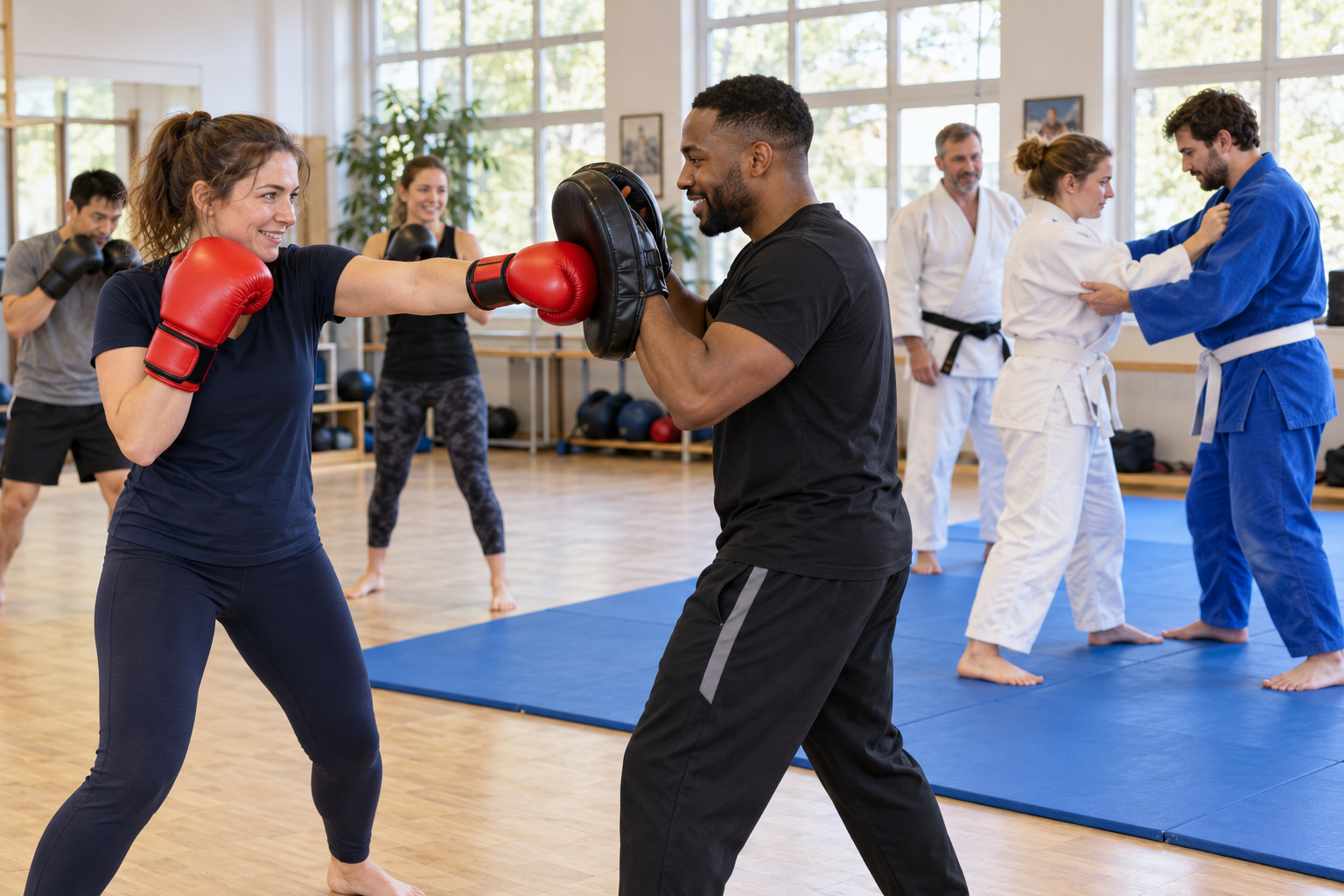
Boxing and martial arts can be enjoyed for fitness, confidence, learning a discipline, social contact or competition. This guide compares common activities and explains how to find and check a club before joining.
Last reviewed 1 October 2026
Choosing a class as a beginner
Clubs may welcome adults, children, older beginners and people returning after a long break. You do not need to arrive already fit. Tell the coach that you are new, ask how quickly the class progresses, and choose a pace you can manage.
- Ask whether there is a beginners’ class, an adults-only class or an age-appropriate children’s group.
- Ask whether fitness-only, technique-only or non-contact sessions are available.
- Check how much partner work or contact is usual and whether you can opt out.
- Ask whether competition is optional. It should never be presented as a condition of belonging.
- If you are returning after a break, explain your previous experience without assuming the new club follows the same syllabus.
Watch a session or book a trial if the club offers one. A good first class should include a clear welcome, an explanation of the session and a chance to ask questions.
Eight activities at a glance
Contact varies between activities, clubs and individual sessions. The descriptions below are broad guides, not promises about what a particular club will provide.
Comparing boxing and martial arts
Boxing
Boxing training usually includes footwork, punches, fitness work, bag work and pad work. Some classes include controlled sparring, while fitness-boxing sessions may have no person-to-person contact. Ask exactly what happens in the beginner class and whether sparring is optional.
Judo
Judo focuses on throwing, grappling, holding and learning how to fall safely through supervised breakfall practice. Beginners normally build skills gradually with partners. The amount and intensity of free practice or competition training varies by session.
Traditional jujitsu
Traditional Japanese-style jujitsu may include throws, joint controls, escapes, strikes and breakfalls, depending on the association and syllabus. You may see the name written as jujitsu, ju-jitsu or ju jitsu. Ask the club what its style covers and how beginners practise safely.
Brazilian jiu-jitsu (BJJ)
Brazilian jiu-jitsu is usually centred on ground grappling, positional control and submissions. It is distinct from traditional Japanese-style jujitsu, even though the names share a history. Classes may be in a uniform called a gi or in sports clothing for no-gi training. Controlled sparring is common, so ask how new starters are introduced and matched.
Karate
Karate commonly combines basics, set forms called kata, partner drills and some form of sparring. Styles differ considerably in their rules, pace and level of contact. Ask which style the club teaches and what contact is expected in the class you are considering.
Kickboxing
Kickboxing usually combines punches and kicks with pad, bag, fitness and partner work. Some classes are mainly fitness-based; others prepare people for controlled sparring or competition. The name alone does not tell you the contact level, so ask before booking.
Taekwondo
Taekwondo often gives particular emphasis to kicking, alongside hand techniques, patterns or forms, partner drills and sparring. Different organisations use different competition rules and grading systems. A beginner class should explain these rather than assume prior knowledge.
Mixed martial arts (MMA)
MMA combines striking and grappling skills, which may include boxing, kickboxing, wrestling and submission grappling. Beginner, fitness and competition sessions can be very different. Ask how the club separates experience levels and whether contact or sparring can be declined.
Finding a club in the UK
There is no single directory covering every discipline and every UK nation. Start with an official or established association directory, then check the individual club carefully. Affiliation is one useful check, but it is not a guarantee that a club will suit you or that every advertised detail is current.
Check the geographic scope
England Boxing and the English Karate Federation CIC are England-focused. Boxing Scotland’s page says its map is still being developed, Welsh Boxing provides a club list, and the Irish Athletic Boxing Association’s locator covers the whole island of Ireland, including Northern Ireland. The English Karate Federation describes itself as a member-focused community interest company; this page does not call it a national governing body. Kickboxing GB covers Great Britain. British and UK-named organisations may cover Great Britain or the wider UK differently. For MMA, use the IMMAF national-federations list to find the current organisation for your home nation.
Always read the directory’s own coverage and then confirm the club’s address, affiliation and current classes directly.
A practical club checklist
- Ask what coaching qualifications the lead coach holds for the specific discipline being taught.
- Ask whether the club has current insurance, first-aid arrangements and a named welfare or safeguarding contact.
- For work with children or adults at risk, ask about the criminal-record checks appropriate to the role and nation: DBS in England and Wales, PVG in Scotland, or AccessNI in Northern Ireland. A check alone does not prove that a person is suitable.
- Ask how participants are matched by age, size, experience and the nature of the exercise.
- Check that contact is explained beforehand and requires clear consent, with a straightforward way to stop.
- Look for clean, well-maintained mats and shared equipment, and ask how they are cleaned.
- Ask about a trial session, written club rules, complaints process and what happens if somebody feels unsafe.
In England, the Safeguarding Code in Martial Arts is an additional scheme you can check. It is England-specific and should not be treated as a guarantee of safety or as a substitute for your own questions.
Check the Safeguarding Code in Martial ArtsRead NSPCC Sport safeguarding guidanceQuestions for a child’s club
- Is the curriculum designed for the child’s age, and how are groups supervised?
- What are the rules on physical contact, sparring and head contact?
- How are children paired, and can a child stop or sit out without being shamed?
- What are the collection, late-pick-up and changing-room arrangements?
- What is the photography, filming and social-media policy?
- Who should a parent or child speak to about a worry?
Children and adult beginners should never be pressured into sparring or competition.
Costs, your first visit and equipment
Ask for the full cost before committing. Depending on the club, this may include:
- each session or a monthly payment;
- club or association membership, licence and insurance charges;
- gradings, courses or seminars;
- a uniform, gloves, wraps, mouthguard or other protective equipment;
- travel, entry and coaching costs for competitions; and
- notice periods, freezes or cancellation fees.
Some clubs offer concessions, family rates or loan kit, and some councils, leisure centres or community schemes support lower-cost activity. Availability is not guaranteed. Ask rather than assuming.
Before the first class
Ask what to wear, what to bring, when to arrive and whether jewellery must be removed. Introduce yourself to the coach and explain that you are new, returning after a break, or need an adjustment. Do not buy a uniform or protective kit until the club has confirmed exactly what is required and whether suitable kit can be borrowed.
Accessible and adapted sessions
Not every club can provide every adaptation, but it is reasonable to ask before travelling. Useful questions include:
- Is there step-free access from the entrance to the training area and an accessible toilet?
- Can activities be done seated, at a slower pace or without contact?
- Can the coach demonstrate in more than one way or provide written instructions?
- Can lighting, noise, group size, breaks or communication be adjusted?
- Can a support person attend, and is there any charge for them?
Explain what helps you rather than relying only on a diagnosis. Every Body Moves lists activities across Great Britain and can help you search for accessible activities, and our disability-sport guide has a fuller checklist for access, equipment and support.
A proportionate approach to safety
Activities involving contact, throws or submissions carry a risk of injury. Good coaching should introduce skills progressively, supervise partner work and explain how to stop. You should be able to decline contact, use an agreed stop signal or tap, and tell the coach when something feels wrong. Nobody should be pressured to continue through pain, spar, compete or train with a partner they do not feel comfortable with.
A club cannot guarantee that training will make somebody safe in a real-life confrontation or prevent all injuries. This page does not provide technique instruction or claim that martial arts treat a health condition.
Head injury and concussion
If somebody may have a head injury, stop the session and follow current health-service guidance for your nation. Seek urgent help for the warning signs it lists. Do not rely on a headguard as proof that concussion has been prevented.
In Wales or Northern Ireland, use your local health service’s current urgent-care guidance.
Frequently asked questions
Am I too old or unfit to begin?
Not necessarily. Clubs differ, so look for a genuine beginner, older-adult, fitness or lower-contact class and ask whether the pace can be adjusted. You do not need to become fit before asking to join.
Do I have to spar or compete?
No. Many people train for fitness, learning and company. Ask before joining because some classes are built around sparring or competition, but you should not be pressured into either.
Is traditional jujitsu the same as Brazilian jiu-jitsu?
No. Traditional Japanese-style jujitsu may combine throws, controls, strikes, escapes and breakfalls. Brazilian jiu-jitsu usually concentrates on ground grappling, positions and submissions. Exact syllabuses vary by club.
Does affiliation prove that a club is safe and suitable?
No. Affiliation can help you check a club’s connection to a wider organisation, but you should still ask about coaches, insurance, safeguarding, matching, consent, hygiene and complaints.
Should I buy equipment before a trial?
Usually it is better to wait. Ask what the club lends and what its exact rules are before buying a uniform, gloves or protective equipment.
Related guides
- [1] England Boxing. Boxing information and club finder (England) · 2026
- [2] Boxing Scotland. Find a club (Scotland) · 2026
- [3] Welsh Boxing. Clubs (Wales) · 2026
- [4] Irish Athletic Boxing Association. Club locator (all-Ireland, including Northern Ireland) · 2026
- [5] England Boxing. Boxing for fitness (England) · 2026
- [6] England Boxing. Boxing with a disability (England) · 2026
- [7] British Judo. Club finder · 2026
- [8] British Ju Jitsu Association GB. How do I start? · 2026
- [9] The Jitsu Foundation. Find a class · 2026
- [10] UK Brazilian Jiu Jitsu Association. Official website and current club-finder link · 2026
- [11] British Taekwondo. Find a club · 2026
- [12] English Karate Federation CIC. Member-focused karate organisation, not a national governing body (England) · 2026
- [13] Kickboxing GB. Club finder (Great Britain) · 2026
- [14] International Mixed Martial Arts Federation. National federations, including the UK home nations · 2026
- [15] Safeguarding Code in Martial Arts. Safeguarding scheme (England) · 2026
- [16] NSPCC Sport. Safeguarding guidance · 2026
- [17] Every Body Moves. Find accessible activities (Great Britain) · 2026
- [18] NHS. Head injury and concussion (England) · 2026
- [19] NHS inform. Concussion (Scotland) · 2026