
Disability Sport, Inclusive Clubs and Accessible Activities
A plain-English United Kingdom guide to taking part in sport, exercise, recreation and social activity as a disabled person. It explains what inclusive, adaptive and para sport can mean, the kinds of activities people may find, how to search in England, Scotland, Wales and Northern Ireland, what to ask before booking, equipment and costs, transport, reasonable adjustments, and what to do when a club says it is inclusive but access is poor.
Reviewed August 2026
Sport and activity at the level that suits you
Disabled people take part in sport, exercise, recreation and social activity at many different levels — from gentle movement and friendly social sessions through to organised competition. There is no single “right” way to take part, and no requirement to be sporty, fit or experienced before you begin.
Across the United Kingdom you will find activities where:
- no previous sporting experience is needed;
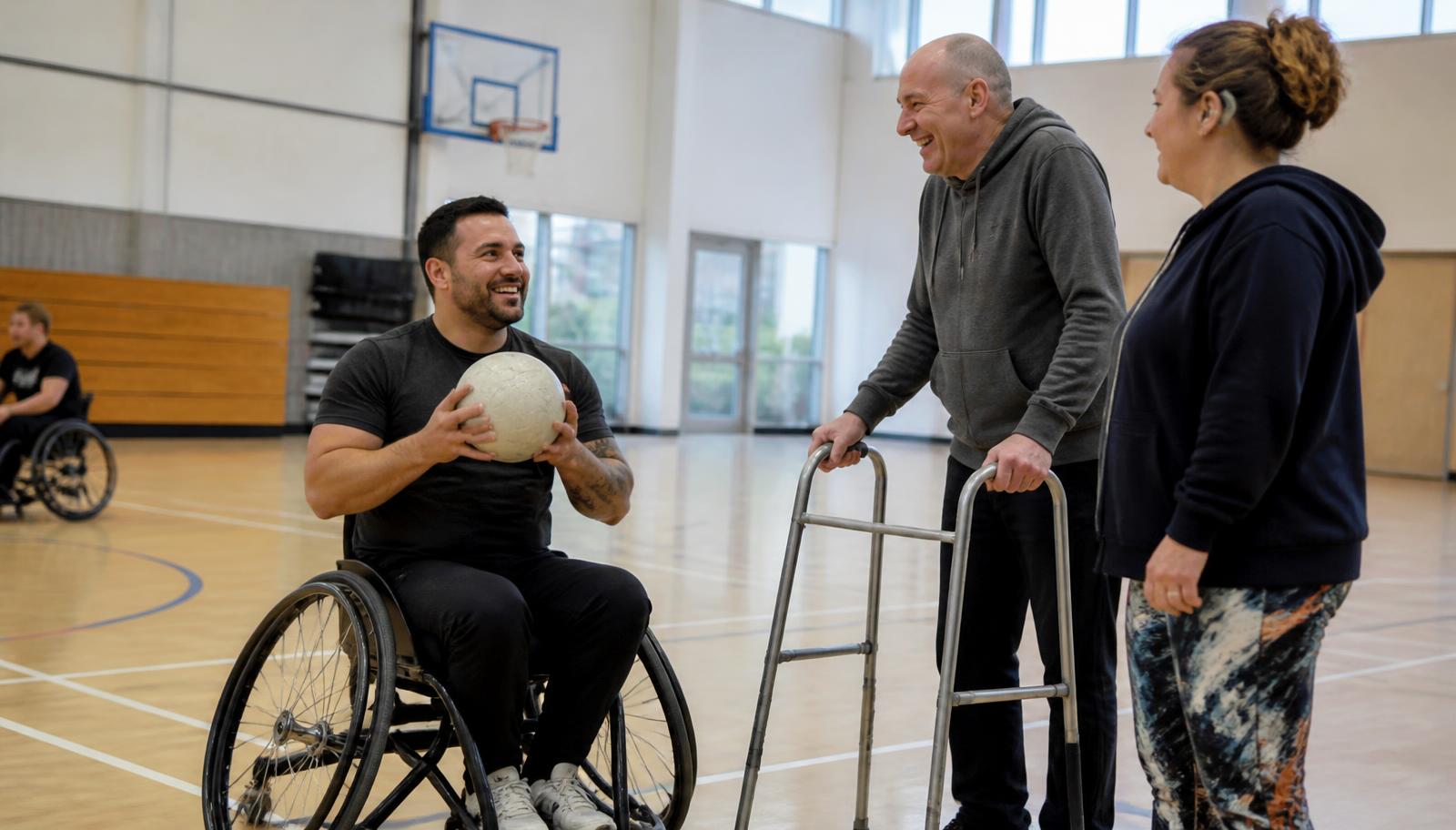
- people take part standing, seated, using a wheelchair, using a walking aid, or with adapted equipment;
- sessions may be disability-specific, or inclusive sessions where disabled and non-disabled people take part together;
- the pace, contact, noise level, session length and level of support vary enormously between clubs.
The right activity depends on the person: their interests, access requirements, health, energy levels, communication preferences and the amount of support they want. An activity that suits one disabled person may be entirely unsuitable for another, even where both people have the same diagnosis.
You are allowed to ask detailed questions before you book. Asking about steps, toilets, equipment, staff experience or costs is normal and reasonable. A good provider will welcome the questions and answer honestly, including saying when something is not available.

Accessibility can vary by location. Check directly before travelling.
This page cannot tell you whether a particular sport, venue or club is suitable or safe for you, and a club describing itself as “inclusive” is not a guarantee that it will meet your access requirements. Always check directly with the provider.
Key points
- Inclusion should mean more than simply being allowed through the door — it means being able to take part properly, safely and with dignity.
- Contact the provider before you travel. Websites and listings are often out of date.
- Ask about four things in particular: physical access, communication, equipment and the support available.
- A wheelchair user may need a sports wheelchair or other adapted equipment — but nobody should ever be pressured to transfer, or to use unfamiliar equipment they are not comfortable with.
- Carers, personal assistants and family members can sometimes attend, but arrangements and charges vary between venues and clubs.
- Start at a comfortable level. You can always build up later.
- Stop and seek appropriate help if an activity causes concerning symptoms, pain that is not usual for you, or injury.
- Being competitive is entirely optional. Enjoyment, movement, routine and meeting people are equally valid reasons to attend.
What “inclusive”, “adaptive” and “para sport” can mean
These words are used loosely, and they are descriptions rather than guarantees. It is always worth asking a provider what they actually mean by the word they have used.
Inclusive or integrated sessions
Disabled and non-disabled people take part in the same session. The activity may be adapted so everyone can join in, for example by changing the rules, the equipment, the group size or the pace. Quality varies: some inclusive sessions are thoughtfully planned, while others simply do not turn anyone away. Ask how the session is actually run and how many disabled people usually attend.
Disability-specific sessions
Sessions designed for disabled participants, sometimes for a particular group — for example wheelchair users, people with a learning disability, or Deaf participants. Some people prefer these sessions because coaching, equipment and pace are planned around disabled participants from the start. Others prefer mixed sessions. Neither choice is better than the other.
Adapted or adaptive activity
The activity, equipment or rules are changed so that a person can take part — for example seated versions of an exercise, lighter or larger balls, ramps, sound cues, shorter playing time, or handcycles and trikes instead of a two-wheeled bike. Adaptation is normal good practice, not special treatment.
Para sport
Organised, usually competitive sport for disabled athletes, with formal classification systems that group athletes by the impact of impairment on that particular sport. Classification rules are set by each sport’s international and national governing bodies and are strict. Eligibility rules for formal competition are completely different from the rules for community participation. Not being eligible for a classified competition does not stop anybody joining a community session.
Recreational versus competitive activity
Recreational activity is about taking part, moving, and enjoying company. Competitive activity involves fixtures, leagues, selection or events, and usually more commitment, travel and cost. Many clubs offer both, and you can stay recreational for as long as you wish.
Special Olympics opportunities
Special Olympics Great Britain provides year-round training and competition for people with an intellectual (learning) disability, through local and regional programmes. Eligibility criteria and the available sports vary by programme, so check with Special Olympics GB or your local group.
Deaf sport
Deaf sport is organised separately in many sports, with communication and visual signals built into how sessions and competitions run. UK Deaf Sport provides information about Deaf sport across the UK, and many hearing clubs can also make communication adjustments if asked in advance.
Visually impaired sport
Blind and partially sighted people take part in a wide range of sports, sometimes with sound-based equipment, guides, tandem partners, tactile markers or high-contrast kit. British Blind Sport provides information about available sports and local opportunities.
Activities people may find
The list below gives examples of activities that exist somewhere in the UK. It does not mean each one is available near you, and it does not mean any particular activity is suitable for any particular person or condition. Availability depends heavily on your area.
Wheelchair and powerchair sports
Wheelchair basketball, wheelchair rugby, wheelchair tennis, wheelchair badminton and powerchair sports are run by clubs in many parts of the UK. Many clubs keep a small stock of sports wheelchairs for beginners to try, but you should never assume this — always ask first. Powerchair sports have their own equipment rules, and clubs will explain what is required.
Boccia
Boccia is a precision target ball sport played seated, indoors, and is played by people with a wide range of impairments, including people who use ramps and assistants to release the ball. It is widely used as an introductory sport because equipment demands are low and sessions are usually calm.
Swimming and aquatic activities
Options may include accessible public swimming sessions, disability swimming sessions, quiet sessions, aqua-fitness classes and one-to-one coaching. Ask how you would enter the water — ramp, steps, moveable floor or hoist — and whether a hoist requires you to bring your own sling. Also ask about water temperature, accessible changing, poolside seating and how many staff are on duty.
Cycling, handcycling and adapted cycling
Inclusive cycling schemes may offer handcycles, trikes, recumbents, side-by-side cycles, tandems and wheelchair-carrying cycles, often on a traffic-free circuit with staff on hand. Sessions are frequently pay-as-you-go, and trying different cycles before buying anything is strongly advisable.
Athletics and running with support
Track and field clubs, inclusive running groups, guide runner schemes, frame running and community events of different distances exist across the UK. Ask whether a club has coaches experienced in disability athletics, whether guides are available, and whether you can walk, wheel or take part over a shorter distance.
Gym, fitness and strength activities
Many leisure centres have some accessible gym equipment and inductions, and some offer supported sessions or referral-based programmes. Ask about step-free routes between machines, transfer space, adjustable or seated equipment, staff experience, and whether an induction can be longer or repeated.
Yoga, seated exercise and gentle movement
Chair-based exercise, adapted yoga, tai chi, stretching and gentle movement classes suit people who want lower-intensity activity or who are pacing carefully. Instructors vary in experience, so ask what adaptations they routinely offer.
Dance and wheelchair dance
Inclusive dance groups, wheelchair dance and community dance projects focus on movement and expression rather than technique. Sessions are often social and can be a comfortable route back into activity.
Football and powerchair football
Options can include pan-disability football, blind and partially sighted football, Deaf football, frame football, walking football and powerchair football. Each has different rules, equipment and age groups.
Racket sports and table tennis
Table tennis, badminton, tennis and short-format racket games are widely adapted, including seated play, sound-based versions, and modified serving or scoring rules. Some sports centres run informal drop-in sessions.
Archery and bowls
Archery clubs often use supportive stands, releases and seated shooting positions. Indoor and outdoor bowls clubs may offer bowling arms, ramps and level-access rinks. Both sports tend to be sociable and low-noise.
Rowing, canoeing and sailing
Adaptive rowing (including indoor rowing), paddlesport and sailing schemes operate at some clubs and centres, with adapted seating, straps used only where agreed and appropriate, transfer support and safety cover. Water-based activities require careful planning around transfers, temperature and rescue arrangements — ask what the centre’s plan is before you attend.
Horse riding and equestrian activities
Riding for the Disabled Association groups and some riding schools offer riding, carriage driving and horse care activities with trained volunteers. Groups have their own assessment procedures, weight and safety limits, and waiting lists.
Walking, wheeling and accessible outdoor activities
Accessible trails, health walks and wheeling groups, all-terrain wheelchair or Tramper hire schemes, nature groups, fishing, gardening projects and accessible outdoor centres provide activity that is sociable and often free or low-cost. Check surface type, gradient, distance, rest points, toilets and what happens in poor weather.
Online or home-based activity
Online classes, recorded seated workouts, virtual clubs and home programmes can be useful when travel is difficult, energy is limited or you would rather start privately. They can also complement, rather than replace, meeting people in person.
Finding a suitable club or activity
There is no single national list. Most people find something by combining several of these routes:
- Postcode-based activity finders run by national disability sport organisations.
- Your local council’s leisure or sports-development team, which often knows about sessions that are never listed online.
- Local leisure centres and pools — ask at reception or for the inclusion or activity coordinator.
- National governing bodies for individual sports, which usually hold a club list and can say which clubs run disability or inclusive sessions.
- Disability organisations and condition-specific charities, including local branches and peer groups.
- Schools, colleges and adult social-care services, including day services and supported living teams.
- Occupational therapists, physiotherapists or rehabilitation teams, where you are already under their care and activity is relevant to your goals.
- Local community groups and accessible outdoor organisations, community centres, libraries and social-media community pages.
Online listings go out of date quickly. Sessions move, change day, close, become full or change their eligibility. Always confirm dates, times, costs, eligibility and access directly with the provider before you travel.
Four-nation starting points
Sport and leisure are organised differently in each UK nation. Use the organisation that covers where you live.
England and UK-wide
Every Body Moves lists accessible activities by area and activity type. WheelPower provides information for wheelchair users, including a “Find a Sport or Activity” route. Activity Alliance works nationally on inclusive activity and produces guidance for providers and participants. The relevant sport’s national governing body can point you to affiliated clubs, and your council’s leisure service knows local sessions.
Scotland
Scottish Disability Sport is the national body for disability sport in Scotland. Its regional branch directory lists the branch covering your area, which can advise on local clubs and sessions. sportscotland and your local authority leisure service can also help.
Wales
Disability Sport Wales works with clubs and local authorities across Wales, and its “Join In” finder lets you search insport clubs and sessions by postcode. Local authority sports-development services in Wales also run and support inclusive sessions.
Northern Ireland
Disability Sport NI is the lead organisation for disability sport in Northern Ireland, and its “Find an Opportunity” route lists clubs and sessions. Northern Ireland’s eleven councils run leisure services and can advise on accessible facilities locally.
Each organisation covers its own nation unless its official website states otherwise. Do not assume that a service for one nation will be able to help with clubs in another.
Questions to ask before you book
Not every point matters to every person, and you do not need to tick them all. Choose the questions that matter to you and ask them in one message or phone call.
- Is the entrance step-free?
- Is there a lift where one is needed?
- Are doorways and activity spaces wide enough?
- Is accessible parking available, and does it have to be booked?
- Is there an accessible toilet?
- Is there a Changing Places toilet at the venue or nearby?
- Are accessible changing facilities, benches or hoists available?
- Do I need to bring my own sling?
- If there is a pool, is access by ramp, steps or hoist?
- Is adapted equipment provided, or must I bring my own?
- Can I stay in my own wheelchair?
- Is assistance available with equipment?
- Can a carer, personal assistant or family member attend?
- Is there a charge for the person accompanying me?
- Is there a quiet space or somewhere to rest?
- What is the noise and lighting like during the session?
- Can instructions be given slowly, visually, in writing, in Easy Read or using British Sign Language?
- What experience does the coach have with disabled participants?
- Can I visit or watch a session before joining?
- What happens if I need to cancel at short notice because of my health?
If a provider cannot answer a question, that is useful information too. It is reasonable to ask who else you can speak to.
Plan your first visit
- Contact the club or venue first, by phone, email or their contact form.
- Explain only the access information needed to arrange the session. You do not have to share your full medical history.
- Confirm the address, which entrance to use, and where accessible parking is.
- Ask what clothing, footwear or equipment you need to bring.
- Ask whether medication, food, drink or personal equipment can be kept beside you or somewhere secure and close by.
- Arrange transport there and back before you commit to the session.
- Consider going with a trusted person the first time.
- Allow time to rest before and after — the journey counts as part of the effort.
- Save the provider’s phone number and email in case plans change on the day.
- Have a backup plan if the venue turns out to be inaccessible: know how you would get home, and who you would contact.
Wheelchairs and adapted equipment
Everyday wheelchairs and sports wheelchairs are built for different jobs. An everyday chair is designed for daily mobility, comfort and transport; a sports chair is designed for a specific sport and may have angled wheels, different seating and different stability. Using a sports chair is not compulsory, and many activities can be done in your own chair.
- Some clubs lend equipment for beginners; many do not. Always ask before you attend.
- Suitability, transfers, seating, straps and positioning should be discussed with competent staff who know both the sport and the equipment.
- Nobody should be lifted, transferred or strapped into equipment without their agreement and an appropriate, safe plan. You can say no, or ask to try something differently.
- Powered-wheelchair users should ask about powerchair-friendly activities, the space available, floor surfaces, charging arrangements and any equipment rules, including footguards or speed limits used in some sports.
- Do not buy expensive specialist equipment before trying the activity and getting suitable advice. Second-hand equipment, club loans and taster sessions are usually a better first step.
This page deliberately does not give technical instructions for modifying wheelchairs or equipment. Talk to the club, the equipment supplier or your wheelchair service.
Health, medicines, pacing and fatigue
Most people can be active in some way, but some people need individual advice before starting or changing activity — particularly after surgery, a new injury or a new diagnosis, or where symptoms are unstable or changing. If you are unsure, speak to your GP, consultant, physiotherapist or specialist nurse. This page is general information and cannot advise on your own condition.
- Pacing. Build up gradually. A short first session that goes well is better than a long one that sets you back.
- Pain. Some effort is normal; sharp, new or worsening pain is a reason to stop and take advice.
- Fatigue and post-exertional symptom worsening. Some conditions cause symptoms to worsen hours or days after activity. If that applies to you, plan smaller amounts and allow recovery time.
- Breathlessness. Know what is usual for you, and what is not.
- Temperature regulation. Some people cannot regulate temperature well. Ask about hall temperature, ventilation, water temperature and shaded or cool areas.
- Pressure care. Check seating, cushions and skin, and plan pressure relief during longer sessions.
- Hydration. Keep drinks within reach, and factor in toilet access when planning fluids.
- Seizures. Tell staff what to do and what not to do, and agree this before the session starts.
- Diabetes. Plan monitoring, food and timing around activity, and keep what you need nearby.
- Allergies. Tell organisers about serious allergies and where your emergency medication is kept.
- Medication timing. Some people function better at particular times of day; choose session times that fit.
- Emergency medication. Carry any emergency medication you have been prescribed, and make sure someone present knows where it is.
Sixpence Support UK does not give doses, and nothing here should be used as a reason to stop, start or change any prescribed medicine.
Serious injury or medical emergency
Call 999 immediately for a life-threatening emergency, including if someone:
- is unconscious or cannot be woken;
- is not breathing, or is not breathing normally;
- has a suspected serious injury, such as a head, neck, back or bone injury;
- has severe bleeding that will not stop;
- has signs of a heart attack, stroke or severe allergic reaction (anaphylaxis);
- has a seizure that is unusually long, repeated, or does not stop.
Follow the 999 call handler’s instructions and do not move a person with a suspected spinal or serious head injury unless they are in immediate danger. For urgent but non-emergency health advice, use NHS 111 (111 in Scotland, Wales and Northern Ireland).
Children and young people
- Age and eligibility. Clubs set minimum ages and age bands. Ask what happens when a young person moves between groups.
- Parent and carer involvement. Ask whether parents or carers stay, watch or wait elsewhere, and what happens at drop-off and collection.
- School and college opportunities. PE, extra-curricular clubs, school games, and links between schools and community clubs.
- Safeguarding. Every club working with children should have a safeguarding policy, a named safeguarding lead and a way to raise concerns.
- Trained and checked staff. Ask about coach qualifications, safeguarding training and criminal record checks (DBS in England and Wales, PVG in Scotland, AccessNI in Northern Ireland).
- Supervision ratios and who provides personal care, if any is needed.
- Changing arrangements, privacy and whether a family or accessible changing room is available.
- Transport to and from sessions, including school or council transport where relevant.
- Communication needs — visual instructions, short steps, demonstrations and a familiar adult.
- Trial sessions before paying membership.
- The young person’s own preferences and consent. Their views about the activity, the group and any support they receive should be listened to.
Learning disabilities and communication support
Small, practical adjustments often make the difference between an activity working and not working. It is reasonable to ask for:
- Easy Read information about the session, the venue and the cost;
- demonstrations rather than long verbal explanations;
- pictures, photographs or a visual schedule of what happens;
- short, clear instructions given one step at a time;
- extra processing time before a response is expected;
- predictable routines, so each session runs in a similar order;
- repetition without embarrassment or comment;
- a familiar supporter attending, at least at first;
- smaller groups or a quieter session time;
- a pre-visit to see the space before taking part;
- changes explained in advance, including a different coach or a different room.
Adults with a learning disability are adults. Information, choices and consent should be offered to them directly, in a format they can use, and staff should speak to them rather than only to a supporter.
Autistic and neurodivergent participants
Autistic and neurodivergent people have very different preferences, and some of the following will matter a great deal while others will not matter at all. Ask the person what helps.
- Sensory environment: noise, echo in a sports hall, lighting, smells, flooring and crowding.
- Communication preferences, including written information and time to reply.
- Uncertainty — knowing exactly what will happen, and for how long.
- Busy changing rooms and whether there is an alternative.
- Waiting time, queues and unstructured gaps in a session.
- A quiet space to use if needed, and permission to use it without explanation.
- A predictable session structure, with the same warm-up and finish each week.
- Advance notice of any change, including cancellations and new staff.
Deaf people and people with hearing loss
- British Sign Language interpretation or other communication support, arranged in advance.
- Written instructions, session plans or notes on a whiteboard.
- Captions on any video used in coaching or induction.
- Visual starting signals — a flag, a hand signal or a light rather than a whistle only.
- Coaches facing the participant when speaking, and not covering their mouth.
- Hearing-loop availability at reception and in meeting spaces.
- Emergency procedures that do not rely on sound alone, including how a fire alarm would be communicated.
Blind and partially sighted people
- Orientation to the venue on arrival, including the route to toilets and exits.
- Clear verbal descriptions of the space, equipment and what is about to happen.
- Guides, sighted-guide arrangements or a regular partner where the activity needs one.
- Good contrast and lighting, and reducing glare where possible.
- Guide dogs — where the dog can be during the session, and who is responsible.
- Tactile markers, textured surfaces or sound cues.
- Safe storage for belongings and routes kept clear of obstructions and trailing equipment.
- Asking the individual what assistance they would like, rather than assuming — and not taking hold of a person or their cane without asking.
Carers, personal assistants and companions
Arrangements vary widely between venues, clubs and local authorities, so check before the first visit. Useful things to clarify:
- whether the accompanying person needs to be booked in;
- whether there is an entry or session charge for them;
- whether they are expected to take part, to support, or simply to wait;
- changing facilities for a supporter of a different gender;
- who does any lifting or personal care, and what the club will and will not do;
- emergency contact details and who holds them;
- confidentiality and dignity, including where personal care takes place;
- staff speaking to the disabled person directly, not over them;
- whether support during the activity is the club’s responsibility, or must be provided by the participant.
Costs and practical help
Costs differ enormously. Possible costs include:
- membership or joining fees;
- per-session or block-booking fees;
- equipment hire;
- competition entry and affiliation fees;
- transport to and from sessions;
- specialist clothing or footwear;
- charges for an accompanying person.
It is always worth asking about:
- free or discounted trial sessions;
- concessions, including for people on certain benefits;
- free community sessions run by councils or charities;
- equipment loan schemes;
- payment plans or monthly membership instead of an annual fee;
- local grants or hardship funds, where a club or council operates one;
- exercise referral or supported-activity schemes;
- whether a carer or personal assistant can attend free of charge.
Sixpence Support UK cannot promise that funding exists in your area, and no scheme mentioned here is guaranteed. Ask the club, the leisure operator and your council what they currently offer.
Transport and getting there
- Accessible public transport, including step-free stations and stops, and booking assistance.
- Community transport and dial-a-ride schemes run by councils and charities.
- Taxis and private hire vehicles, including wheelchair-accessible vehicles, booked in advance.
- Blue Badge parking, and whether the venue has designated bays.
- Drop-off points close to the entrance.
- The route from the bus stop, station or car park to the entrance — surface, distance and gradient.
- Travelling with sports or mobility equipment, and whether it will fit.
- Booking assistance where the operator offers it, and how far in advance.
- The return journey, especially late in the evening or on Sundays.
Reasonable adjustments and discrimination
This section is general information written in plain English. It is not legal advice, and the law differs between Great Britain and Northern Ireland.
England, Scotland and Wales (Great Britain)
- Clubs, leisure centres and other service providers may have duties under the Equality Act 2010, which can include making reasonable adjustments for disabled people.
- What counts as reasonable depends on the circumstances — the size and resources of the organisation, the practicality of the change, and the barrier being removed.
- An adjustment is not automatically unreasonable simply because it needs planning, notice or a small cost.
- You can ask in writing. Explain the barrier clearly, and say what change you think would help. A written request also creates a record.
Northern Ireland
The Equality Act 2010 does not apply in Northern Ireland. Disability discrimination in Northern Ireland is covered by separate Northern Ireland legislation, and the Equality Commission for Northern Ireland provides current advice and can explain what duties service providers have there.
Two messages you can copy
Asking about access before booking
“Hello. I am interested in attending your activity. Before I book, please could you confirm whether the venue and session can meet the following access requirements: [briefly list them]. Please also tell me who I can contact if I need to discuss the arrangements.”
Requesting an adjustment
“Hello. I would like to take part in your activity, but I am currently prevented from doing so because [explain the barrier]. A possible adjustment would be [explain what may help]. Please let me know whether this can be arranged or whether we can discuss another suitable option.”
If a club says it is inclusive but access is poor
This happens, and it is disappointing rather than your fault. Practical steps that tend to work best:
- Record what was advertised — take a screenshot or save the page.
- Note what actually happened, with dates, times and names where you have them.
- Keep booking confirmations, emails and messages.
- Raise the issue calmly with the organiser or venue manager first. Many problems are fixed here.
- Explain the barrier plainly and say what outcome you are asking for.
- Request a written response, and a date by which you will hear back.
- Use the organisation’s formal complaints process if the first conversation does not resolve it.
- Escalate where appropriate to the sport’s national governing body, the council, or the leisure-service operator that runs the building.
- Seek independent equality advice if the problem continues.
Keep communication factual and polite. Abusive or threatening messages make it harder to get the outcome you want, and can end a complaint early.
Volunteering, coaching and officiating
Disabled people are not only participants. Clubs need volunteers, coaches, officials, organisers, committee members, welfare officers and social organisers, and disabled people do all of these roles.
- Reasonable adjustments apply to volunteering and training as well as to taking part.
- Ask whether coaching courses and qualifications are delivered accessibly.
- Ask what support the club offers to new volunteers, and what time commitment is realistic.
- Do not assume that a disabled person only wants to be an athlete — and do not assume they only want a non-playing role either. Ask.
Returning after illness, injury or a long break
Coming back after a long gap is common and nothing to apologise for. A gradual return usually works best:
- Start with a trial or taster session rather than committing to a season.
- Reduce the length or intensity of your first few sessions.
- Plan rest before and after, especially if travel is tiring.
- Review your access needs — they may have changed since you were last active.
- Get appropriate professional advice where you have had surgery, a new injury, a new diagnosis or unstable symptoms.
- Expect progress to be uneven. Missing a week is not failure.
This page does not set exercise targets and cannot predict how any activity will affect your health or condition.
Comprehensive planning checklist
Work through the points below before your first session. This is a planning tool to help you organise questions and arrangements. It is not a medical assessment and it is not an eligibility test.
- Preferred activity — what you actually want to do, not what you feel you should do.
- Location — how far you are willing and able to travel.
- Eligibility — age, any classification or membership rules, and whether a referral is needed.
- Access — step-free entrance, lifts, doorway widths and space in the activity area.
- Toilets and changing — accessible toilet, Changing Places, benches, hoists and privacy.
- Equipment — what is provided, what you must bring, and whether you can use your own chair.
- Communication — BSL, written instructions, Easy Read, demonstrations and processing time.
- Sensory needs — noise, lighting, crowding and a quiet space.
- Rest — breaks during the session and somewhere to sit out.
- Support person — whether they can attend, any charge, and what they will do.
- Coaching — experience with disabled participants, qualifications and group size.
- Costs — membership, sessions, hire, competitions and companion charges.
- Transport — the journey there and back, parking, assistance and equipment.
- Health planning — pacing, medication timing, food, hydration and pressure care.
- Emergency arrangements — first aid cover, what staff should do, and your emergency contact.
- Safeguarding — policy, named lead and staff checks, especially for children and adults at risk.
- Trial visit — a chance to watch or try before committing.
- Cancellation — what happens if your health means you cannot attend.
- Contact details — a named person, phone number and email saved on your phone.
- Feedback or complaints — how to raise a problem and who deals with it.
Verified official and national organisations
Find an activity
Nation-specific organisations
Sport-specific and specialist organisations
Rights, safeguarding and health
Related pages on this website
Sixpence Support UK is an information and signposting service. It cannot book activities for you, assess whether a venue or club is accessible or safe for you, provide medical care, or offer emergency assistance. Call 999 in a life-threatening emergency.
Please check details with the provider
This page gives general information only and is not medical, legal or safeguarding advice. Sessions, costs, eligibility, facilities and organisations change, and the law differs between Great Britain and Northern Ireland. Always confirm current details directly with the club, venue or organisation, and take individual advice about your own health where that is needed.
Reviewed August 2026.
- [1] Every Body Moves (ParalympicsGB / Toyota). Find accessible activities near you · 2026
- [2] WheelPower. Find a sport or activity · 2026
- [3] Activity Alliance. Activity Alliance — inclusive activity for disabled people · 2026
- [4] Sport England. Sport England · 2026
- [5] Scottish Disability Sport. Branches directory · 2026
- [6] sportscotland. sportscotland — the national agency for sport · 2026
- [7] Disability Sport Wales. Join In — clubs and sessions · 2026
- [8] Disability Sport NI. Disability Sport NI — find an opportunity · 2026
- [9] Special Olympics Great Britain. Special Olympics GB · 2026
- [10] UK Deaf Sport. UK Deaf Sport · 2026
- [11] British Blind Sport. British Blind Sport · 2026
- [12] ParalympicsGB. ParalympicsGB · 2026
- [13] Riding for the Disabled Association. RDA — find your local group · 2026
- [14] Wheels for Wellbeing. Inclusive cycling information · 2026
- [15] NSPCC Child Protection in Sport Unit. Safeguarding in sport · 2026
- [16] NHS. Physical activity guidelines for adults aged 19 to 64 · 2026
- [17] NHS. Exercise — Live Well · 2026
- [18] Equality Advisory and Support Service. Equality advice for England, Scotland and Wales · 2026
- [19] Equality and Human Rights Commission. Disability discrimination and the Equality Act 2010 · 2026
- [20] Equality Commission for Northern Ireland. Disability discrimination law in Northern Ireland · 2026
- [21] nidirect (Northern Ireland Government). Disabled people — information and services · 2026
- [22] GOV.UK. Apply for a Blue Badge · 2026
- [23] Changing Places. Find a Changing Places toilet · 2026
- [24] GOV.UK. Find your local council · 2026
References checked against the official sources listed above in August 2026.