
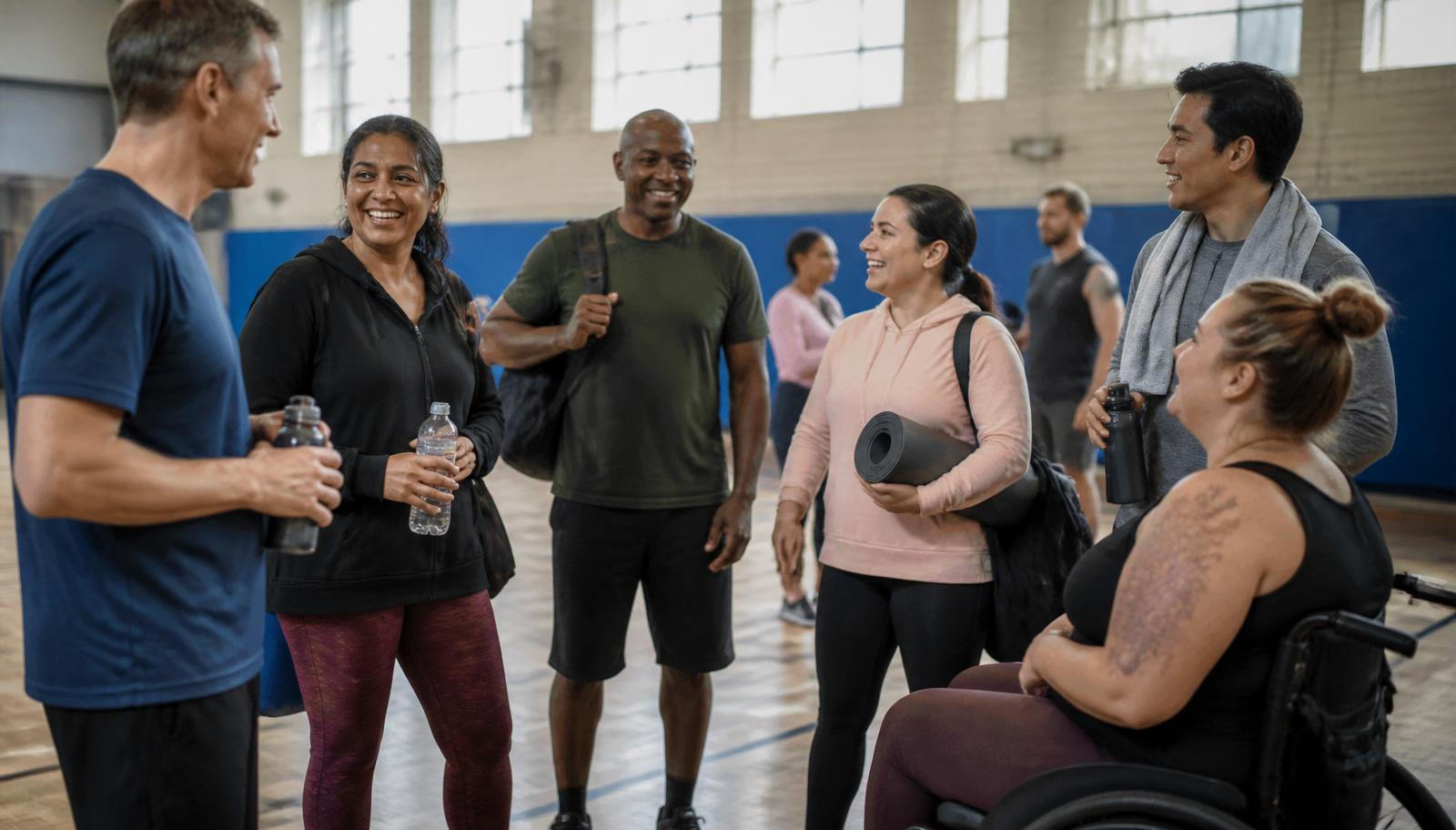
Sports, Leisure & Wellbeing Facilities
A plain-English guide to finding sports, swimming, leisure and wellbeing facilities near you — including accessible sessions, hydrotherapy, physiotherapy and sports massage, with honest information on costs, safety and what to ask before you go.
- 63.7%
of adults in England (30.0 million) did an average of 150 minutes or more of physical activity a week in 2023–24.
Source: Sport England, Active Lives Adult Survey November 2023–24
- 25.1%
of adults in England (11.8 million) were inactive, doing less than an average of 30 minutes a week.
Source: Sport England, Active Lives Adult Survey November 2023–24
Getting startedFinding facilities near you
Most towns and cities across the UK have a mix of council-run and privately-owned facilities that welcome members of the public. These usually include:
- Council and private leisure centres — sports halls, fitness suites and multi-use spaces.
- Gyms and exercise classes — from beginners' classes to strength training and dance.
- Swimming pools and accessible swimming sessions — including lane swimming, family swim and disability-friendly sessions.
- Saunas, steam rooms and wet facilities — often part of a wider leisure centre.
- Hydrotherapy pools — warm-water pools sometimes offered through the NHS or specialist providers.
- Physiotherapy and rehabilitation services — available through the NHS and privately.
- Sports massage — offered by qualified therapists to support recovery and comfort.
- Activities for older and disabled people — including chair-based exercise, walking groups, seated yoga and adapted sports.
A good starting point is the NHS pages on staying active, which describe safe ways to get moving at any age or fitness level.[1]NHS[2]NHS guidelines
Searching locallyHow to search for what's near you
You can find local facilities in a few ways:
- Your local council website — most councils list their leisure centres, pools, exercise classes and community wellbeing services. You can find your council on GOV.UK.[4]GOV.UK
- The NHS website — has service finders for physiotherapy and information about staying active safely.[9]NHS physiotherapy
- Swim England — offers a pool finder and information about accessible swimming sessions.[6]Swim England
- Activity Alliance — supports disabled people to be active and lists inclusive local opportunities.[5]Activity Alliance
- Trusted local directories — many areas have community wellbeing directories run by the NHS, local charities or community hubs.
You can also use our free list of NHS service finders to get started — choose a service, then enter your postcode or location on the official NHS website.
AccessibilityMaking sure a facility is right for you
Facilities vary a lot in how accessible they are. Before travelling, it is worth checking:
- Accessible entrances and equipment — step-free access, lifts, and adapted gym equipment.
- Pool hoists — for people who need help getting in and out of the water.
- Accessible changing rooms and toilets — including Changing Places facilities where available.
- Quiet or disability-friendly sessions — lower noise, reduced lighting, or smaller groups.
- Carer or personal assistant access — some centres allow a carer to attend free of charge with the right paperwork.
We strongly recommend contacting the facility before you travel to check what is available on the day you want to go. Activity Alliance has helpful resources on inclusive activity across the UK.[5]Activity Alliance
Costs and financial help
Prices and support vary widely between areas. Options can include:
- Council concessionary memberships — reduced-price access for local residents.
- Reduced prices for disabled people, older people, carers and people receiving certain benefits.
- Free trials or community sessions — for people trying an activity for the first time.
- Exercise-referral schemes — some GPs, NHS services and councils can refer people with certain health conditions to a supported programme at a local leisure centre.[3]NHS
Availability and eligibility differ between areas, so always check with your council or GP surgery. Some disabled people also find it helpful to look at wider concessions such as the Blue Badge and Disabled Persons Railcard when planning travel.[10]GOV.UK
Physiotherapy and sports massage
These sound similar but are different services:
- NHS physiotherapy — free at the point of use, usually accessed through your GP or self-referral where available. It focuses on assessing and treating movement problems, injuries and long-term conditions.[9]NHS physiotherapy
- Private physiotherapy — a paid service, sometimes with shorter waiting times. Registered physiotherapists in the UK must be on the HCPC register.[7]CSP[8]HCPC
- Sports massage — a soft-tissue therapy that can support recovery, ease muscle tension and help general wellbeing. Sports massage therapists are not statutorily regulated in the UK, so it is sensible to check qualifications, professional membership and insurance.
Always check the provider's qualifications, professional registration where relevant, prices and cancellation terms before booking. Sports massage is a supportive therapy — it does not replace medical treatment, diagnosis or physiotherapy for injury or illness.
EquipmentPower Plates and vibration training
A Power Plate is a type of vibration platform. You stand, sit or exercise on the platform while it produces rapid vibrations. This is often called whole-body vibration training.
Some research suggests that supervised vibration training may help improve muscle strength, balance, mobility and physical function, particularly in some older adults. However, results vary and it should not be presented as a guaranteed treatment, a quick way to lose weight or a replacement for walking, strengthening exercises or other suitable physical activity.
Using a vibration plate safely
- Begin with a low setting and a short session.
- Follow the machine's safety instructions.
- Use a stable support if you have difficulty balancing.
- Stop if you feel pain, dizziness, numbness or unwell.
- Ask a physiotherapist, GP or another qualified healthcare professional before using one if you are pregnant, have an implanted medical device, have recently had surgery or an injury, or have a medical condition that could be affected by vibration.
A gym instructor can explain how to use the equipment, but they should not diagnose a condition or claim that vibration training will cure a health problem.
Questions to ask before attending
- Is the building and equipment accessible to me?
- What does membership include, and what is not covered?
- Are there additional charges for classes, lockers or wet facilities?
- Is help available for beginners, or a first session with staff?
- Are staff appropriately trained, and is any qualification checked?
- Can I visit or have a tour before joining?
- Is there a concessionary rate, and what proof is needed?
- Can a carer or personal assistant come with me?
Safety information
Exercise, swimming, saunas, steam rooms, hydrotherapy and massage are safe for most people, but they are not suitable for everyone.
Please seek suitable professional advice before using these services if you:
- are pregnant;
- are unwell or recovering from an illness or operation;
- have a heart condition or chest pain;
- have breathing difficulties, such as asthma or COPD;
- have uncontrolled high blood pressure;
- have a recent injury, wound or skin condition;
- have any other medical concern you are unsure about.
If you are ever in doubt, speak to your GP or NHS 111 before starting a new activity. In an emergency, always call 999.
This page provides general information and does not replace professional medical advice, diagnosis or treatment.
Sources and further information
- [1] NHS. Exercise — benefits, guidelines and getting started · 2024
- [2] NHS. Physical activity guidelines for adults aged 19 to 64 · 2024
- [3] NHS. Exercise referral schemes · 2024
- [4] GOV.UK. Find your local council · 2024
- [5] Activity Alliance. Inclusive activity — resources and local support · 2024
- [6] Swim England. Find a pool and accessible swimming · 2024
- [7] Chartered Society of Physiotherapy (CSP). Find a physiotherapist · 2024
- [8] Health and Care Professions Council (HCPC). Check the Register (physiotherapists) · 2024
- [9] NHS. Physiotherapy — how to get it · 2024
- [10] GOV.UK. Disabled Persons Railcard, Blue Badge and local concessions · 2024