
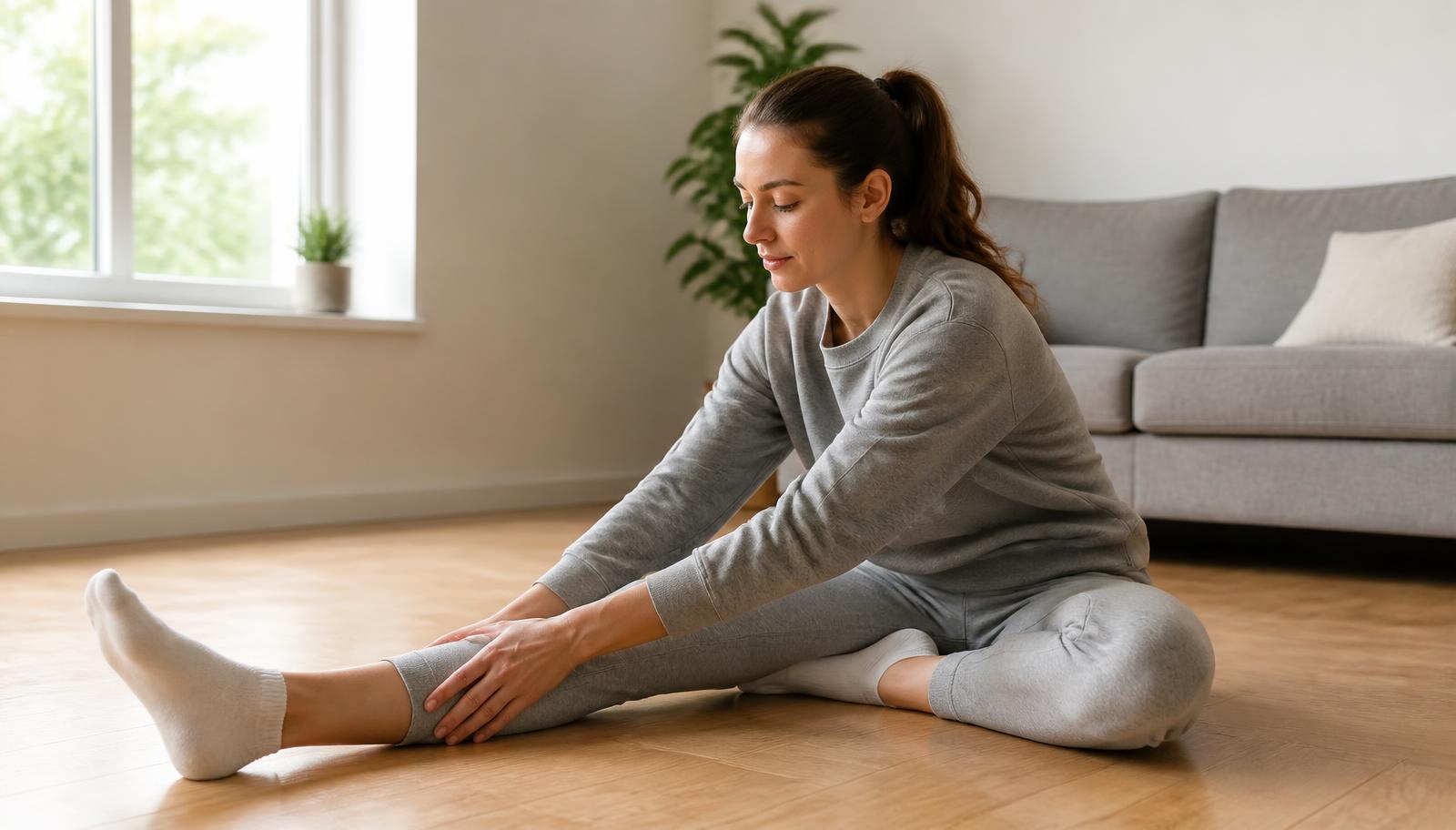
Muscle Cramps: Causes, Relief and When to Get Help
A plain-English United Kingdom guide to muscle cramps — what a cramp is, what can bring one on, what may help while it is happening, how to reduce night-time leg cramps, and the warning signs that need medical help.
What a muscle cramp is
A muscle cramp is a sudden, painful tightening of a muscle that the person cannot immediately control. The muscle squeezes on its own and will not let go for a few seconds or a few minutes.
Cramps most commonly affect the calf, but they can also affect the feet, thighs, hands or other muscles in the body.
They often happen at night or while resting, which is why many people first notice them in bed. The muscle may stay sore or tender for some time after the cramp itself has stopped.
Muscle cramps are very common and are usually harmless. This page is about cramp in the muscles of the limbs and body — it is not about period pain, stomach cramps or abdominal pain, which are different problems and need separate advice.
This page gives general information only. Sixpence Support UK cannot identify the cause of anyone's cramps and does not give personalised medical advice.
Call 999 if leg pain or swelling comes with chest pain or breathlessness
Call 999 or go to A&E immediately if pain or swelling in a leg happens together with:
- chest pain, or pain that is worse when breathing in
- breathlessness or sudden difficulty breathing
- coughing up blood, or feeling faint or collapsing
This combination can be a sign of a blood clot on the lung, which is a medical emergency. Do not wait to see whether it settles.
Blood clots: when leg pain is not ordinary cramp
Ordinary muscle cramp is common and usually short-lived. However, unexplained pain, throbbing or aching in one leg — especially in the calf or thigh — together with any of the following may be a sign of deep vein thrombosis (DVT), a blood clot in a deep vein, rather than cramp:
- swelling in one leg, ankle or foot
- warmth, tenderness or hardness in the affected area
- a change in skin colour, which may be harder to see on brown or black skin
- pain that came on without an obvious cause and does not ease like a cramp does
If DVT is suspected, ask for an urgent GP appointment or contact NHS 111 straight away.
Please keep this in proportion. A short cramp that grips the muscle and then eases, leaving the muscle a little sore, is not usually a blood clot. The concern is one-sided leg pain that is unexplained and comes with swelling, warmth or a colour change.
1. Common causes and contributing factors
Things that can bring on or contribute to muscle cramps include:
- muscle strain or overuse
- exercise, particularly in hot or humid conditions
- not drinking enough fluid
- pregnancy
- ageing
- sitting or staying in one position for a long time
- some medicines, including certain statins and diuretics (water tablets)
- some medical conditions, including problems affecting circulation, nerves, the thyroid, the liver or the kidneys
Very often no clear cause is found at all. Cramps can happen in people who are perfectly well, and not finding a reason does not mean something has been missed.
Please be careful with claims you may read elsewhere. It is not true that every cramp is caused by a vitamin, salt or mineral deficiency. Supplements are not a general answer to cramp, and taking them without advice can cause harm.
2. What may help during a cramp
While a cramp is happening, these steps may help:
- Stop the activity safely. If you are walking, cycling, swimming or driving, come to a safe stop first.
- Gently stretch the affected muscle, and massage it with your hand.
- For a calf cramp, straightening the leg and gently drawing the toes up towards the shin may help, if you can do that safely and without force.
- Standing up and carefully placing weight on the affected leg helps some people — only do this if you feel steady and have something to hold on to.
- Some people find warmth on the muscle, or a warm bath or shower, soothing afterwards.
Do not force a stretch, and do not push on through severe pain or keep exercising while a muscle is cramping. Forcing it can strain or tear the muscle.
The muscle may ache for a while afterwards. Gentle movement is usually better than staying completely still, unless it is painful to move.
3. Reducing recurring cramps
If cramps keep coming back, these general steps may reduce how often they happen:
- Regular gentle calf stretching — little and often, rather than one hard stretch.
- Warming up and cooling down properly around exercise.
- Avoiding sudden increases in strenuous activity — build up gradually instead.
- Drinking enough fluid, especially in hot weather or when active — where that is medically appropriate for you.
- Suitable, supportive footwear that fits properly.
- Reviewing exercise technique where relevant, for example with a coach, physiotherapist or gym instructor.
- Moving position or standing up regularly if you sit still for long periods.
Important: some people have been told to restrict their fluids because of a heart, kidney or other condition. If that applies to you, follow your healthcare professional's advice about how much to drink, not general advice about drinking more.
4. Night-time leg cramps
Cramps that happen at night can be very disruptive. They wake people suddenly, they are painful, and the muscle can stay sore afterwards — so it is hard to settle back to sleep. Broken sleep night after night affects mood, concentration and daytime energy, and it can wake a partner too.
Things some people find helpful before bed:
- a gentle calf stretch as part of a regular evening routine
- light movement in the evening rather than sitting still for hours
- keeping bedding loose over the feet, so the toes are not pulled downwards
- a warm bath or shower before bed if that is comfortable for you
If a cramp wakes you:
- gently straighten the leg and draw the toes towards the shin
- massage the muscle with your hand
- if you feel steady, stand carefully beside the bed and put a little weight on the leg — hold on to something for balance
- let the muscle settle before lying down again
Please make a GP appointment if cramps regularly disturb your sleep. This is worth being seen about — it is not something you simply have to put up with.
5. Medicines and muscle cramps
Some prescribed medicines can contribute to muscle cramps. Statins and diuretics (water tablets) are two examples, and there are others. Cramps that started soon after beginning a new medicine, or after a dose change, are worth mentioning.
A pharmacist or GP can carry out a medication review and look at whether anything you take may be playing a part. Community pharmacists are easy to reach and can advise without an appointment.
Do not stop prescribed medicine without professional advice. Stopping some medicines suddenly can be harmful, and the medicine may be protecting you from something more serious than cramp.
This page does not recommend supplements, and does not give doses for any medicine. In particular, quinine is not suitable for everyone and can cause serious side effects. It must only ever be considered by a clinician who knows the person's full medical history — never bought, borrowed or self-prescribed.
6. When to contact a GP
Please contact a GP if:
- cramps regularly disturb your sleep
- they happen frequently, or are getting worse
- a cramp lasts longer than 10 minutes
- there is numbness, weakness or swelling
- you have difficulty walking or carrying out everyday activities
- the cramps started after beginning or changing a medicine
- there are cramps in several parts of the body, or other unexplained symptoms
If you are not sure how quickly to act, NHS 111 can help you decide. Arrangements differ across the UK — see the trusted information section below.
7. How recurring cramps may be assessed
A GP looking into repeated cramps will usually ask about:
- when and where the cramps happen — time of day, which muscles, at rest or on activity
- how long each episode lasts
- exercise, fluid intake and other possible triggers such as heat or long periods sitting
- current medicines, including anything bought over the counter
- other symptoms, such as weakness, numbness, swelling or weight change
They may examine the legs and muscles, check strength and sensation, and arrange blood tests where clinically appropriate — for example to look at kidney, liver or thyroid function.
Testing depends on the individual. Many people with cramps need no tests at all. What is offered will depend on symptoms, examination findings and medical history — that decision belongs to the clinician.
8. Preparing for an appointment
A short amount of preparation makes an appointment far more useful:
- keep a short record of when the cramps happen, over a week or two
- note which muscles are affected and how long each episode lasts
- record any swelling, weakness, numbness or skin changes
- bring an up-to-date list of medicines and supplements, including anything bought without a prescription
- note any connection with exercise, heat, illness or a recent medicine change
- write down the questions that matter most to you, in case time is short
9. Related Sixpence Support UK pages
These pages may be useful alongside this one — for finding local NHS services, for problems with walking or mobility, and for help putting a concern in writing.
10. Reliable help and trusted information
Please use the official sources below for the most up-to-date guidance, and always check the organisation's own website for the latest information.
Urgent NHS advice differs across the UK:
- England: contact NHS 111 by phone on 111, or use NHS 111 online.
- Scotland: contact your GP practice, or phone 111 when the practice is closed.
- Wales: contact NHS 111 Wales by phone on 111.
- Northern Ireland: contact your GP practice, or the GP out-of-hours service when the practice is closed.
In an emergency — including leg pain or swelling with chest pain or breathlessness — call 999.
Please speak to a healthcare professional
Sixpence Support UK provides general information only. We cannot identify the cause of someone's muscle cramps, cannot say whether a particular medicine is responsible, and are not a substitute for medical advice, diagnosis or treatment. Please speak to a pharmacist, GP or another healthcare professional about your own situation, and never stop prescribed medicine without professional advice.
- [1] NHS. Leg cramps · 2026
- [2] NHS. Deep vein thrombosis (DVT) · 2026
- [3] NHS. Pulmonary embolism · 2026
- [4] NHS. Pharmacy services · 2026
- [5] NHS. Statins · 2026
- [6] NHS. Exercise — Better Health · 2026
- [7] NHS. Water, drinks and your health · 2026
- [8] NHS 111. Get help for your symptoms (England) · 2026
- [9] NHS 111 Wales. Health advice and services · 2026
- [10] nidirect (Northern Ireland). Health services · 2026