
Sixpence Support UK logo
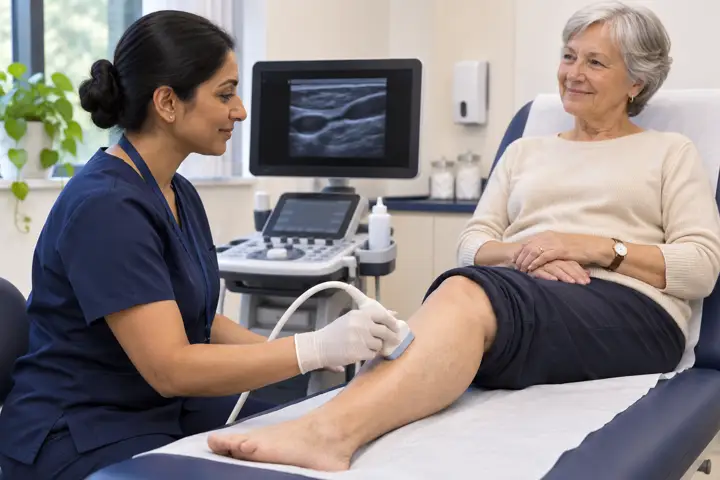
A clinician using an ultrasound probe to scan a patient's lower leg

Varicose veins: symptoms, treatment and recovery

General information about enlarged leg veins, assessment and treatment. Follow your own GP or vascular team's advice: symptoms, treatment choices and recovery differ between people.

This information is free to read. No subscription is needed.

Get immediate help for severe bleeding or possible lung clot

Get immediate medical help for heavy or uncontrolled bleeding. Call 999 if bleeding is severe, will not stop, or you feel faint or seriously unwell.

Call 999 if you have possible DVT symptoms, such as leg pain and swelling, together with chest pain or shortness of breath. This can be a sign of a clot in the lungs. Do not drive yourself to A&E. NHS — deep vein thrombosis · NHS England — treatment decision aid (PDF)

Seek urgent assessment for bleeding or possible DVT

Any bleeding from a varicose vein needs urgent medical advice, even if it stops. NICE recommends immediate referral to a vascular service for bleeding varicose veins. NHS — varicose veins · NICE CG168 — recommendations

New swelling and pain in one leg, sometimes with warmth or a change in skin colour, need urgent assessment for possible DVT. Do not assume this is just your usual varicose veins. You cannot diagnose or rule out a clot by appearance alone. NHS — deep vein thrombosis

  • England: NHS 111 or an urgent GP appointment.
  • Scotland: NHS 24 on 111 or an urgent GP appointment.
  • Wales: NHS 111 Wales or an urgent GP appointment.
  • Northern Ireland: your GP out-of-hours service or local urgent care service.

For the emergency signs above, use 999 instead. Our blood clots guide explains DVT and pulmonary embolism.

What varicose veins are: symptoms and causes

Veins carry blood back towards the heart. Small valves help it move in the right direction. When valves in leg veins do not close properly, blood can flow backwards and collect. Increased pressure can stretch the veins, making them enlarged, twisted or bulging.

Small thread or spider veins are fine visible vessels near the skin. They are not the same as larger varicose veins and are usually harmless. Appearance alone does not show whether larger veins need treatment.

  • Bulging, twisted veins, often blue or purple.
  • Aching, heaviness or uncomfortable legs.
  • Swollen ankles or legs, itching or dry skin.
  • Changes in skin colour, particularly around the ankle.

Symptoms may be worse after standing for a long time. Not everyone has pain. Getting older, a family history, pregnancy and excess weight can increase the chance of developing varicose veins. Previous DVT can damage vein valves and contribute to later vein problems. NHS — varicose veins · NHS inform — varicose veins

Skin changes and possible complications

Varicose veins can cause persistent swelling, eczema, darker skin or hardened skin. Some people develop a venous leg ulcer: a sore caused by poor blood flow in the leg veins. Bleeding can happen if a vein near the surface is damaged.

Superficial thrombophlebitis is inflammation and clotting in a vein near the skin. A vein may feel hard and painful. This is different from DVT, but a new painful or swollen leg needs assessment rather than self-diagnosis. NHS — varicose veins · NICE CG168 — recommendations

For eczema linked to vein problems, read our eczema guide. Do not rely on moisturiser alone when there are ongoing skin changes or a sore.

GP review, vascular referral and ultrasound

See your GP for bothersome or worsening symptoms, pain, swelling, itching or skin changes. Also arrange GP review for a sore on the leg that has not healed after 2 weeks. Get urgent help for bleeding or possible DVT rather than waiting for a routine appointment. NHS — varicose veins

NICE recommends vascular referral for:

  • Bleeding varicose veins — immediate referral.
  • Varicose veins, including recurrent veins, with troublesome symptoms.
  • Skin changes thought to be caused by poor flow in the leg veins.
  • Hard, painful superficial veins with suspected faulty vein function.
  • An active venous leg ulcer below the knee not healed within 2 weeks, or a healed venous leg ulcer.

A vascular service checks your symptoms and examines your legs. Duplex ultrasound combines a picture of the veins with information about blood flow. It confirms where blood is flowing backwards and helps plan treatment. NICE CG168 — recommendations

Cosmetic-only treatment is not usually offered by the NHS. Local referral and funding routes vary across the UK; ask your GP what applies where you live. NHS — varicose veins

Treatment options: the NICE sequence

For confirmed varicose veins with truncal reflux — backward flow in a main surface vein — NICE recommends this order, moving to the next option if the previous one is unsuitable:

  1. endothermal ablation
  2. ultrasound-guided foam sclerotherapy
  3. surgery

Your ultrasound findings, general health and preferences help determine what is suitable. The intended benefit is better vein flow and relief of symptoms, not a promise that every visible vein or symptom will disappear. NICE CG168 — recommendations

Heat treatment: laser or radiofrequency ablation

A thin tube is placed in the affected vein, guided by ultrasound. Local anaesthetic is usually used, and laser or radiofrequency heat closes the vein. Blood then uses other veins. Small surface veins may also be removed through tiny cuts.

Ultrasound-guided foam sclerotherapy

Foam is injected into the vein using ultrasound guidance. It irritates the vein lining so the vein closes. The team explains whether this suits the size and position of your veins and whether further sessions might be needed.

Surgery

Surgery can tie off and remove affected veins, sometimes with smaller veins removed through short cuts. The anaesthetic and procedure depend on the treatment planned.

Risks and repeat treatment

Possible problems include pain, bruising, bleeding, infection, temporary or persistent numbness, skin colour changes and inflamed superficial veins. Less common complications include DVT. Heat treatment can affect nearby skin or nerves; foam can occasionally cause visual symptoms or headache. Ask about risks specific to the proposed procedure.

New veins can develop and treated veins can recur. More than one session or a combination of treatments may be needed, particularly for recurrent veins. Discuss likely benefits and downsides rather than expecting a permanent cure. NHS — varicose veins · NICE CG168 — recommendations · NHS England — treatment decision aid (PDF)

Compression stockings and pregnancy

Compression stockings apply graduated pressure and may reduce aching and swelling. NICE recommends them when intervention is unsuitable, or for symptom relief in pregnancy. They do not repair leaky valves or cure varicose veins, and are not a compulsory trial before suitable intervention.

Ask a clinician to check suitability, measure your legs and choose the correct type and fit. Stockings may not suit some people with poor arterial circulation. Ask for help if you find them difficult to put on. Follow professional advice about when to wear them. NHS — varicose veins · NICE CG168 — recommendations

Invasive treatment during pregnancy is offered only in exceptional circumstances. Veins may improve after birth. Discuss symptom relief and reassessment with your maternity or vascular team. NICE CG168 — recommendations

Everyday care while you wait or manage symptoms

  • Walk and move as you are able; change position rather than staying still for long periods.
  • Rest with your legs raised when comfortable.
  • If appropriate, ask for support with weight management.
  • Look after dry skin with advice from a pharmacist or clinician, and report sores or persistent skin changes.

These steps may ease discomfort but do not remove established varicose veins or replace assessment for warning signs. Choose activity that fits your mobility and other health conditions. NHS — varicose veins

Recovery after treatment

Bruising, tenderness and some swelling can occur. Recovery differs between heat treatment, foam and surgery, and with the extent of treatment and your health. There is no single timetable for everyone.

Follow your clinic's instructions about dressings, washing, walking, exercise, lifting and any compression they prescribe. Ask what symptoms are expected and how to contact the team if you are worried.

Return to work depends on your job, pain, mobility and procedure. Ask about transport home, driving, long journeys and follow-up before treatment. Do not drive until you can control the vehicle safely and meet your team's advice and insurer's requirements.

Get urgent advice for new one-sided pain and swelling or concerning wound changes. Use 999 for leg symptoms with chest pain or shortness of breath, or severe uncontrolled bleeding. NHS — deep vein thrombosis · NHS England — treatment decision aid (PDF)

Appointment checklist and questions

  • Bring your medicine and allergy list, including blood thinners; do not stop medicines yourself.
  • Describe when pain, swelling or itching happens, any bleeding and any past DVT, ulcers or vein treatment.
  • Tell the team about pregnancy, mobility, work duties and communication or access needs.
  • Ask: what did the ultrasound show, and which options are suitable for me?
  • Ask about likely symptom improvement, risks, repeat sessions and the choice not to have a procedure.
  • Ask about stockings, wound care, recovery, work, transport home and follow-up.
  • Ask which warning signs need a clinic call, urgent care or 999, and keep the contact number.

You can use the NHS England decision aid to prepare questions with a trusted helper. It supports discussion, not a diagnosis or guaranteed outcome. NHS England — treatment decision aid (PDF)

Sources and support

Your GP and vascular team can advise on your own symptoms, assessment and care. Sixpence Support UK provides general information, not a diagnosis or an individual treatment plan.

Sources checked on 8 November 2026. NHS, NICE and the NHS England decision aid were accessible; direct access to NHS inform was not confirmed, although its official guidance was available through indexed results. This is not a claim of professional clinical review.

Blood clots, stroke and VTE · Eczema and skin care · All support topics.