
CPR, Resuscitation and Defibrillators
What to do if someone collapses and is not breathing normally. This page explains, in plain English, how to recognise a possible cardiac arrest, call 999, give hands-only CPR to an adult, and use a public-access defibrillator.
What CPR and defibrillators are
- CPR means cardiopulmonary resuscitation.
- CPR keeps blood moving around the body when someone’s heart has stopped pumping effectively.
- A defibrillator is also called an AED — an automated external defibrillator.
- Anyone can use an AED. You switch it on and follow its spoken instructions.
- A defibrillator assesses the person’s heart rhythm and only delivers a shock when that is appropriate.
- Never delay calling 999 or starting CPR in order to look up information online.
Emergency — call 999 now
If someone is unresponsive, call 999 immediately.
While waiting for the call to be answered, check whether they are breathing normally. Gasping, panting, slow, laboured or irregular breaths are not normal breathing.
If the person is unresponsive and not breathing normally, start CPR immediately. Put the phone on loudspeaker and follow the ambulance call handler’s instructions.
If another person is present, ask them to find a defibrillator while you continue CPR. Do not leave the person alone unless the 999 call handler tells you to.
This page provides general first-aid information. In a real emergency, call 999 and follow the ambulance service’s instructions.
- More than 30,000
Out-of-hospital cardiac arrests occur in the UK each year where emergency services attempt resuscitation.
Source: British Heart Foundation — Out-of-hospital cardiac arrests
- Fewer than 1 in 10
People survive an out-of-hospital cardiac arrest in the UK.
Source: British Heart Foundation — Out-of-hospital cardiac arrests
- More than double
Early CPR and defibrillation can more than double a person’s chance of surviving an out-of-hospital cardiac arrest.
Source: British Heart Foundation — Out-of-hospital cardiac arrests
Figures describe out-of-hospital cardiac arrest and may be updated as new national data becomes available.
Recognising a possible cardiac arrest
Signs that someone may be in cardiac arrest include:
- The person does not respond when spoken to or gently shaken at the shoulders.
- The person is not breathing normally.
- They may be gasping, panting, or taking slow, laboured or irregular breaths.
- A short period of seizure-like movement can sometimes happen as a cardiac arrest begins.
If there is any doubt at all, call 999. The call handler will help you assess the situation. Do not spend time trying to find a pulse.
The three immediate steps
Check
- Make sure it is safe to approach.
- Check whether the person responds.
- Shout for nearby help.
Call 999
- Call 999 immediately if the person is unresponsive.
- Put the phone on loudspeaker.
- Give the exact location.
- Follow every instruction from the call handler.
- Check the person’s breathing while waiting for the call to be answered.
Start CPR
- Begin CPR immediately if the person is unresponsive and not breathing normally.
- Continue until professional help takes over, the person shows definite signs of life, or the 999 call handler tells you to stop.
- Attach a defibrillator as soon as one is available and follow its instructions.
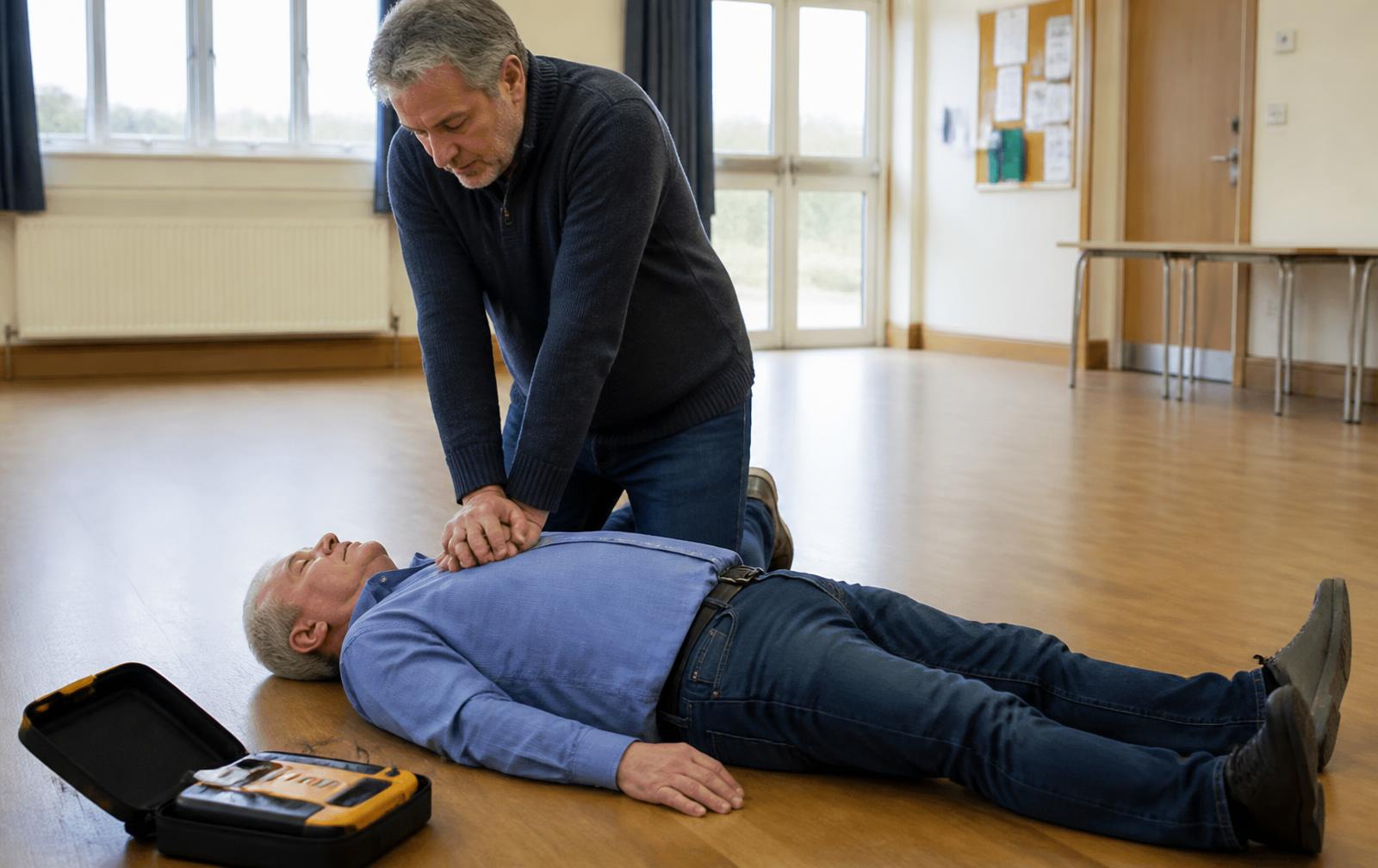
Hands-only CPR for an adult
- Kneel beside the person.
- Place the heel of one hand in the centre of their chest, on the breastbone.
- Place the other hand on top and interlock the fingers.
- Keep your arms straight and position your shoulders directly above your hands.
- Press straight down by 5 to 6cm.
- Allow the chest to rise fully after each compression.
- Give compressions at a rate of 100 to 120 each minute.
- Keep any interruptions as short as possible.
- Keep following the 999 call handler’s instructions.
If someone is trained and confident in giving rescue breaths, they may use 30 chest compressions followed by 2 rescue breaths. Someone who is not trained or not confident should give continuous hands-only CPR as directed by the 999 call handler.
Reading this page is not the same as practical training. If you can, take a recognised first-aid or CPR course so that you have practised the technique before you ever need it.
Using a defibrillator (AED)
- Anyone can use an AED. Specialist training is not required.
- Call 999 and start CPR first.
- Switch the AED on and follow its spoken or visual instructions.
- Expose the chest and attach the pads exactly as shown on the pad diagrams.
- Make sure nobody is touching the person while the AED analyses the heart rhythm or delivers a shock.
- Resume CPR immediately when the AED tells you to.
- Leave the pads attached and keep following the AED and the 999 call handler.
- The AED will not deliver a shock unless it detects a heart rhythm that requires one.
Defibrillators in public places can be registered on the national defibrillator network. The 999 ambulance call handler can direct somebody to a registered nearby defibrillator when that is appropriate, so tell them where you are and ask.
How the national defibrillator network worksChildren and babies
CPR techniques for babies and children are different from adult CPR. Do not assume the adult steps above apply.
If a baby or child is unresponsive and not breathing normally:
- Call 999 immediately.
- Put the phone on loudspeaker.
- Follow the call handler’s instructions.
- Start CPR as directed.
- Use an AED if one is available and follow its instructions.
The full sequence for babies and children, including rescue breaths and compression depth, is set out by the NHS.
NHS child and baby CPR instructionsCardiac arrest is not the same as a heart attack
Cardiac arrest
- The heart suddenly stops pumping blood effectively.
- The person becomes unresponsive and is not breathing normally.
- Call 999 and begin CPR immediately.
Heart attack
- Blood flow to part of the heart is blocked.
- The person is usually conscious and breathing.
- Symptoms can include chest pressure or pain, sweating, breathlessness, nausea, or pain spreading to the arm, jaw, back or stomach.
- A heart attack can lead to cardiac arrest.
- Call 999 for suspected heart-attack symptoms.
Do not try to work out which one it is yourself. If you are uncertain, call 999.
If the person is unconscious but breathing normally
- Call 999.
- Follow the call handler’s instructions.
- If there are no injuries preventing movement, the call handler may advise placing the person in the recovery position.
- Keep watching their breathing.
- If their breathing becomes abnormal or stops, tell the call handler and begin CPR as instructed.
After witnessing or giving CPR
Witnessing a cardiac arrest, or attempting CPR, can be frightening and upsetting. Many people feel shaken for some time afterwards, whatever the outcome. That is a normal reaction.
- Speak to the ambulance staff before leaving the scene, if you are able to.
- Contact your GP or NHS 111 if you need support afterwards.
- Resuscitation Council UK publishes support information for people affected by cardiac arrest.
Related Sixpence topics
Sources and further information
Official source list
Important notice: Sixpence Support UK provides general information only. This page is not a diagnosis, individual medical advice, or a substitute for practical first-aid training or assessment and treatment by a qualified healthcare professional. In an emergency, call 999.
- [1] NHS. CPR · 2025
- [2] NHS. First aid · 2025
- [3] NHS. When to call 999 · 2025
- [4] NHS. How to resuscitate a child · 2025
- [5] Resuscitation Council UK. 2025 Resuscitation Guidelines — Adult basic life support · 2025
- [6] British Heart Foundation. Out-of-hospital cardiac arrests · 2025
- [7] British Heart Foundation. The Circuit — the national defibrillator network · 2025
- [8] Resuscitation Council UK. Support after cardiac arrest · 2025