
First Aid in an Emergency: What to Do While Help Arrives
Calm, plain-English first aid for the minutes before an ambulance arrives — how to check breathing, what to do about heavy bleeding, choking, a suspected heart attack or stroke, seizures, allergic reactions and other emergencies.
Call 999 or 112 in a life-threatening emergency
Call immediately if someone is unconscious, not breathing normally, choking, bleeding heavily, having a suspected heart attack or stroke, experiencing a severe allergic reaction or has suffered a serious injury.
Put the phone on speaker if possible. The emergency call handler can tell you what to do while help is travelling to you.
Do not delay calling while searching this website.
You do not need to be an expert to help
Most emergencies are helped most by three simple things: keeping yourself safe, calling 999 or 112 early, and doing what the call handler tells you. Doing something simple straight away is far better than waiting because you are afraid of getting it wrong.
This page is general information based on NHS, St John Ambulance and Resuscitation Council UK guidance. It is not a diagnosis, and it is not a replacement for practical first-aid training.
The order to work in
- Check for danger — do not become a second casualty.
- Check whether the person responds and is breathing normally.
- Call 999 or 112 and put the phone on speaker.
- Give the help the call handler describes until help arrives.
What to do in common emergencies
Open any heading below for clear steps.
1. Check for danger first
Before you go near anyone, look around and ask what could hurt you. Common dangers include moving traffic, fire or smoke, electricity, gas, chemicals or fumes, broken glass, unstable structures, deep or fast-moving water, and cold water.
Do not put yourself in danger. If you are hurt too, nobody is left to help.
If the area is unsafe, stay back, call 999 or 112 and follow the emergency operator’s instructions. Tell them exactly what the danger is, so the right services are sent.
2. Check whether the person responds and is breathing
- Speak loudly and clearly: ask “Are you all right?”
- Gently tap or shake their shoulders.
- If there is no response, open the airway by tilting the head back gently and lifting the chin.
- Look, listen and feel for normal breathing for no more than 10 seconds — watch the chest, listen at the mouth and feel for breath on your cheek.
Gasping, irregular breaths, slow noisy breaths or occasional single breaths are not normal breathing. Treat that as not breathing.
If the person is unresponsive and not breathing normally, call 999 or 112, ask for a defibrillator to be brought if one is available nearby, and begin CPR.
3. The recovery position
If someone is unconscious but breathing normally, they should usually be placed in the recovery position. It helps keep the airway open and lets fluid or vomit drain away rather than block their breathing.
- Kneel beside the person. Remove glasses and any bulky items from their pockets.
- Place the arm nearest to you out at a right angle to their body, elbow bent, palm up.
- Bring the far arm across their chest and hold the back of that hand against the cheek nearest to you.
- With your other hand, pull up the far knee until the leg is bent and the foot is flat.
- Keeping the hand pressed to the cheek, pull on the far knee to roll them towards you.
- Adjust the upper leg so the hip and knee are bent at right angles.
- Tilt the head back gently so the airway stays open, and check breathing again.
- Call 999 or 112 if you have not already, and keep watching their breathing.
If they stop breathing normally at any point, roll them onto their back and start CPR.
Suspected serious neck or spinal injury: do not move the person unnecessarily. Only move them if they are in immediate danger, or if their airway cannot be kept open any other way. Support the head and neck as best you can and follow the emergency operator’s instructions.
4. Severe or life-threatening bleeding
- Call 999 or 112 straight away, or ask someone else to call.
- Wear disposable gloves if any are available.
- Apply firm, direct pressure to the wound with a sterile dressing, clean cloth or clothing — or with your gloved hand if nothing else is to hand.
- Keep the pressure on. Do not keep lifting the dressing to look.
- If you can, raise the injured part above the level of the heart while keeping pressure on.
- Keep the person warm and lying down, and keep talking to them.
If blood soaks through the dressing, keep pressing and add another dressing on top, then follow the emergency operator’s instructions.
Do not remove an object that is embedded in a wound. Press firmly around it instead, and leave the object for the ambulance crew.
5. Choking
Mild choking: the person can still speak, cough or breathe. Encourage them to keep coughing and stay with them. Coughing is usually the most effective way to clear a blockage.
Severe choking: they cannot speak, cry, cough or breathe effectively, may be silent, and may go blue or become distressed. Act immediately and shout for help.
Adults and children over one year old
- Give up to five sharp back blows: lean them forwards and strike firmly between the shoulder blades with the heel of your hand.
- If that does not clear it, give up to five abdominal thrusts: stand behind them, put your arms around the upper part of the tummy, make a fist just above the belly button and pull sharply inwards and upwards.
- If the blockage still has not cleared, call 999 or 112 and continue alternating five back blows and five abdominal thrusts until help arrives.
Anyone who has had abdominal thrusts should be checked by a doctor afterwards.
Babies under one year old — the technique is different
- Never give abdominal thrusts to a baby.
- Lay the baby face down along your forearm or thigh, supporting the head and chin, and give up to five back blows between the shoulder blades with the heel of your hand.
- If that does not work, turn the baby face up along your forearm and give up to five chest thrusts: two fingertips in the middle of the chest, pushing sharply downwards.
- If the blockage still has not cleared, call 999 or 112 and continue five back blows and five chest thrusts until help arrives.
Call 999 or 112 if the obstruction does not clear, if the person becomes unresponsive, or if you are worried at any point. If they become unresponsive and are not breathing normally, start CPR.
6. Suspected heart attack or stroke
Heart attack — common warning signs
- Pain, pressure, tightness or squeezing in the chest
- Pain spreading to the arms, neck, jaw, back or stomach
- Sweating, clamminess or pale grey skin
- Shortness of breath
- Feeling sick, being sick or indigestion-like discomfort
- Feeling light-headed, very anxious, or sudden collapse
Call 999 immediately. Help the person sit down and rest quietly, loosen tight clothing, and stay with them. Follow the call handler’s instructions, including any advice about aspirin. If they become unresponsive and are not breathing normally, start CPR.
Stroke — remember FAST
- Face — has their face fallen on one side? Can they smile?
- Arms — can they lift both arms and keep them there?
- Speech — is their speech slurred, or can they not speak or understand you?
- Time — if you see any single one of these signs, it is time to call 999.
Note the time the symptoms started, if you know it, and tell the ambulance crew. Treatment is far more effective the sooner it is given.
Do not drive the person to hospital yourself when an ambulance is needed. Ambulance crews begin treatment on the way and take them to the right hospital.
7. Seizures
What to do:
- Stay calm and stay with them. Note the time the seizure started.
- Move away nearby dangers such as hot drinks, furniture, glass or traffic.
- Cushion their head with something soft.
- Loosen tight clothing around the neck.
- When the shaking stops, if they are unconscious and breathing normally, put them in the recovery position and stay with them until they have fully recovered.
Do not:
- Do not restrain them or try to hold them still.
- Do not put anything in their mouth.
- Do not give food or drink until they have fully recovered.
Call 999 if:
- It is their first known seizure
- The seizure lasts five minutes or longer
- They have repeated seizures without recovering in between
- They are seriously injured, or have hurt themselves badly during the seizure
- They are having trouble breathing afterwards
- They are pregnant
- You are simply not sure what to do
More about living with seizures: Epilepsy and Seizures.
8. Severe allergic reactions
A severe allergic reaction (anaphylaxis) is a medical emergency. Warning signs include:
- Swelling of the lips, mouth, tongue or throat
- Difficulty breathing, wheezing, coughing or a hoarse voice
- A tight throat or trouble swallowing
- Sudden dizziness, feeling faint, confusion or collapse
- Widespread rash, raised itchy welts or swelling of the skin
- Feeling sick, tummy pain or a sudden sense that something is very wrong
- Call 999 straight away and say you think it is anaphylaxis.
- If they carry an adrenaline auto-injector, help them use their own device, or use it for them as the label and the call handler describe, without delay.
- Help them lie down with their legs raised. If they are struggling to breathe, let them sit up. If they are pregnant, help them lie on their left side.
- Do not stand them up or let them walk about, even if they feel better.
- Stay with them until the ambulance arrives, and keep the used device to hand over.
We do not give medication doses on this website. Follow the instructions on the person’s own device and the emergency call handler.
More information: Allergies, Intolerances and Anaphylaxis.
9. Burns, scalds and electrical injuries
- Stop the burning — move the person away from the heat, flame, steam or chemical only if it is safe to do so.
- Cool an ordinary burn under cool or lukewarm running water for at least 20 minutes as soon as possible.
- Remove clothing and jewellery near the burn, unless it is stuck to the skin.
- Keep the rest of the person warm, as cooling can make them cold.
- Cover the burn loosely with cling film or a clean, non-fluffy cloth.
Do not:
- Do not use ice or iced water.
- Do not apply creams, butter, oils, ointments or toothpaste.
- Do not pull away clothing that is stuck to a burn.
- Do not burst blisters.
Get urgent medical help for large or deep burns, white or charred skin, burns to the face, hands, feet, joints or genitals, any burn on a baby or young child, and any chemical or electrical burn. Chemical and electrical burns always need urgent assessment, even when the skin looks only slightly damaged.
More detail: Burns and Scalds: First Aid and When to Get Help.
10. Head, neck and spinal injuries, broken bones and serious falls
After a serious fall, a road collision, a blow to the head or any suspected spinal injury, do not move the person unless they are in immediate danger or you cannot keep their airway open any other way.
- Call 999 or 112 and describe what happened and how they fell.
- Keep them still, warm and as comfortable as possible where they are.
- Support the head and neck gently with your hands if you can do so without moving them.
- Keep checking that they are awake and breathing normally, and keep talking to them.
- Follow the emergency operator’s instructions until help arrives.
For a suspected broken bone, support the limb in the position you found it — with cushions, clothing or your hands. Do not try to straighten a limb and do not try to push a bone back into position. Do not give food or drink, in case an operation is needed.
If they become unresponsive and are not breathing normally, start CPR and follow the call handler’s instructions.
11. Poisoning and suspected overdose
Call 999 immediately if someone has swallowed, breathed in or been exposed to something harmful and is unconscious, drowsy, having difficulty breathing, having a seizure, or is seriously unwell. If you are unsure and they seem well, call NHS 111 for advice.
Do not:
- Do not try to make the person vomit.
- Do not give them anything to eat or drink unless you are told to.
- Do not taste, smell or handle an unknown substance yourself.
If it is safe, keep the container, packaging, medicine box, plant or details of what may have been taken, and how much and when, so the emergency services know what they are dealing with.
If someone is unconscious but breathing normally, put them in the recovery position and stay with them until help arrives.
12. Electric shock
Do not touch the person while they are still in contact with electricity. The current can pass through them into you.
- Switch off the supply at the mains or unplug the appliance — but only if you can reach it safely and easily.
- If you cannot switch it off safely, stay well back and call 999. Never approach high-voltage electricity, overhead cables or railway lines — wait for the emergency services.
- Once you are sure they are no longer in contact with electricity, check whether they respond and are breathing normally.
- Follow the emergency operator’s instructions, and start CPR if needed.
Call 999 for any serious electric shock, or if the person is unconscious, has breathing problems, chest pain, burns, numbness, confusion, muscle pain or any other worrying symptom. A shock can affect the heart even when the skin looks unharmed.
13. Drowning and water emergencies
Do not enter dangerous water — sea, rivers, canals, lakes, floodwater or cold water — unless you are trained and equipped to do so. Most people who die trying to rescue someone were not trained.
- Call 999 or 112. At the coast, ask for the Coastguard. Inland, ask for the fire service.
- Shout to the person, and encourage them to float on their back and keep calm.
- Reach or throw — hold out something long, or throw a rope, ring or anything that floats. Stay on dry land.
- If the person has been brought out of the water, check whether they respond and are breathing normally, and follow the emergency operator’s instructions.
- Keep them warm, and get them checked even if they seem to recover.
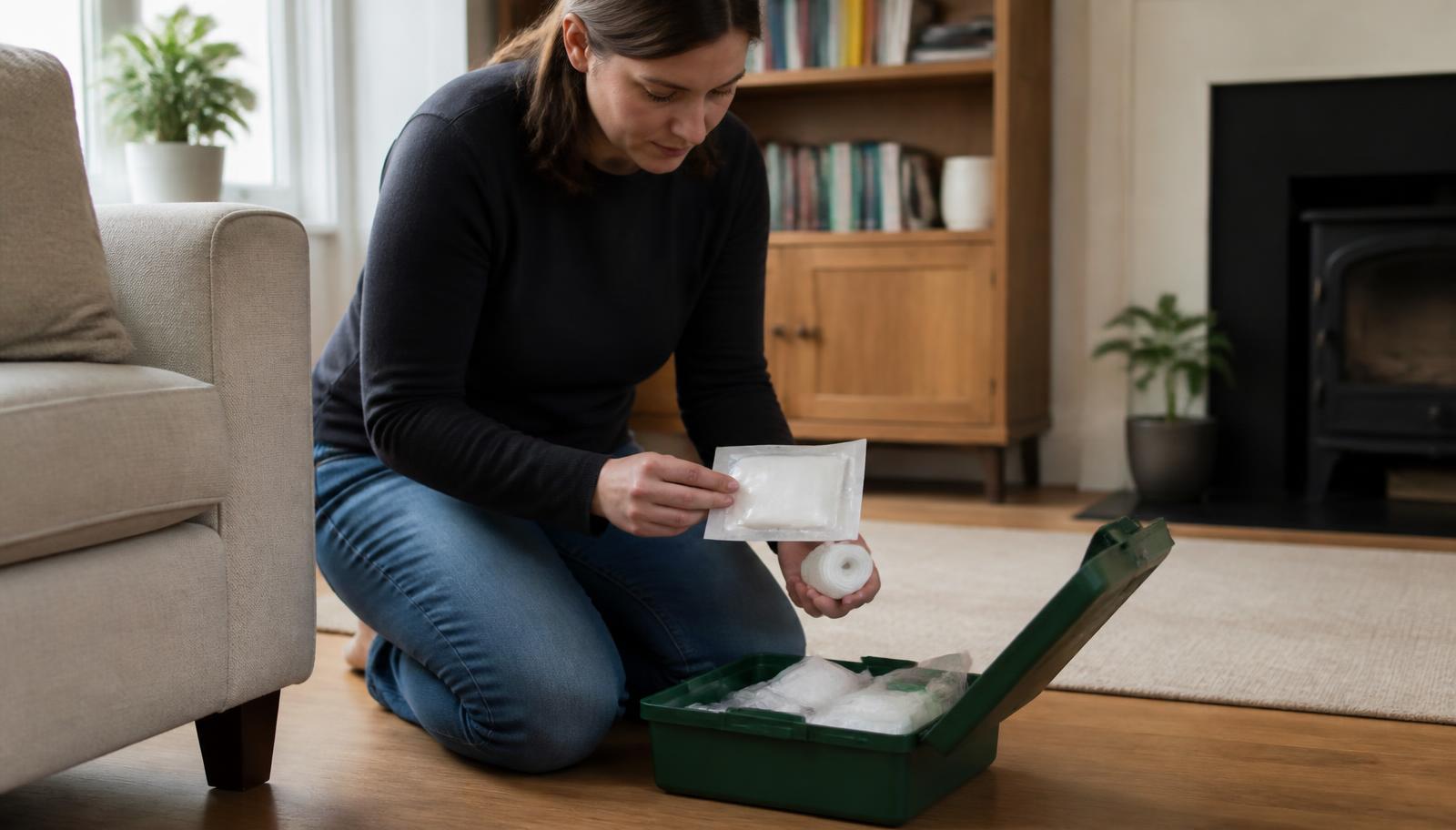
14. What to keep in a first-aid kit
- Sterile dressings in a few different sizes
- Plasters, including waterproof ones
- Disposable gloves
- Roller bandages and triangular bandages
- Sterile eye-wash solution or sterile water, and eye pads
- Micropore tape and safety pins
- Safety scissors and tweezers
- A foil survival blanket
- Cleansing wipes without alcohol
- A first-aid guidance card or leaflet
Keep the kit somewhere everyone in the household knows about, and take a small kit in the car. Check it a couple of times a year and replace anything that is out of date, opened, damp or damaged — a dressing is only sterile while its packet is sealed.
We do not recommend prescription medicines or give medication doses. Keep prescribed items, such as an inhaler or adrenaline auto-injector, where the person who needs them can reach them quickly.
15. Learning first aid
Reading a website is not the same as being trained. In a real emergency, hands-on practice is what makes people act quickly and confidently.
Consider a recognised first-aid course covering CPR and defibrillators, choking, serious bleeding, the recovery position and how to assess an unresponsive person. Courses run from short free sessions to full one- and two-day qualifications, and many workplaces, community groups and schools can arrange them.
Trusted UK information
Every link below opens in a new tab.
Also useful: NHS — when to call 999 and RNLI water safety advice.
Free help from us
If you need help finding a local NHS service, or support writing a letter, email or complaint after an incident, we can help — free of charge.
Important
This page provides general first-aid information. It is not a replacement for calling 999 or 112, following instructions from an emergency call handler, receiving medical care or completing recognised practical first-aid training.
- [1] NHS. First aid · 2026
- [2] NHS. When to call 999 · 2026
- [3] NHS. The recovery position · 2026
- [4] NHS. Severe bleeding · 2026
- [5] NHS. Choking · 2026
- [6] NHS. Heart attack · 2026
- [7] NHS. Stroke · 2026
- [8] NHS. Epilepsy and seizures · 2026
- [9] NHS. Anaphylaxis · 2026
- [10] NHS. Burns and scalds · 2026
- [11] NHS. Poisoning · 2026
- [12] NHS. Electric shock · 2026
- [13] NHS. Drowning · 2026
- [14] St John Ambulance. First aid advice · 2026
- [15] Resuscitation Council UK. Guidelines and public resources · 2026
- [16] British Red Cross. First aid guidance · 2026
- [17] RNLI. Water safety advice · 2026