
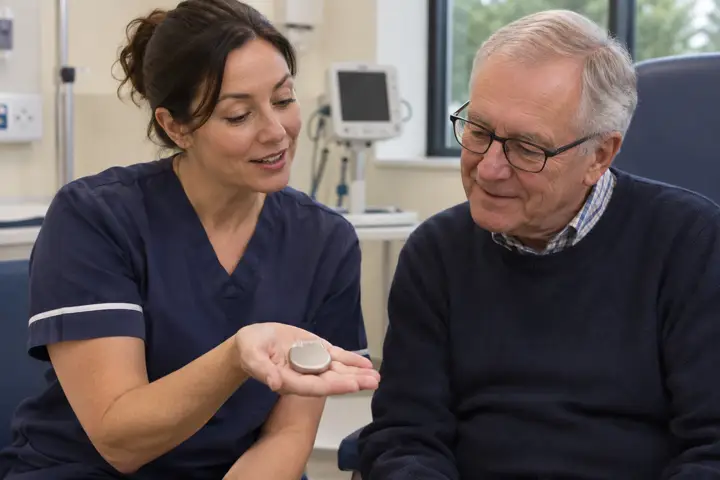
Pacemakers: fitting, recovery and living with one
General information about fitting, recovery and everyday life. Follow your own cardiology or device team's instructions: your heart condition, device and recovery may need different advice.
Sixpence Support UK information is free. No subscription is needed.
At a glance
Your heart has its own electrical signals that tell its muscle when to contract. A pacemaker is a small battery-powered implant that monitors the rhythm and gives tiny electrical pulses when needed to help the heart beat appropriately.
It may help when a heartbeat is too slow, when electrical signals are delayed or interrupted, or in selected heart-failure cases where the main pumping chambers need help working together. It is not a cure for every heart problem.
A standard pacemaker does not deliver a defibrillator shock. Devices called ICDs or CRT-D have different functions and restrictions. NHS — pacemaker implantation · British Heart Foundation — pacemakers
Call 999 in an emergency
Call 999 immediately for severe difficulty breathing, tight or heavy chest pain, pain spreading to an arm, back, neck or jaw, or if someone collapses and is unresponsive.
Do not drive yourself to A&E. Having a pacemaker does not make these symptoms safe to ignore. NHS — pacemaker implantation
Contact your device clinic promptly
Contact your device or pacemaker clinic promptly if the wound becomes more red, swollen or tender, leaks blood, pus or clear fluid, or you have a fever or chills. Redness can be harder to see on brown or black skin. Also contact the clinic if symptoms you had before the procedure return.
If the clinic is unavailable, use your local urgent care service:
- England: NHS 111.
- Scotland: NHS 24 on 111.
- Wales: NHS 111 Wales.
- Northern Ireland: your GP out-of-hours service or local urgent care service.
Use 999 instead for the emergency signs above. Do not wait for your next routine check. NHS — pacemaker implantation
Sources and support
Your pacemaker or device clinic is the first contact for individual questions about your implant, symptoms, restrictions and follow-up.
The British Heart Foundation Heart Helpline offers general heart-health support on 0808 802 1234. Weekdays 9am–5pm, excluding bank holidays. It is not an emergency service. British Heart Foundation — Heart Helpline
Official source links checked on 8 November 2026. This is general information, not a professional clinical review; your own team's instructions take priority.
- NHS — pacemaker implantation
- NHS — heart block
- British Heart Foundation — pacemakers
- Chelsea and Westminster Hospital — your pacemaker
- British Heart Foundation — pacemaker questions
- GOV.UK — pacemakers and driving
- DVLA — pacemaker implantation and box change: licence standards
- nidirect — heart conditions and driving
- British Heart Foundation — Heart Helpline
Related information: Coronary artery disease · High blood pressure · All support topics.