
Psoriasis: Symptoms, Types, Treatment and Everyday Support
Psoriasis is a common long-term skin condition involving the immune system. It is not contagious, it is not caused by poor hygiene, and there are NHS treatments that can help most people control it.
The short version
- Psoriasis is a long-term inflammatory condition in which the immune system makes skin cells build up too quickly.
- It is not contagious. You cannot catch it from anyone, or give it to anyone.
- It can look different on different skin tones and is not always red.
- Most people are treated by their GP; a dermatology referral is available when psoriasis is severe, widespread or not improving.
- Around 1 in 3 people with psoriasis develop psoriatic arthritis, so tell a healthcare professional about joint pain, stiffness or swelling.
What psoriasis is
Psoriasis is a long-term (chronic) condition in which the immune system becomes overactive and causes skin cells to be replaced far faster than usual. Instead of shedding gradually, the cells build up on the surface and form raised, scaly patches known as plaques.[1]NHS
Psoriasis often comes and goes. Many people have periods when their skin is clear or almost clear, followed by flare-ups. It is not an infection, it is not caused by being unclean, and it cannot be passed from person to person.[9]British Association of Dermatologists
It can start at any age, though it most commonly begins in adults under 35. It affects men and women in roughly equal numbers, and it can run in families.[1]NHS
What psoriasis can look and feel like
The most common signs are patches of skin that feel thicker than the skin around them, with a build-up of scale on the surface. People describe a range of sensations, and psoriasis is not always itchy.
Common signs and symptoms
- Plaques — raised patches of skin, often with clearly defined edges.
- Scaling — silvery, white or greyish flakes on the surface of a plaque.
- Itching — some people itch a great deal, others hardly at all.
- Soreness, burning or stinging, particularly where skin rubs or bends.
- Cracking and bleeding where plaques are dry or over a joint such as a knuckle.
- Tightness, especially after washing or in cold weather.
Plaques may leave temporary darker or lighter marks after they settle. These usually fade over weeks or months and are not scars.
Psoriasis on different skin tones
Descriptions of psoriasis often say the patches are "red". That reflects how it looks on white skin. On brown and black skin, plaques more often look purple, violet, grey or dark brown, and the scale can appear greyer. The redness that clinicians look for may be difficult to see at all.[9]British Association of Dermatologists
Because of this, psoriasis on darker skin is sometimes recognised later or mistaken for another condition. Darker or lighter marks left behind after a flare-up (post-inflammatory pigment change) also tend to be more noticeable and can last longer on brown and black skin.
If you feel your skin has not been properly examined, it is reasonable to say so and to ask for a further opinion or a dermatology referral.
Where psoriasis commonly develops
Psoriasis often appears on the elbows, knees, scalp and lower back — but it can develop anywhere, including places that are easy to miss.[1]NHS
- Elbows, knees, shins and forearms
- Scalp, hairline, behind the ears and the ear canal
- Lower back and buttocks
- Hands, feet, palms and soles
- Skin folds — under the breasts, armpits, groin and between the buttocks
- Face, eyelids, navel and genital skin
- Fingernails and toenails
Main types of psoriasis
Several patterns of psoriasis are recognised. Some people have more than one type, and the type can change over a lifetime. Only a healthcare professional can tell you which type you have.
Plaque psoriasis (psoriasis vulgaris)
By far the most common type. Raised patches covered in scale, typically on the elbows, knees, scalp and lower back. Plaques vary from small coin-sized patches to large areas.[1]NHS
Scalp psoriasis
Thickened, scaly patches on the scalp, often along the hairline, behind the ears or at the back of the head. It can range from light flaking that resembles dandruff to thick, crusted plaques. Hair may thin over badly affected areas during a flare-up, but hair usually regrows once the skin settles.[10]British Association of Dermatologists
Guttate psoriasis
Small, drop-shaped scaly spots, often spread over the trunk, arms and legs. It frequently appears a week or two after a throat infection, particularly in children and younger adults. It often clears within a few months, though some people go on to develop plaque psoriasis.[1]NHS
Inverse (flexural) psoriasis
Affects skin folds such as the armpits, groin, under the breasts and between the buttocks. Because the skin there is moist, the patches tend to be smooth and shiny rather than scaly, and they can become sore or cracked. It is easily mistaken for a fungal infection, so it is worth having it properly assessed rather than treating it yourself.
Pustular psoriasis
Small pus-filled spots (pustules) on inflamed skin. The pus is not an infection. Localised forms affect the palms and soles (palmoplantar pustulosis). A rare, widespread form called generalised pustular psoriasis can develop quickly and make a person feel very unwell — that needs urgent medical assessment.[1]NHS
Erythrodermic psoriasis
A rare and serious form in which almost the whole skin surface becomes inflamed, hot and shedding. It can affect body temperature and fluid balance and is treated as a medical emergency. See the urgent-help panel further down this page.[1]NHS
Nail psoriasis
Around half of people with psoriasis have nail changes. Look out for:
- Pitting — small dents in the nail surface.
- Colour changes — yellow-brown or oily-looking patches under the nail.
- Thickening and crumbling of the nail.
- Onycholysis — the nail lifting and separating from the nail bed.
- Ridges and lines across the nail.
Nail psoriasis can be uncomfortable and is closely linked with psoriatic arthritis, so it is worth mentioning to your GP. Nail treatment often takes many months to show a difference because nails grow slowly.[8]NICE CKS
Possible triggers
Triggers vary a great deal from person to person. Something that sets off a flare-up for one person may have no effect on another, and many flare-ups have no obvious cause at all. Keeping a simple note of what was happening before a flare can help you and your GP spot a pattern.
Commonly reported triggers
- Stress and periods of poor sleep.
- Infections, particularly streptococcal throat infections.
- Skin injury — cuts, scratches, sunburn, insect bites or tattoos (the Köbner response).
- Smoking, which is also linked with palm and sole psoriasis.
- Alcohol, especially heavier drinking.
- Some medicines, including lithium, some blood-pressure and antimalarial medicines, and stopping oral steroids. Never stop a prescribed medicine yourself — speak to your prescriber first.
- Cold, dry weather and central heating.
- Hormonal changes, for example around puberty or the menopause.
Sources: NHS and NICE Clinical Knowledge Summaries.
Getting diagnosed
What a GP will usually do
Psoriasis is normally diagnosed by examining the skin. There is no routine blood test for it. A GP will usually look at the pattern, site and appearance of the patches, check your scalp and nails, ask about family history, and ask how the condition affects your day-to-day life.[8]NICE CKS
They should also ask about joint symptoms, because psoriatic arthritis is common and is better treated early. Ask for your skin to be examined in good light and for all affected areas — including the scalp, nails and skin folds — to be looked at.
When a dermatology referral may be appropriate
NICE suggests referral to a dermatologist when, for example:
- the diagnosis is uncertain;
- psoriasis is extensive, or covers a large part of the body;
- it affects sensitive or high-impact sites such as the face, hands, feet or genitals;
- treatments prescribed in general practice have not worked well enough;
- the condition is having a major effect on wellbeing, work or sleep; or
- an urgent form such as generalised pustular or erythrodermic psoriasis is suspected — this needs same-day assessment.
Treatment options on the NHS
There is no cure for psoriasis, but treatment can control it well for most people. Treatment is usually stepped: simple treatments first, moving on if the skin does not improve enough.[2]NHS
This page does not give doses. Never start, stop or change a prescription medicine without talking to your GP, dermatologist or pharmacist.
Emollients and moisturisers
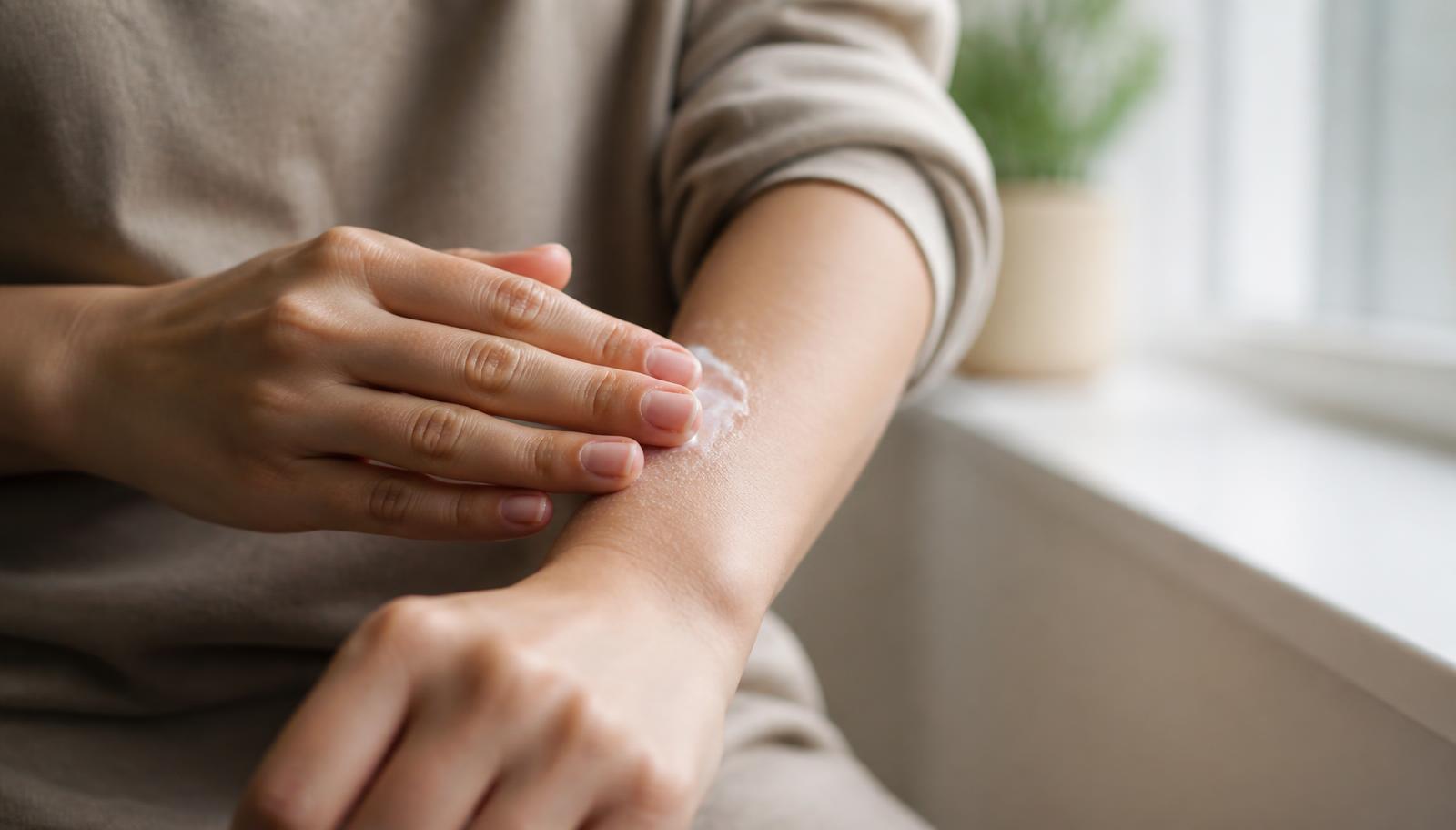
Emollients soften scale, reduce cracking and itching, and make other treatments work better. They come as lotions, creams, ointments and soap substitutes, and heavier products generally suit drier skin. Many are available on prescription as well as over the counter.[5]NHS
Emollients containing paraffin can make fabric and dressings highly flammable. Keep away from naked flames, cigarettes and heat sources, and wash clothing and bedding often.
Topical treatments applied to the skin
- Vitamin D preparations (such as calcipotriol) slow the rate at which skin cells build up and reduce scale.
- Topical corticosteroids reduce inflammation and itching. They are prescribed at a strength suited to the site and used for defined periods with review, because long-term unsupervised use can thin the skin.[6]NHS
- Combined vitamin D and steroid products are often used for plaque psoriasis.
- Coal tar preparations for plaques and the scalp.
- Dithranol, used for short contact periods, usually under specialist guidance.
- Calcineurin inhibitors for delicate sites such as the face and skin folds, on specialist advice.
Phototherapy (light treatment)
Controlled ultraviolet light treatment given in a hospital or clinic, usually two or three times a week for a course of several weeks. It is used when topical treatments have not been enough. It is not the same as using a sunbed — sunbeds are not a treatment for psoriasis and carry skin-cancer risk.[2]NHS
Systemic medicines and biologic treatments
For more severe or resistant psoriasis, a dermatology team may prescribe tablets or injections that act on the whole body — for example methotrexate, ciclosporin or acitretin. These require monitoring, often with regular blood tests, and some are unsuitable in pregnancy.
Biologic treatments are targeted injected medicines used when other systemic treatments have not worked, are unsuitable, or cannot be tolerated. They are prescribed and monitored by specialist services under NICE criteria.[7]NICE CG153
Scalp psoriasis: treatment and hair care
Scalp psoriasis is usually treated with medicated shampoos, scalp applications, oils to loosen thick scale, and prescribed topical treatments designed for hair-bearing skin.[10]British Association of Dermatologists
- Loosen thick scale with an oil or ointment before washing rather than picking it off.
- Leave medicated shampoos on for the time stated on the label — rinsing straight away does little.
- Use a gentle conditioner; combing gently reduces pulling at plaques.
- Avoid harsh chemical treatments during a flare-up and tell your hairdresser it is not contagious.
- Any hair thinning over plaques is usually temporary and improves as the scalp settles.
Living with psoriasis
Washing, moisturising and clothing
- Use lukewarm rather than hot water, and a soap substitute instead of soap or foaming shower gel.
- Pat skin dry rather than rubbing, and apply emollient while the skin is still slightly damp.
- Apply emollient generously and often — several times a day during a flare-up.
- Smooth creams on in the direction the hair grows to reduce irritation of hair follicles.
- Loose cotton or other soft fabrics are usually more comfortable than wool or tight synthetics.
- Ointments can mark clothing and bedding; older sheets or dark towels save frustration.
Itching, sleep and comfort
- Keeping emollient in the fridge can make it more soothing on itchy skin.
- Keep nails short, and press or pat rather than scratch — scratching can trigger new patches.
- A cooler bedroom and lighter bedding often help night-time itching.
- Tell your GP if itching is regularly disturbing your sleep; it is a treatable problem, not something to put up with.
Psoriasis and mental wellbeing
Psoriasis is a visible condition and it is entirely normal to feel self-conscious, frustrated or low because of it. Many people describe worrying about other people staring, avoiding swimming, short sleeves or the gym, or feeling anxious about relationships and intimacy.
The effect on wellbeing is a legitimate reason to seek treatment or a referral, and clinicians are expected to ask about it. Support routes include:
- Speaking to your GP about how psoriasis is affecting your mood, confidence or sleep.
- NHS Talking Therapies in England, which you can refer yourself to; equivalent services exist in Scotland, Wales and Northern Ireland through your GP.
- Peer support through the Psoriasis Association and PAPAA.
- Our Mental Health and Depression pages.
Psoriatic arthritis
Around one in three people with psoriasis develops psoriatic arthritis, a form of inflammatory arthritis linked to the same immune process. It usually appears in people who already have skin psoriasis, but it can come first.[4]NHS
Signs worth mentioning to your GP
- Joint pain that does not settle, particularly with stiffness in the morning lasting 30 minutes or more.
- Swollen, warm or tender joints.
- A whole finger or toe swelling up like a sausage (dactylitis).
- Pain at the back of the heel or under the foot (enthesitis).
- Lower back or buttock pain and stiffness that improves with movement.
- Marked fatigue alongside joint symptoms.
- Nail pitting or lifting, which is associated with joint involvement.
Please do not try to diagnose this yourself. Early assessment matters, because treatment started early can help protect joints from lasting damage. Ask your GP about a rheumatology referral if these symptoms persist.
Children, older people, disability and pregnancy
Children and young people
Psoriasis can start in childhood. Guttate psoriasis after a throat infection is relatively common in children and teenagers. Treatments are broadly similar but are chosen carefully for children's skin, and stronger treatments are usually managed by a paediatric dermatology service.
Practical points for families: tell the school it is not contagious, ask about PE and swimming rather than letting a child opt out quietly, and take teasing or bullying seriously — see our School Bullying and Cyberbullying page.
Older people and people with disabilities
Applying creams to the back, legs or feet can be genuinely difficult if you have limited movement, painful joints, tremor or reduced vision. That is a practical problem with practical answers.
- Ask your GP or pharmacist about pump dispensers, long-handled applicators and easier-to-open containers.
- Ask about a district nurse or carer support with applying treatment where you cannot manage it yourself.
- Ask your council adult social care service for an assessment if washing or dressing has become difficult.
- Ask for appointments at accessible clinics, longer appointments, home visits where appropriate, or telephone and video review.
- Thin, fragile skin and other long-term conditions can affect which treatments are suitable, so make sure the whole medicines list is reviewed.
Our Mobility Aids and Home Adaptations and Care After Hospital pages cover related help.
Pregnancy, planning a pregnancy and breastfeeding
Psoriasis behaves differently in different pregnancies — some people improve, some flare, and flares after birth are common. Several psoriasis treatments, including some tablets, are not suitable in pregnancy, and some require reliable contraception for a period before conceiving.
If you are pregnant, breastfeeding or planning a pregnancy, ask your GP, dermatology team, midwife or pharmacist to review your treatment. Do not simply stop a prescribed medicine — stopping some treatments suddenly can cause a serious flare. Care is also needed with where creams are applied when breastfeeding.
Work, school and everyday life
Severe psoriasis can amount to a disability under the Equality Act 2010 in England, Scotland and Wales (and the Disability Discrimination Act 1995 in Northern Ireland), which can mean an employer or school should consider reasonable adjustments.[15]Acas
- Time off for phototherapy courses or hospital appointments.
- Uniform flexibility where fabric or fit irritates the skin.
- Gloves, barrier creams or reduced exposure to irritants in hands-on roles.
- Somewhere private to apply treatment during the day.
- Adjusted PE, swimming or uniform arrangements at school.
Common myths
What is not true
- "You can catch psoriasis." You cannot. It is not an infection and cannot be passed to another person by touch, swimming pools, towels or sharing a bed.
- "It is caused by poor hygiene." It is not. Washing more will not clear it.
- "It is just dry skin." It is an immune-driven condition, not simply dryness.
- "It only affects the skin." It can also affect nails and joints, and is associated with other health conditions your GP may check for.
- "Sunbeds will treat it." Sunbeds are not a treatment and increase skin-cancer risk. Medical phototherapy is a different, controlled treatment.
- "Nothing can be done." Most people can achieve good control with the right treatment, and more options exist now than ever.
When to contact a GP or healthcare professional
Contact your GP practice if
- you think you have psoriasis and have not been diagnosed;
- your psoriasis is getting worse, spreading, or not improving with your current treatment;
- it affects your scalp, face, hands, feet, genitals or nails;
- itching, soreness or cracking is affecting your sleep, work or mood;
- you have joint pain, stiffness, swelling or heel pain;
- a patch becomes hot, weepy, crusted, increasingly painful or smells unpleasant, which can suggest an infection;
- you are pregnant, breastfeeding or planning a pregnancy and need your treatment reviewed; or
- you are struggling to apply your treatment.
If your GP surgery is closed and you are not sure how urgently you need to be seen, use NHS 111 online or call 111.
When urgent medical help is needed
Psoriasis is rarely an emergency, but a small number of severe forms need same-day medical assessment. Contact your GP urgently or call NHS 111 straight away, and call 999 if someone is seriously unwell, if you or someone you care for has:
- widespread severe inflammation covering most of the body, with skin that is hot, painful and shedding in sheets (possible erythrodermic psoriasis);
- a rapidly spreading eruption of pus-filled spots over large areas, especially with fever or shivering (possible generalised pustular psoriasis);
- a high temperature, chills, feeling very unwell, confused or drowsy alongside a skin flare;
- signs of a spreading skin infection — increasing pain, heat, swelling, red or darkened streaks, or feeling feverish; or
- swollen, very painful joints with a fever.
Also seek urgent help if you have thoughts of harming yourself. You can call Samaritans free on 116 123, at any hour.
Preparing for an appointment
What to take with you
- When your symptoms started, and how they have changed.
- Which parts of your body are affected, including scalp, nails and skin folds.
- Photographs of a flare-up if your skin is calmer on the day of the appointment.
- Treatments you have already tried, how you used them and what happened.
- A list of all your medicines, including anything bought over the counter.
- Any joint pain, stiffness or swelling, and how long it lasts in the morning.
- How psoriasis affects your sleep, work, studies, relationships and mood.
Questions you might ask:
- What type of psoriasis do you think this is?
- How should I use this treatment, and for how long before we review it?
- What should I do if it does not work, or if I have side effects?
- Should I be referred to a dermatologist?
- Should my joints be checked?
- Is anything else I take likely to be making it worse?
A practical checklist
Living well with psoriasis
- Use an emollient every day, not only during flare-ups.
- Use prescribed treatments as directed and go back for review rather than stopping quietly.
- Keep a short note of flare-ups and what was happening beforehand.
- Ask for help with stress, sleep or low mood — it is part of the condition, not a separate issue.
- Report joint symptoms early.
- Ask about stopping smoking and about alcohol if either applies to you.
- Order repeat prescriptions before you run out, particularly emollients.
- Ask about prescription-charge exemptions and prepayment certificates in England if costs are a problem; prescriptions are free in Scotland, Wales and Northern Ireland.
- Consider joining a patient organisation for reliable information and peer support.
Trusted organisations and further support
These UK organisations provide information and support about psoriasis. The NHS, NICE and the British Association of Dermatologists are national health bodies and a professional body rather than charities.
- NHS — official UK health service information on psoriasis, its treatment and living with it.
- NICE — this is the national body that issues clinical guidance for the NHS, including the psoriasis guideline used by GPs and dermatologists.
- British Association of Dermatologists — this is the professional body for UK dermatologists and publishes patient information leaflets on psoriasis and its treatments.
- Psoriasis Association — charity providing information, a helpline and support for people with psoriasis and psoriatic arthritis.
- PAPAA (Psoriasis and Psoriatic Arthritis Alliance) — charity offering information on both the skin and joint aspects of the condition.
- British Skin Foundation — charity funding skin disease research and publishing patient information on skin conditions including psoriasis.
Go straight to these organisations
Please take telephone numbers and opening hours from their own current pages. Each button opens in a new tab.
These organisations are independent of Sixpence Support UK CIC. Their inclusion is for information and signposting and does not imply a partnership or endorsement.
Further reading on rights at work: GOV.UK — Equality Act 2010 guidance.
Related Sixpence Support UK topics
Medical disclaimer
Sixpence Support UK CIC provides general information only. This page does not diagnose any condition and does not replace advice from a GP, pharmacist, dermatologist or other qualified healthcare professional. Always follow the advice of the professionals treating you, and seek urgent medical help if you are worried that you or someone else is seriously unwell.
- [1] NHS. Psoriasis — overview · 2026
- [2] NHS. Psoriasis — treatment · 2026
- [3] NHS. Psoriasis — living with · 2026
- [4] NHS. Psoriatic arthritis · 2026
- [5] NHS. Emollients · 2026
- [6] NHS. Topical steroids · 2026
- [7] NICE. Psoriasis: assessment and management (CG153) · 2017
- [8] NICE Clinical Knowledge Summaries. Psoriasis · 2025
- [9] British Association of Dermatologists. Psoriasis — patient information · 2026
- [10] British Association of Dermatologists. Topical treatments for psoriasis — patient information · 2026
- [11] Psoriasis Association. Information and support · 2026
- [12] PAPAA. Psoriasis and Psoriatic Arthritis Alliance · 2026
- [13] NHS. Mental health support · 2026
- [14] NHS. How to register with a GP surgery · 2026
- [15] Acas. Reasonable adjustments at work · 2026