
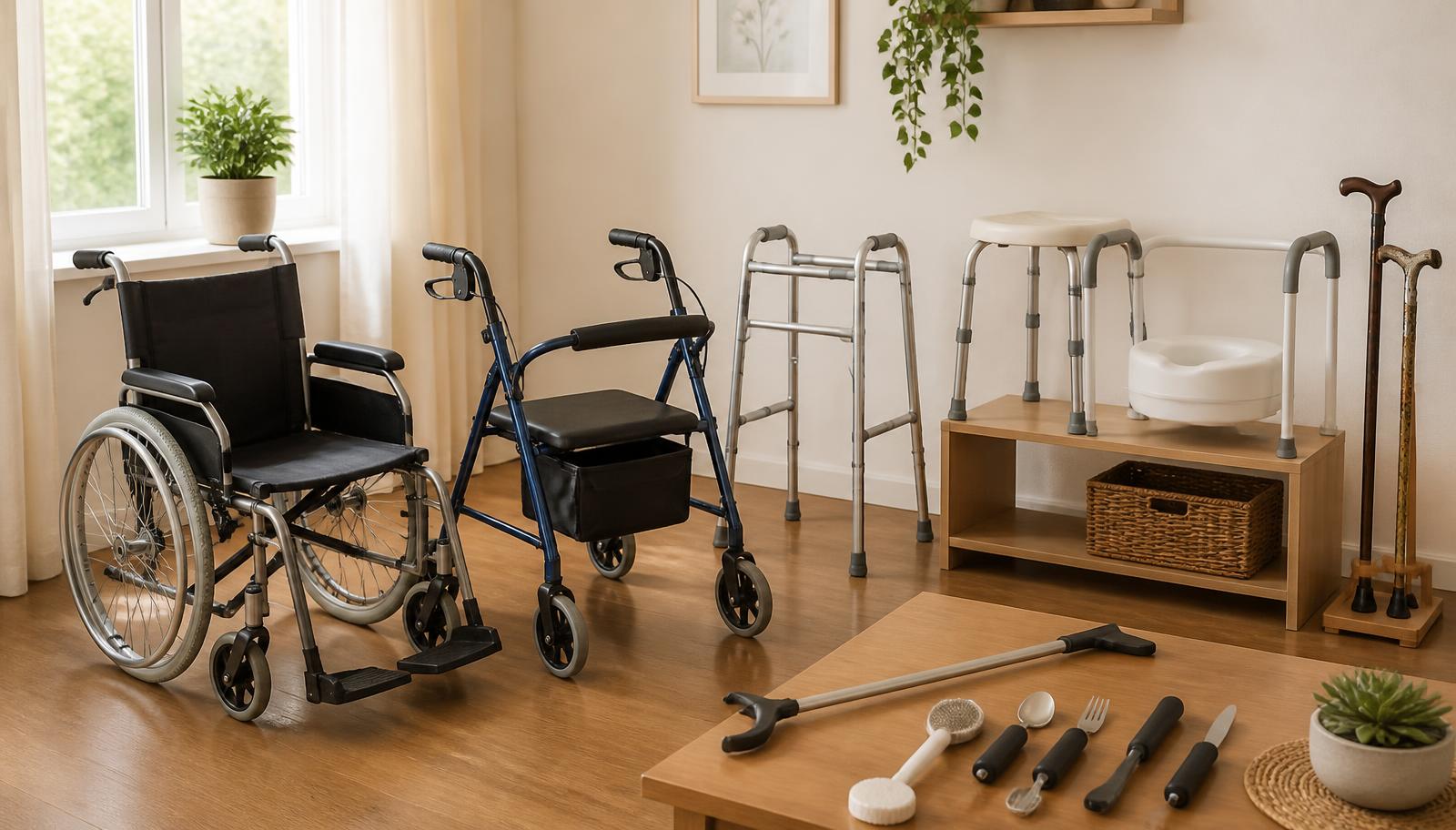
Mobility Aids, Disability Equipment and Home Adaptations
A plain-English United Kingdom guide to equipment that can make everyday life safer or easier at home — from walking aids, wheelchairs and mobility scooters to beds, seating, bathroom and kitchen aids and building adaptations. It explains how to ask for an assessment, what the NHS, councils and social care may provide, how funding differs across the four nations, VAT relief, and how to buy, rent or complain safely.
Reviewed August 2026
Equipment can help — but the right equipment matters more than the price
Mobility aids and disability equipment can make everyday activities safer, less painful or more manageable — but the most expensive product is not automatically the most suitable one. A cheap, well-chosen aid that fits the person and their home is worth far more than an expensive item that is the wrong size, cannot be stored, cannot be charged, or does not suit the way the person actually moves.
Before spending a large amount of money, ask about an assessment and about what the NHS, your council or social-care services may be able to provide or loan. Some equipment is supplied free of charge after an assessment. Some minor adaptations may also be provided or funded. People sometimes buy an item privately, only to be told later that a service could have supplied something more suitable.
Equipment should suit all of the following at once:
- the person — their height, weight, strength, posture, pain, fatigue, balance and understanding;
- their condition — including whether it is stable, improving or likely to change;
- the home — doorway widths, thresholds, stairs, floor surfaces, turning space and storage;
- the activity — washing, dressing, cooking, sleeping, getting outdoors, working or studying;
- anyone helping — family, carers or personal assistants, and their own safety.
Needs change. Equipment that was right two years ago may now be unsafe or unhelpful. Reassessment is normal and is not a sign of failure.
Sixpence Support UK is independent. We do not assess, prescribe or supply equipment, we do not recommend shops, manufacturers or products, and we are not paid by any supplier.
Key points
- Consider a professional assessment before buying — especially for wheelchairs, seating, beds, hoists, stairlifts and bathroom equipment.
- Some equipment may be loaned or supplied through the NHS, a community equipment service or adult social care.
- Funding and assessment arrangements differ across the UK. England, Wales, Scotland and Northern Ireland have different grant systems and different rules.
- Check dimensions, access, storage and charging before purchasing. Measure doorways, corridors, turning space and the boot of any vehicle involved.
- Ask for a demonstration and a written quotation. A reputable seller will provide both without complaint.
- VAT relief may apply to qualifying equipment — but not every product qualifies, and conditions apply to both the product and the buyer.
- Never feel pressured into signing or paying immediately. A genuine price is still there tomorrow.
Where to start
There is no single route into equipment and adaptations, and arrangements vary between areas. Any of the following may be a sensible first contact:
- Your GP or another healthcare professional — who may refer you to therapy or specialist services.
- Your local council adult social-care team — you can usually ask for a needs assessment directly, without a referral.
- Children’s social care or children’s therapy services — for a disabled child or young person.
- Occupational therapy — the service most often involved in daily-living equipment and adaptations.
- Physiotherapy — for walking aids, movement, strength and balance.
- NHS wheelchair services — for manual and powered wheelchairs and specialist seating.
- The community equipment service — which supplies, delivers, maintains and collects loaned equipment in many areas.
- A hospital discharge team — if equipment is needed to get someone safely home.
- Your housing association, council housing team or private landlord — for anything fixed to the property.
- Sensory-support services — for sight or hearing equipment and alerting systems.
- Specialist education services — for equipment a child or student needs to learn and take part.
Referral routes, waiting times and eligibility rules vary locally. If you are told you have contacted the wrong service, ask politely who the correct service is and ask for the referral to be passed on.
What an occupational therapy assessment may involve
An occupational therapist (OT) looks at what a person is trying to do, what is getting in the way, and what would make the activity safer or easier. That may mean equipment, a minor adaptation, a change in how a task is done, building work — or a combination.
An OT may consider:
- moving around the home, including corridors, thresholds and floor surfaces;
- getting in and out of bed, chairs and the bath or shower;
- washing, dressing, grooming and using the toilet;
- preparing food and drinks safely;
- using stairs, steps, ramps and the entrances to the property;
- falls history and falls risk;
- fatigue, pain, strength, stamina, breathlessness and dexterity;
- memory, understanding, concentration, communication and sensory needs;
- the needs and safety of anyone providing care;
- available space, storage, power supply and the structure of the property;
- whether equipment, a minor adaptation or major building work is the most appropriate answer.
An assessment does not guarantee that a particular item or adaptation will be provided or funded. Services apply eligibility criteria, and there may be waiting lists. If you disagree with the outcome, ask for the reasons in writing and ask about the complaints or review process.
Before the assessment, it helps to note
- the tasks that are difficult, and what happens when they go wrong;
- any recent falls, near-falls or injuries;
- which rooms are used and which are avoided;
- who helps, how often, and what they find difficult;
- what already gets tried at home, including improvised arrangements;
- whether the person’s condition is likely to change.
Walking and balance equipment
Walking aids are often thought of as simple, but the wrong height, wrong type or worn-out ferrule (the rubber tip) can increase pain and falls risk. Ask a physiotherapist, occupational therapist or other qualified professional to check the type, height and fit, and to show the person how to use it safely.
Walking sticks
Usually used for light support or confidence on one side. Height, grip shape and the condition of the rubber tip all matter. A stick that is too long or too short can push the body out of position and make balance worse.
Check the tip regularly — worn tips slip. Replace them rather than continuing to use them.
Crutches
Usually issued after injury or surgery, or for longer-term use. Elbow crutches and underarm crutches are used differently, and technique on stairs and slopes should be shown by a clinician.
Walking frames (Zimmer-type frames)
Give more support than a stick, but must be lifted or wheeled and need clear floor space. They may not fit through narrow doorways or be safe on stairs.
Rollators (wheeled frames with brakes)
Often have a seat, a bag and hand brakes. Useful for people who need to rest frequently. The brakes must work properly and the person must be able to operate them reliably. Rollators can be heavy to lift into a car and need storage space.
Perching stools and kitchen or bathroom seating
Allow someone to sit while cooking, washing up or washing at a basin. Height, stability, the surface it stands on and the person’s ability to get on and off safely all need checking.
Transfer aids
Includes turning discs, transfer boards, handling belts and leg lifters. These should be chosen and demonstrated by a professional, because the wrong aid or the wrong technique can injure both the disabled person and the person helping.
A note on technique
This page does not give instructions on how to walk with an aid, how to climb stairs with crutches, or how to transfer someone. Those instructions should come from a physiotherapist, occupational therapist or another qualified clinician who has seen the person.
Manual wheelchairs

A wheelchair is not a single standard product. Chairs differ enormously in width, depth, weight, seating, adjustability and purpose, and a chair that suits one person may cause pain, pressure damage or poor posture in another.
Accessibility can vary by location. Check directly before travelling.
Temporary use and long-term use
A basic chair borrowed for a few weeks after surgery is a different proposition from a chair used all day, every day. Long-term users usually need proper assessment of posture, pressure care and propulsion.
Self-propelled and attendant-propelled chairs
Self-propelled chairs have large rear wheels with handrims so the user can push themselves. Attendant-propelled (transit) chairs have small wheels and must be pushed by someone else. Choosing the wrong one can remove a person’s independence, or make pushing unnecessarily hard.
Seat width, depth, posture and pressure care
Seat dimensions affect comfort, posture, skin health and how easily the chair fits through doorways. A chair that is too wide is harder to push and to get through doors; a chair that is too narrow can cause pressure damage. People at risk of pressure ulcers should have cushions assessed by a professional.
Footplates, cushions, backrests and supports
Footplate height affects pressure through the thighs and heels. Cushions and backrests are part of the seating system, not accessories. Do not assume any cushion will do.
Folding, weight and transport
Check how the chair folds, what it weighs, whether the person who lifts it can do so safely, and whether it fits the vehicle. Ask to try lifting it before buying.
Maximum user weight
Every chair has a maximum user weight. Exceeding it is unsafe and may invalidate the warranty. Bariatric chairs are a specialist area and should be professionally assessed.
NHS wheelchair services
NHS wheelchair services assess eligibility and may provide a chair, cushion and maintenance. In some areas a personal wheelchair budget may be available so that a contribution can be put towards a different chair. Ask your GP, therapist or local service how referral works where you live.
Maintenance, tyres and brakes
Brakes, tyre pressure, castors, upholstery and folding mechanisms need regular checking. If the chair was issued by a service, ask that service to repair it rather than attempting modifications.
Try the chair where it will actually be used
A chair that works well in a showroom may not turn in a small bathroom, fit a hallway, or cope with a sloped path. Where possible, try it at home and on the routes the person actually travels.
Powered wheelchairs and mobility scooters
A powered wheelchair and a mobility scooter are not the same thing. A powered wheelchair is a wheelchair driven by a controller (often a joystick), designed to be sat in for long periods and often used indoors and outdoors. A mobility scooter is steered with handlebars (a tiller), usually needs more space to turn, and generally requires enough trunk control, arm strength, vision and judgement to steer safely.
Class 2 and Class 3 — what the categories mean
In Great Britain, invalid carriages are grouped as Class 2 (for pavement use, limited to 4mph) and Class 3 (which may also be used on the road, limited to 8mph on the road and 4mph on the pavement). Class 3 vehicles must meet extra requirements such as lights, indicators, a horn, a rear-view mirror and a maximum-speed device. Always check the current GOV.UK rules before buying.
Pavement and road use
Pavements are the normal place for these vehicles. Motorways must not be used. There are restrictions on dual carriageways and on cycle lanes and bus lanes. Users should give way to pedestrians and travel at walking pace in busy areas.
Registration with DVLA
Class 3 invalid carriages generally need to be registered with DVLA before being used on the road. Class 2 vehicles do not. Registration rules can change — check the current GOV.UK guidance and keep the paperwork.
Insurance
Insurance is not currently compulsory for these vehicles in Great Britain, but it is widely recommended. Cover may include damage, theft, breakdown recovery and injury or damage caused to others. Read what is actually covered rather than relying on a summary.
Speed, visibility and safe use
Use the lower speed setting in crowded places. Consider lights, reflective items and bright clothing in poor light. Kerb climbing ability varies enormously between models and is a common cause of tipping.
Battery range and charging
Advertised range figures are usually measured in ideal conditions. Real range is reduced by hills, cold weather, rider weight, tyre pressure and battery age. Plan journeys with a margin, and check where the vehicle will be charged before buying.
Storage and fire safety
Batteries and chargers should be used according to the manufacturer’s instructions. Do not block escape routes, communal corridors or stairwells with a scooter — many landlords prohibit this. Ask your landlord or housing provider about storage and charging rules before buying.
Slopes, kerbs and turning space
Check the maximum safe slope, the kerb height it can manage and the turning circle. Measure the doorways, hallway, lift and any ramp at home before purchase.
Transporting the equipment
Some scooters dismantle into parts; the heaviest part may still be too heavy to lift safely. Boot hoists, ramps and vehicle adaptations are a separate area with their own assessment and cost.
Weight, dimensions and user limits
Check the maximum user weight, the total vehicle weight and the dimensions — including whether it fits through your front door and into a lift.
Servicing and breakdowns
Ask before buying: who services it, how often, at what cost, how long repairs take, whether a replacement is provided during repairs, and whether breakdown recovery is available in your area.
Buying second-hand
Batteries are often the most expensive part and the first to fail. Ask about age, service history and whether spare parts are still available. See the second-hand section further down this page.
For vehicles, leasing and the Motability Scheme, see our separate page rather than repeating that information here.
Beds, mattresses and bedroom equipment
Adjustable and profiling beds
Profiling beds allow the head, back and legs to be raised, and height-adjustable beds help with transfers and with carers’ safety. They need space, a power supply and a plan for what happens in a power cut.
Bed rails and bed levers
Bed rails may reduce the risk of rolling out of bed for some people, but they can be dangerous if the wrong size, badly fitted, or used with an unsuitable mattress. Bed levers and grab handles help some people turn or sit up. Both should be assessed and fitted properly.
Transfer equipment
Turning discs, transfer boards, sliding sheets and handling belts reduce strain when moving between bed and chair — but only when the right item is chosen and everyone helping has been shown how to use it.
Pressure-relieving mattresses and cushions
Pressure-relieving equipment is prescribed on the basis of assessed risk, weight, skin condition and mobility. It must be set up correctly and reviewed. Buying a mattress privately without assessment can leave someone with equipment that does not match their level of risk.
Over-bed tables and positioning equipment
Over-bed tables, backrests, wedges and positioning cushions can help with eating, reading and comfort. Positioning equipment used to hold a person in place should be assessed professionally.
Hoists and slings
Hoists and slings must be matched to each other and to the person, and everyone who uses them needs training. Slings have size, weight and loop-configuration limits, and inspection requirements apply to lifting equipment used in care.
Urgent safety warning — bed rails, hoists, slings and pressure care
Bed rails, hoists, slings and pressure-care equipment can cause serious injury or death if they are unsuitable, badly fitted or used without training. Risks include entrapment between the rail and the mattress, falls during a hoist transfer, sling failure and undetected pressure damage.
Do not fit bed rails, use a hoist or change sling arrangements without a suitable assessment, correct fitting and training. If someone is trapped, seriously injured, unconscious or not breathing normally, call 999 immediately. Stop using equipment that looks damaged or unsafe and report it to the supplier or issuing service straight away.
This page does not give clinical pressure-relief repositioning schedules, and it does not give instructions for operating a hoist. Those must come from the issuing service or a trained professional.
Chairs and seating
An ordinary reclining chair from a furniture shop is not the same as assessed specialist seating. Specialist seating considers posture, pressure, pelvic position, leg support, head support and the way a person gets in and out.
Rise-and-recline chairs
These tilt forward to help someone stand. They must be the right seat height, width and depth: a chair that is too deep pushes the person into a poor position, and a chair that lifts too far can be destabilising. Ask for a proper demonstration and try standing from it.
Supportive and postural seating
For people who cannot maintain a stable seated position, specialist seating may be assessed by an occupational therapist, physiotherapist or wheelchair and seating service.
Pressure-relieving cushions
Cushions vary in material, depth, weight limit and lifespan, and some need regular checking or inflation. A cushion should be matched to assessed risk, not chosen on price alone.
Chair raisers
Raisers lift an existing chair to make standing easier. They must be the correct type for the chair’s feet, fitted evenly and checked for stability. Improvised blocks are not safe.
Measuring the person and the room
Seat height, seat depth, seat width, backrest height and armrest height are all measured against the person. Also check the space needed to recline, the space behind the chair, and access for anyone helping.
Electrical safety and power cuts
Powered chairs need a safe socket and cable route. Ask what happens in a power cut — some chairs have a battery backup that returns the chair to a seated position, and some do not.
Trial periods, returns and warranties
Made-to-measure or bespoke chairs may not be returnable in the same way as standard stock. Confirm trial arrangements, cancellation rights and warranty terms in writing before ordering.
Bathroom and toilet equipment
Bathrooms are where many falls and injuries happen. Equipment here has to cope with wet surfaces, limited space and the need for privacy and dignity.
Grab rails
Rails must be fixed into something strong enough to take a person’s full weight. The wall type matters enormously — plasterboard, tiles, stud walls and older masonry all behave differently. Position matters as much as strength: a rail in the wrong place can encourage an unsafe movement.
Shower seats and shower chairs
Wall-mounted, freestanding and wheeled options exist. Check the weight limit, stability on the floor surface, drainage, and whether the person can transfer on and off safely.
Bath boards and bath seats
These help someone get into or sit in a bath. They must fit the bath’s internal width and be secure. They are not suitable for everyone, particularly where standing balance is poor.
Raised toilet seats and toilet frames
Raising the seat can make standing much easier. Height, fixing method and compatibility with the specific toilet pan all need checking, as does whether a frame will still allow the door to close.
Commodes
Useful where the toilet is far away or upstairs. Consider height, stability, comfort, emptying, cleaning and dignity, and where it will be stored during the day.
Level-access showers and wet rooms
This is building work rather than equipment. It usually requires assessment, drainage checks, landlord or owner permission and possibly building regulations approval. See the adaptations and grants sections below.
Bath lifts
Powered bath lifts lower and raise a person in the bath. Check weight limits, battery charging, how the lift is removed for other household members, and what happens if the battery fails mid-use.
Non-slip measures
Non-slip mats, flooring and strips reduce risk, but they must be suitable for the surface and cleaned properly. A curling or loose mat is itself a trip hazard.
Space for carers
If someone helps with washing or toileting, the room must have space for both people to move safely. This is often the deciding factor between equipment and an adaptation.
Before drilling or fitting anything
Do not fit grab rails or other safety equipment without checking the wall construction, choosing the right fixings, and confirming the position suits the person’s actual movement. Check for pipes and cables. In rented or leasehold property you will usually need the owner’s written permission.
Kitchen and everyday-living aids
Small, inexpensive aids sometimes solve a problem completely, without any need for major alterations. They are often overlooked because they are undramatic.
- easy-grip and chunky-handled utensils, and adapted cutlery;
- kettle tippers and lightweight or one-cup kettles;
- reaching aids and grabbers for high or low items;
- jar, tin and bottle openers, including electric versions;
- non-slip mats, plate guards and angled or lipped crockery;
- one-handed equipment such as chopping boards with spikes and food guards;
- medication organisers, pill dispensers and reminder alarms;
- dressing aids — long-handled shoehorns, sock aids, button hooks, zip pulls and elastic laces;
- long-handled sponges, brushes and washing aids;
- kitchen trolleys and carrying aids for moving items safely;
- adapted controls, large-print or tactile markings, rocker switches and plug pulls.
An occupational therapist can often suggest a simple aid that suits the person’s grip and strength. Where a service does not supply small items, independent advice websites can help you understand the options before you buy anything.
Sensory and communication equipment
Equipment is not only about movement. Alerting, magnification, listening and communication equipment can make a home safer and much less isolating.
- flashing, vibrating or pillow-pad smoke alarms and carbon monoxide alarms;
- vibrating and visual doorbells, telephone alerts and baby or carer alerts;
- magnifiers, task lighting, high-contrast marking and large-print labelling;
- screen readers, screen magnification and accessible device settings;
- hearing loops, personal listening devices and TV listeners;
- communication aids, from simple charts to speech-generating devices;
- easy-read, symbol-based and pictorial materials;
- voice control, smart plugs and environmental controls for lights, doors and curtains;
- reminder technology, clocks, calendars and prompting devices.
Local sensory-support teams, the fire and rescue service (for alarms) and social care may be able to assess or provide some of these items. Ask before buying.
Equipment for children
Children’s equipment is a specialist area. A child is growing, developing and learning, and equipment has to support all of that rather than simply keeping them safe.
- Growth — equipment may need adjusting or replacing regularly.
- Posture — seating and standing equipment can affect development and comfort.
- Development and play — equipment should support participation, not restrict it.
- Education — school, college and exam arrangements may need specific equipment.
- Transport — car seating, wheelchair transport and school transport all need checking.
- Family and carers — the home, siblings and the people lifting all matter.
- Review — regular reassessment is normal for children.
- Safeguarding — restrictive equipment must never be used as a substitute for supervision, and any concern about a child’s safety should be raised with the local authority or the police.
Children’s occupational therapy, physiotherapy, wheelchair services, community paediatric services, schools and local authorities may all be involved. Do not order complex equipment for a child based on measurements alone, or from an online description.
Home adaptations: minor and major
Adaptations change the property itself. They are usually divided into minor works (often small, quick and sometimes provided free by the council) and major works (which normally require assessment, approval and funding).
Minor adaptations
Grab rails, handrails, half-steps, banister rails, lever taps, small ramps, additional lighting and similar items. In many areas minor adaptations under a set value are provided without charge following assessment, though the arrangements vary between councils and nations.
Ramps and safer entrances
A ramp needs the right gradient, width, surface, handrails and landing space — a steep, short ramp can be more dangerous than a step. Doors, thresholds, door widths, lighting and door entry systems may all need to be considered together.
Widened doorways and internal changes
Widening doorways, removing thresholds or moving a wall may be needed for wheelchair access. This is building work and needs proper assessment and, usually, formal approvals.
Stairlifts
Straight and curved stairlifts differ hugely in price and lead time. Assessment should cover whether the person can transfer on and off safely at both ends, what happens in a power cut, whether other household members can still use the stairs, and whether a stairlift is the right answer at all.
Through-floor lifts
A through-floor lift may suit someone who cannot use a stairlift. It requires structural work, space above and below, servicing arrangements and a plan for emergencies and power failure.
Accessible bathrooms and level-access showers
One of the most common major adaptations. Consider drainage, floor structure, heating, ventilation, turning space and the needs of anyone assisting.
Kitchen alterations
Height-adjustable or lowered worktops, accessible storage, lever taps and repositioned sockets can make a kitchen usable. Assessment should reflect what the person actually wants to do in the kitchen.
Lighting, heating and controls
Improved lighting, relocated sockets and switches, accessible heating controls and door entry systems are often inexpensive compared with structural work and can make a large difference.
Downstairs sleeping or washing facilities
Where stairs cannot be managed, an extension or conversion providing a downstairs bedroom or bathroom may be considered. These are the largest and slowest schemes and usually involve grant funding.
Permissions matter — get them in writing
- Tenants normally need the landlord’s or housing association’s written permission before any fixed adaptation.
- Leaseholders may need freeholder consent, and there may be lease conditions.
- Building regulations may apply to structural work, drainage, electrics and ventilation.
- Planning permission may be needed for extensions, external ramps or changes affecting the appearance of a property, and listed buildings and conservation areas have extra rules.
- Never start work before written approval where grant funding is involved — starting early can make the work ineligible.
Disabled Facilities Grants and national differences
Grant schemes for home adaptations are not identical across the United Kingdom. The name, the assessing body, the maximum amount, the means test and the treatment of disabled children all differ. Always check the rules for the nation you live in, because maximum amounts and conditions change over time.
England — Disabled Facilities Grant (DFG)
In England you apply to your local council. An occupational therapy assessment usually establishes what is necessary and appropriate, and the housing authority decides whether the work is reasonable and practicable. The grant is generally means-tested for adults, but applications for a disabled child under 19 are generally not means-tested against the parents’ income. Councils may also offer discretionary assistance. Check current maximum amounts and conditions on GOV.UK and with your council.
Wales — Disabled Facilities Grant and other schemes
Wales also has a Disabled Facilities Grant administered by local authorities, alongside other Welsh Government schemes for adaptations, and Care & Repair services that help older and disabled people arrange work. Rules, maximum amounts and means-testing arrangements differ from England — check Welsh Government guidance and your local authority.
Scotland — adaptations and Scheme of Assistance
Scotland does not use the Disabled Facilities Grant system. Support comes through local authority assessment and the Scheme of Assistance, which may provide equipment, minor adaptations and grants for certain major adaptations, with different rules for owners, private tenants and social tenants. Care and Repair services also operate in Scotland. Check mygov.scot and your council.
Northern Ireland — adaptations and the Housing Executive
In Northern Ireland, arrangements involve Health and Social Care Trust occupational therapy assessment together with the Northern Ireland Housing Executive or your housing association for social tenants, and Disabled Facilities Grants administered by the Housing Executive for owners and private tenants. Check nidirect and the Housing Executive for current rules.
What is generally true across the UK
- An assessment of need normally comes first, usually involving occupational therapy.
- The funding body decides whether the proposed work is necessary, appropriate and reasonable.
- Adults may face a financial assessment; disabled children are often treated differently.
- You may be asked to contribute, and some schemes place conditions on the property.
- Maximum amounts and rules change — never rely on a figure quoted by a salesperson.
- Starting work before written approval can affect eligibility and may leave you paying the whole cost.
- A grant is never guaranteed. Waiting times can be long, and refusals happen.
Equipment provided or loaned by services
Equipment obtained through the NHS or social care may be:
- supplied outright, for example many small daily-living aids;
- loaned for as long as it is needed, remaining the property of the service;
- recycled — cleaned, checked and reissued after someone else has finished with it;
- maintained, serviced and repaired by the issuing service;
- required to be returned when it is no longer needed.
Whenever equipment arrives, ask and write down:
- who owns it;
- who repairs it, and the telephone number to call;
- what to do if it breaks at night or at a weekend;
- how often it is serviced or inspected;
- whether there is a charge for anything;
- how and when it should be returned.
Recycled equipment is not second-rate: it is cleaned and safety-checked, and reuse means services can help more people.
Buying equipment privately — a checklist
Before you pay anything
- Ask for an assessment first where the item is complex, expensive or fixed to the property.
- Obtain more than one written quotation, and compare like with like.
- Check the total price — delivery, installation, removal of old items and any survey fee.
- Ask whether VAT has been charged correctly, and why.
- Check measurements, maximum user weight and whether it fits the space.
- Ask for a proper demonstration, ideally at home, with the person who will use it.
- Test the controls, the comfort and getting in and out — not just sitting still.
- Check access through doors, hallways, lifts and around furniture.
- Confirm charging arrangements and where the item will be stored.
- Ask about servicing intervals and the cost of repairs and parts.
- Read the warranty, the cancellation terms and what voids them.
- Ask whether replacement equipment is provided while yours is repaired.
- Confirm your return rights in writing before you order.
- Never rely only on a salesperson’s verbal promise.
- Do not sign blank or incomplete paperwork.
- Do not accept pressure about a “today only” price.
Take someone with you, or ask a trusted person to be present during a home visit. There is nothing rude about saying “I will think about it and call you tomorrow.”
Buying second-hand
Second-hand equipment can be good value, but check carefully:
- the product’s history and why it is being sold;
- age and general condition, including frame damage, welds and upholstery;
- battery age, charge-holding and whether replacements are available;
- service records and any inspection certificates for lifting equipment;
- whether the model has been subject to a safety recall;
- whether instructions, chargers and parts are included;
- whether the size and settings can be adjusted to fit the person;
- hygiene and cleaning, particularly for seating, slings and commodes;
- whether the manufacturer still supports the model with spare parts;
- a safe inspection before first use, ideally by a competent engineer.
Your consumer rights differ depending on who you buy from. Buying from a business gives you far stronger protection than buying privately from an individual, where “sold as seen” has real consequences. Buying online from a private seller carries additional risk.
Some items should not be bought second-hand without professional advice
Hoists, slings, pressure-relieving mattresses, specialist seating, powered wheelchairs and stairlifts involve safety-critical fitting, load limits, inspection requirements and compatibility issues. Take professional advice before buying any of these second-hand.
Renting or hiring equipment
Hiring can make sense for:
- short-term illness, injury or recovery after an operation;
- holidays and days out, including scooters at some venues;
- visitors staying at your home;
- trying a type of equipment before committing to buying it.
Before hiring, confirm in writing:
- the deposit and how and when it is refunded;
- delivery, collection and installation charges;
- damage charges and what counts as fair wear and tear;
- whether insurance is included or required;
- cleaning arrangements and who is responsible;
- what happens if the equipment fails — repair, replacement or refund;
- how to end the hire and what notice is needed.
VAT relief on disability equipment
Some goods and services that are designed or adapted solely for use by a disabled person, and are for that person’s personal or domestic use, may be zero-rated for VAT. Certain building work to adapt a home for a disabled person may also qualify. This can make a real difference to cost — but the rules are specific.
What to understand about VAT relief
- Not every product used by a disabled person qualifies. The item generally has to be designed or adapted solely for disabled people.
- Ordinary household products do not become VAT-free simply because a disabled person will use them.
- Both the product and the purchaser must meet the conditions, including that the goods are for personal or domestic use.
- The supplier is responsible for applying the correct VAT treatment — not the buyer.
- You will usually be asked to complete a short eligibility declaration. You do not need to send anything to HMRC yourself, and you do not need to be registered disabled.
- Check current HMRC guidance, because reliefs and interpretations change.
Be cautious of any seller who uses VAT as a pressure tactic, refuses to explain the VAT treatment, or asks you to describe a condition inaccurately on a declaration. Sixpence Support UK cannot give tax advice and cannot confirm whether a particular item qualifies.
Help with the cost of equipment
No route is guaranteed, and eligibility depends on individual circumstances, but the following are worth exploring:
- NHS services and community equipment services, which may supply or loan equipment;
- local-authority adult or children’s social care following an assessment;
- Disabled Facilities Grants and the equivalent schemes in each nation;
- housing associations and councils, for adaptations to their own properties;
- Access to Work, for equipment and support needed to do a job;
- education support for children and students, including disabled students’ support at university;
- personal budgets, direct payments or personal wheelchair budgets where available;
- grants from independent charitable organisations, including condition-specific charities;
- benefits that help with general living costs rather than a specific item;
- renting rather than buying, where the need is short-term or uncertain.
Safety, servicing and recalls
- read and keep the instructions, and pass them on if the equipment changes hands;
- observe the maximum user weight and any load limits;
- inspect regularly for cracks, loose bolts, frayed straps and worn tips;
- check brakes, tyres, castors and wheel locks;
- use only the correct charger, and stop using a battery that swells, leaks or overheats;
- keep cables safe, avoid trailing leads and do not overload sockets;
- do not block escape routes or charge equipment in a hallway used for escape;
- check that hoists and slings are compatible and within their inspection dates;
- clean equipment according to the manufacturer’s instructions, particularly shared items;
- record faults, dates and who you reported them to;
- check for manufacturer recalls and register the product where offered;
- stop using anything that appears unsafe and contact the supplier or issuing service.
Urgent: when equipment causes immediate danger
Call 999 if there is a fire, if someone is trapped, unconscious, not breathing normally, has serious bleeding or a suspected serious injury.
If a battery or charger is smoking, burning or overheating, do not tackle it yourself — get everyone out and call 999. For urgent medical advice that is not an emergency, call 111 (or 999 if you are unsure and the person is deteriorating).
Afterwards, report the product: unsafe consumer products can be reported through GOV.UK, and problems with medical devices can be reported to the MHRA through the Yellow Card scheme.
Aggressive selling and scams
Most suppliers are honest. A minority target disabled and older people, especially at home. Warning signs include:
- uninvited doorstep or telephone sales, or a “free assessment” that turns into a sales visit;
- pressure to decide today, or a salesperson who will not leave;
- large “discounts” from an inflated original price;
- claims that a product is medically approved or recommended, with no evidence;
- refusal to provide a written, itemised quotation;
- requests for bank transfers, cash or unusual payment methods;
- vague company identity, no address, or a name that differs from the paperwork;
- misleading claims about VAT, grants or council funding;
- no clear cancellation information;
- encouragement to exaggerate a disability on a form.
You are entitled to take your time. Ask for everything in writing, ask a trusted friend or relative to be present, and check the company independently before paying. If you think you have been targeted by fraud, report it.
Consumer rights and complaints
Your protection depends partly on how and where you bought the item. In general terms:
- Buying in a shop — you can inspect the goods first, and rights apply if the item is faulty, not as described or not fit for purpose.
- Buying online or by telephone — distance selling normally brings additional cancellation rights, with exceptions for bespoke or made-to-measure items.
- Buying during a home visit — off-premises sales normally carry cancellation rights and the trader must give you written information about them.
- Buying from a business — full consumer protection applies.
- Buying privately — protection is far more limited; the item mainly needs to match its description.
If there is a problem:
- contact the seller in writing and keep a copy;
- keep advertisements, quotations, receipts, order forms and photographs;
- record faults, dates, names and what was said;
- contact the finance provider if you paid by credit card or finance, as they may share liability;
- seek consumer advice from Citizens Advice, Advice Direct Scotland or Consumerline in NI;
- report unsafe products through the official route;
- escalate through the trader’s complaints procedure, and ask about any ombudsman or trade body.
Time limits and remedies depend on the circumstances, so we do not quote a guaranteed refund deadline here. Get advice on your specific situation.
If equipment no longer meets the person’s needs
- ask for a reassessment — needs change, and that is expected;
- contact the issuing service first if the equipment was loaned;
- do not make unofficial modifications, which can be dangerous and may void warranties;
- review changes in posture, strength, weight, pain, vision, memory or condition, since any of these can make equipment unsuitable;
- return loaned equipment promptly so it can be cleaned and reissued;
- dispose of, recycle or resell privately owned equipment safely and honestly;
- remove personal information from smart or connected equipment, and unpair it from phones and accounts, before passing it on.
Carers and people helping someone else
If you help someone else, your safety matters too. Back injuries among family carers are common and often preventable.
- ask for training and a demonstration whenever new equipment arrives;
- ask for a carer’s assessment — support, equipment and respite may be available to you as well as the person you care for;
- use the equipment provided rather than lifting manually;
- report faults promptly and stop using anything that seems unsafe;
- plan for what happens if you are ill or unavailable;
- involve the disabled person in every decision — it is their body, their home and their equipment, and dignity and choice come first.
Please do not improvise lifting
Family members should not be expected to lift or drag someone manually. If moving the person is unsafe, that is a reason to ask for reassessment and proper equipment, not a reason to try harder.
Appointment and purchasing checklist
Questions to work through
- What activity is actually difficult, and when?
- Where will the equipment be used — which rooms, indoors, outdoors?
- Has an assessment been requested, and by whom?
- Is public provision available through the NHS, council or equipment service?
- What measurements are needed — person, doorways, spaces, vehicle?
- Will it fit through doors and around the furniture as it is now?
- Is there somewhere to store it safely?
- How and where will it be charged, if powered?
- Can it be transported, and by whom?
- Is training required, and who provides it?
- Who maintains, services and repairs it?
- What is the full lifetime cost — servicing, batteries, parts, insurance?
- Does VAT relief apply, and has the supplier explained why?
- What are the warranty, trial and cancellation terms in writing?
- Is written landlord, freeholder or council permission needed?
- What happens if the person’s needs change within a year?
Where to find official information
NHS guidance
Rules, grants and tax
Councils, assessments and the four nations
Safety, consumer advice and independent information
Trusted organisations and further support
Independent UK disability organisations
Each button opens the organisation's official website in a new tab.
These organisations are independent of Sixpence Support UK. Their inclusion is for information and signposting and does not imply a partnership or endorsement.
Related pages on this website
Important — please read
Sixpence Support UK CIC provides general information only. We do not assess, prescribe, fit or supply equipment. We do not recommend commercial suppliers, shops, manufacturers or products, and we receive no payment for mentioning any product or company.
We cannot guarantee that any funding, grant, loan of equipment or VAT relief will be available to you. Rules, maximum amounts and eligibility change, and they differ across England, Wales, Scotland and Northern Ireland.
This page does not replace advice from an occupational therapist, physiotherapist, wheelchair service, healthcare professional, housing officer or qualified adviser who knows your circumstances. Always check current official guidance before making a decision.
- [1] NHS. Social care and support guide · 2026
- [2] NHS. Getting a needs assessment · 2026
- [3] NHS. Care services, equipment and home adaptations · 2026
- [4] NHS. Home adaptations · 2026
- [5] NHS. Falls — overview and prevention · 2026
- [6] GOV.UK. Mobility scooters and powered wheelchairs: the rules · 2026
- [7] GOV.UK. Disabled Facilities Grants (England) · 2026
- [8] GOV.UK. Financial help if you are disabled — VAT relief · 2026
- [9] HM Revenue & Customs. Reliefs from VAT for disabled and older people (Notice 701/7) · 2026
- [10] HM Revenue & Customs. VAT relief on certain building work if you have a disability · 2026
- [11] GOV.UK. Access to Work · 2026
- [12] GOV.UK. Find your local council · 2026
- [13] mygov.scot. Health and social care (Scotland) · 2026
- [14] Care Information Scotland. Care Information Scotland — care, equipment and adaptations · 2026
- [15] Welsh Government. Housing adaptations (Wales) · 2026
- [16] nidirect (Northern Ireland Government). Disabled people — information and services · 2026
- [17] Northern Ireland Housing Executive. Adaptations for people with disabilities · 2026
- [18] GOV.UK. Product safety guidance · 2026
- [19] MHRA. Yellow Card scheme — report a medical device problem · 2026
- [20] Citizens Advice. Consumer advice · 2026
- [21] Citizens Advice. If you have changed your mind — cancellation rights · 2026
- [22] nidirect. Disabled people — information and services · 2026
- [23] Disability Rights UK. Information and advice for disabled people · 2026
- [24] Living Made Easy (Disabled Living Foundation / Shaw Trust). Impartial advice on daily living equipment · 2026
- [25] Age UK. Care and housing advice · 2026
- [26] Foundations. Home Improvement Agencies and Disabled Facilities Grants (England) · 2026
- [27] GOV.UK. Care Act 2014 Part 1 factsheets · 2026
- [28] Action Fraud. Report fraud and cyber crime · 2026
- [29] Health and Safety Executive. Musculoskeletal disorders and manual handling · 2026
- [30] GOV.UK. Apply for a Blue Badge · 2026