
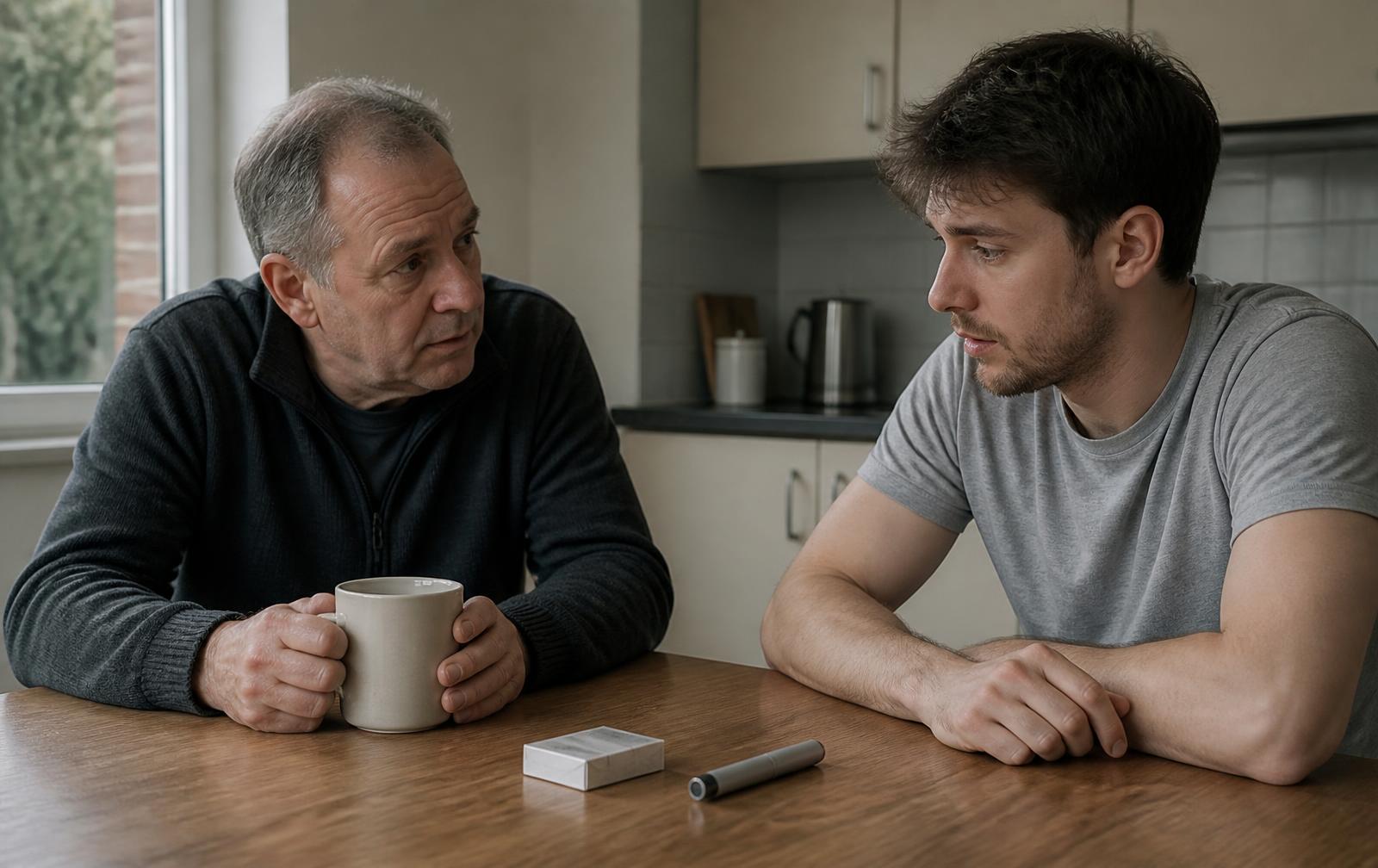
Smoking, Vaping and Nicotine: Health Risks and Getting Help
A calm, factual and non-judgemental United Kingdom guide to cigarettes, tobacco, vapes and nicotine — what the evidence actually says, what the risks are at every age, the honest difference between smoking and vaping, and how to get free NHS help to stop without being blamed or shamed.
Reviewed August 2026
Cigarettes, tobacco, vapes and nicotine explained
Tobacco products such as cigarettes, roll-ups, cigars, pipes and shisha work by burning tobacco. Burning creates smoke, and that smoke contains tar, carbon monoxide and thousands of other chemicals, many of which are harmful and some of which cause cancer. Most of the serious harm from smoking comes from burning and inhaling smoke.
Vapes (also called e-cigarettes) do not burn tobacco. A battery heats a liquid — usually containing propylene glycol, vegetable glycerine, flavourings and, in most products, nicotine — until it becomes an aerosol that is breathed in. Because nothing is burned, there is no tar and no carbon monoxide, and a person who switches completely is exposed to fewer toxins, at lower levels, than a person who smokes.
Nicotine is the addictive substance found in tobacco and in most vapes. It is also sold as licensed medicine in nicotine-replacement therapy — patches, gum, lozenges, sprays, inhalators and pouches of various kinds. Nicotine is addictive and is not recommended for children, young people or people who are pregnant without professional advice, but nicotine on its own is not the main cause of the cancers, heart disease and lung disease linked to smoking.
These products are not all the same and should not be described as though they carry identical risk. Sorting them honestly is the only way people can make an informed decision. This page gives general information only and cannot replace advice from a GP, pharmacist, midwife or stop-smoking adviser.
Call 999 or go to A&E now
Call 999 immediately, or go to A&E, if someone has:
- severe difficulty breathing, or is fighting for breath
- blue, grey or unusually pale lips, face or skin (on brown or black skin, check the lips, gums, tongue, palms and soles)
- severe chest pain, or pain spreading to the arm, neck, jaw or back
- collapsed, or has lost consciousness or cannot be woken
- had a seizure or fit
- a serious burn, or has been injured by a device or battery fire
- become seriously unwell after swallowing nicotine liquid — this is a particular danger for young children and pets, and can also affect adults
- any other immediate threat to life
If you are calling for help:
- Do not drive yourself in a serious emergency — call an ambulance.
- Tell the call handler what product may have been used, including anything unknown, illegal or homemade.
- Keep the packaging, bottle or device so professionals can see it — only if it is safe to do so.
- Do not try to make the person vomit.
- Follow the instructions given by the emergency services.
You will not be wasting anyone’s time. Nobody will be judged for asking for help.
Urgent advice — get medical help today
This is for symptoms that are worrying but not immediately life-threatening. Contact NHS 111 (England and Wales), NHS 24 on 111 (Scotland) or your GP — in Northern Ireland contact your GP or the GP out-of-hours service — if there is:
- a cough that will not go away, is getting worse, or has lasted three weeks or more
- coughing up blood, or blood-streaked phlegm
- getting breathless doing things that used to be easy
- a hoarse voice lasting more than three weeks
- a mouth ulcer, sore, lump or white or red patch that has not healed in three weeks
- unexplained weight loss, night sweats or persistent tiredness
- repeated chest infections
- persistent chest tightness, wheezing or dizziness after using a product
- skin or eye contact with nicotine liquid causing burning, rash or swelling — rinse with plenty of water and seek advice
- any concern that a child or vulnerable adult may have swallowed or handled nicotine liquid, even if they seem well
Key points
- Smoking is extremely harmful at every age — it damages nearly every organ in the body.
- Stopping helps, even after many years or decades of smoking. Benefits begin within days.
- Vaping is less harmful than smoking for an adult who switches completely — but it is not harmless.
- Children, young people and people who have never smoked should not vape.
- Nicotine dependence is real, it is not a lack of willpower, and free support is available.
- Expert quitting support makes success far more likely than trying alone.
- A setback is not a failure. Most people who stop for good have tried before.
What smoking does to the body
Tobacco smoke affects almost every system in the body. The effects build up over time, but some begin quickly — and improvements also begin quickly once someone stops.
Lungs and breathing
Smoke damages the tiny hairs (cilia) that clear the airways, which is why a smoker’s cough develops. Over time it narrows and inflames the airways and destroys lung tissue, causing chronic obstructive pulmonary disease (COPD), which includes emphysema and chronic bronchitis. Smoking also triggers and worsens asthma, and increases the risk of chest infections and pneumonia.
Heart and circulation
Smoking damages the lining of blood vessels, raises blood pressure and heart rate, thickens the blood and speeds up the furring of the arteries. It raises the risk of heart attack, angina, abdominal aortic aneurysm and peripheral arterial disease, which can cause painful legs and, in severe cases, tissue loss.
Stroke risk
Smoking substantially increases the risk of stroke, by damaging blood vessels in the brain and making clots more likely. Stopping reduces this risk over time.
Cancer
Smoking is the single biggest preventable cause of cancer in the UK. It is linked to cancers of the lung, mouth, throat, voice box, oesophagus, bladder, kidney, pancreas, bowel, stomach, liver, cervix and some blood cancers. Risk falls after stopping, though it does not return to that of a lifelong non-smoker immediately.
Mouth, gums and teeth
Smoking stains teeth, causes bad breath, reduces the sense of taste and smell, and is a major cause of gum disease and tooth loss. It also delays healing after dental treatment and makes mouth cancer more likely.
Bones and healing
Smoking weakens bone, contributing to osteoporosis and fractures, and it slows the healing of broken bones and surgical wounds. Many surgical teams ask people to stop before an operation because it lowers the risk of complications and infection.
Fertility and sexual health
Smoking reduces fertility in all genders. It can affect sperm quality and count, reduce the chance of conceiving, increase the risk of miscarriage and bring on an earlier menopause. It is also a common cause of erectile difficulties because of its effect on blood vessels.
Pregnancy
Smoking in pregnancy restricts the baby’s oxygen supply and increases the risk of miscarriage, stillbirth, premature birth, low birth weight and sudden infant death. Stopping at any stage of pregnancy helps — see the pregnancy section further down this page.
Skin and ageing
Reduced blood flow and damage to collagen and elastin lead to earlier wrinkling, a dull or greyish complexion and slower skin healing. Smoking also worsens some skin conditions and delays wound repair.
Eyes
Smoking increases the risk of age-related macular degeneration, cataracts and dry eye, and it can worsen eye complications of diabetes and thyroid eye disease.
Diabetes and long-term conditions
Smoking increases the risk of developing type 2 diabetes and makes existing diabetes harder to control. It worsens kidney disease, circulation problems, foot ulcers and many long-term conditions, and it can interact with some medicines.
Mental wellbeing and dependence
Nicotine dependence creates a cycle: withdrawal causes tension and irritability, and the next cigarette relieves it, which feels like stress relief. Research suggests that people who stop smoking tend to report improved anxiety, depression and general wellbeing over the following weeks and months, once withdrawal settles.
Around two-thirds of long-term smokers die from smoking-related illness, and smoking remains the leading cause of preventable death and disease in the UK. Figures are drawn from NHS and official UK public-health sources reviewed in August 2026.
Different forms of tobacco
All burned tobacco products are harmful. Words such as “natural”, “additive-free”, “herbal”, “filtered”, “water-filtered”, “light”, “organic” or “hand-rolled” do not make a product safe. This section describes what these products are; it does not explain how to use any of them.
Cigarettes
Manufactured cigarettes burn processed tobacco. Filters and “smoother” blends do not remove the main harms — people often inhale more deeply, which can offset any theoretical difference.
Roll-up (hand-rolling) tobacco
Roll-ups are not a safer choice. They deliver tar, carbon monoxide and the same range of harmful chemicals, and are often smoked without a proper filter.
Cigars
Cigars contain large amounts of tobacco and produce a high volume of smoke. Even when smoke is not inhaled deeply, cigars raise the risk of cancers of the mouth, throat and oesophagus, and they expose other people to second-hand smoke.
Pipes
Pipe smoking causes cancers of the mouth, lip, tongue and throat, gum disease and other tobacco-related illness. It is not a gentle alternative to cigarettes.
Shisha and waterpipes
Shisha is often assumed to be filtered and mild because the smoke passes through water. Water does not remove the harmful chemicals. A single shisha session can last a long time and may involve inhaling a large volume of smoke, along with carbon monoxide from the burning charcoal. Sharing a mouthpiece can also spread infection.
Bidi
Bidis are small hand-rolled products wrapped in leaf. They are not a safer traditional option — they can deliver high levels of tar, nicotine and carbon monoxide.
Smokeless and chewing tobacco
Tobacco that is chewed, sucked or held in the mouth is not smoked, but it still causes serious harm, including mouth, gum and throat disease, tooth loss and cancers of the mouth and oesophagus, as well as nicotine dependence.
Paan, gutkha and betel products
Paan, gutkha, supari, betel quid and similar products are widely used in some communities, sometimes with tobacco and sometimes without. Areca (betel) nut is itself linked to mouth cancer, and adding tobacco increases the risk further. These products can also cause a stiffening of the mouth that makes it hard to open the jaw. NHS information about paan, bidi and shisha is linked below.
What vaping involves
A vape has a battery, a heating coil and a supply of e-liquid held in a pod, cartridge or refillable tank. The coil heats the liquid to form an aerosol. Devices range from small pod systems to larger refillable tanks.
Devices, pods, tanks and e-liquids
Pod systems use pre-filled or replaceable pods. Tank systems are refilled from bottles of e-liquid. E-liquids vary in nicotine strength and in the type of nicotine used. In the UK, nicotine e-liquid sold to consumers is limited to a maximum strength of 20 mg/ml, refill bottles to 10 ml and tanks to 2 ml.
Nicotine and non-nicotine vapes
Some vapes contain no nicotine. These are not risk-free either — the aerosol and flavourings are still inhaled — and non-nicotine products are sometimes mislabelled. Nicotine-free does not mean harm-free.
Regulated versus illegal or counterfeit products
Legally sold UK nicotine vapes must be notified to the MHRA, meet limits on strength and volume, carry warnings and ingredient information, and use child-resistant, tamper-evident packaging. Illegal or counterfeit products can bypass all of that — with unknown contents, excessive nicotine or oversized tanks. See the section on illegal vapes below.
Short-term effects some people notice
Coughing, a dry or irritated throat, a dry mouth, headache, nausea, dizziness or a racing heartbeat can occur — particularly with a nicotine strength that is too high for the person. If symptoms persist or are severe, seek advice from a pharmacist or GP.
What is not yet known
Vaping is relatively new, so the long-term effects over several decades are not yet known. Current UK evidence reviews conclude that vaping poses a small fraction of the risk of smoking in the short and medium term, while making clear that it is not risk-free and that non-smokers should not start.
Health reactions and product defects
Some people have allergic-type reactions to flavourings or ingredients. Devices can also be faulty, leak or overheat. Suspected side effects and defective products can be reported through the MHRA Yellow Card scheme.
UK-regulated vapes are not completely safe. Regulation reduces certain risks; it does not remove them.
Honest comparison: smoking and vaping are not the same
- Cigarettes burn tobacco. Burning creates tar, carbon monoxide and many toxic and cancer-causing chemicals. This is where most of the serious harm comes from.
- Regulated nicotine vapes do not burn tobacco. They expose the user to fewer toxins, and at lower levels, than cigarette smoke.
- For an adult who smokes, switching completely can reduce harm, and NHS services offer vaping as one recognised way to stop smoking.
- The safest option is not to smoke and not to vape.
- Vaping should not be taken up by children, by people who have never smoked, or by people who have already stopped using nicotine.
- Continuing to smoke while also vaping (“dual use”) is best treated as a step on the way to stopping smoking, needing more support — not as the same thing as switching completely.
You may see the claim that vaping is “95% safer”. That figure came from an expert estimate and was never intended as a precise calculation of one person’s risk. The accurate and honest statement is that vaping is substantially less harmful than smoking, but not harmless, and its long-term effects are still being studied.
“Popcorn lung”: this is a rare lung condition linked to inhaling high levels of diacetyl in an industrial setting. Diacetyl is banned from e-cigarettes and e-liquids in the UK, and there is no good evidence that UK-regulated nicotine vapes cause it. Repeating the claim can push people back towards cigarettes, which are far more dangerous.
Children and young people
Vaping is intended as a tool to help adults stop smoking. It is not intended for children or young people, and it is not for anyone who does not already smoke. It is illegal to sell nicotine vapes to anyone under 18 in the UK.
At the same time, it is important to keep the facts calm and accurate. Many young people try something once or twice and stop. Trying a vape does not mean a young person will inevitably become permanently addicted, and it does not mean they will start smoking cigarettes. Fear-based messages tend to stop young people asking for help.
Developing dependence
Regular nicotine use can lead to dependence, and the teenage brain is still developing. Young people who vape often may find they need it more frequently, feel uncomfortable without it, and struggle to cut down.
Cravings and withdrawal
Cravings, irritability, restlessness and feeling on edge between vapes are signs of dependence. These feelings are real, they are not bad behaviour, and they do ease with support.
Concentration, mood and sleep
Some young people notice difficulty concentrating in lessons, low mood or irritability, and disturbed sleep — particularly if they wake to vape or use it late at night.
Physical effects
Coughing, a sore or dry throat, dizziness, headaches and nausea are commonly reported, especially with high nicotine strengths or heavy use.
Peer pressure
Vaping is often social. Young people may feel pressure to join in, to share a device, or to avoid standing out. Talking through how to say no — and having a ready phrase — helps more than a warning.
Social media influence
Vaping content circulates widely online, often designed to look appealing and sometimes posted by sellers. Content promoting products to under-18s can be reported to the platform, and misleading advertising can be reported to the Advertising Standards Authority.
Flavours, packaging and appearance
Sweet flavours, bright packaging and small, easily hidden devices are attractive to young people and are a key reason for tighter UK rules. Any product designed to look like sweets or a children’s item should be treated as a serious warning sign.
School rules
Most schools and colleges prohibit vaping on site and may confiscate devices. Policies differ, and a young person who is dependent needs support alongside any rule enforcement, not punishment alone.
Illegal sales
Selling nicotine vapes or tobacco to under-18s is illegal, as is buying them on a young person’s behalf (proxy purchasing). Retailers suspected of underage sales can be reported to Trading Standards.
Counterfeit and unregulated devices
Products bought from unofficial sellers, social media or friends may contain unknown substances or far more nicotine than allowed. They are also more likely to have unsafe batteries.
Vaping substances other than legal nicotine e-liquid
Some devices sold informally have been found to contain illegal drugs, including synthetic cannabinoids (sometimes called “spice”). These have caused young people to collapse, have seizures and need emergency care. If a young person becomes seriously unwell after using an unknown device, call 999 and say what may have been used.
Getting help without punishment or humiliation
A young person can speak to a GP, pharmacist, school nurse or local stop-smoking service. Many local services now support young people with vaping as well as smoking. Childline is available free on 0800 1111 at any hour.
Helping a young person
How the first conversation goes often decides whether a young person asks for help again. Calm and curious works better than angry and accusing.
- Stay calm and choose a private, unhurried moment.
- Ask what they are using and how often, without interrogating them.
- Listen before lecturing — let them explain in their own words.
- Be honest about the difference between smoking and vaping; exaggeration destroys trust.
- Talk about dependence — cravings, cost, sleep, concentration — rather than making dramatic health claims.
- Ask what is going on underneath: stress, exams, bullying, anxiety, low mood or wanting to fit in.
- Store nicotine products safely and out of reach of younger children and pets.
- Get support together from a GP, pharmacist, school nurse or the local stop-smoking service.
- Escalate serious illness (see the 999 panel) and any safeguarding concern through the proper route.
- Report suspected illegal underage sales to Trading Standards through the official route below.
Searching a young person’s room, confiscating things without discussion, shouting or shaming should not be the main response. It usually pushes the behaviour out of sight rather than ending it.
If you are an adult who smokes
Nobody needs to be lectured. Most people who smoke already know it is harmful, and most have tried to stop at least once. Dependence is a medical and behavioural condition, not a character flaw.
- It is never too late to stop. Benefits begin at any age and after any length of smoking.
- The body starts recovering quickly. Carbon monoxide levels fall within a day, circulation and lung function improve over weeks and months, and long-term risks continue to fall for years.
- Previous attempts are not failures. Each attempt teaches something useful about triggers and what helps.
- You do not have to rely on willpower alone. Combining behavioural support with a suitable treatment gives a much better chance than going it alone.
- A planned quit attempt — a chosen date, a plan for triggers, and support in place — works better than an unplanned one for most people.
- Cutting down can be a step, but stopping completely gives by far the greatest health benefit.
- Switching completely to a regulated nicotine vape is one option many adult smokers use successfully, ideally alongside advice from a stop-smoking service.
Older people who have smoked for many years
- Stopping is still worthwhile after decades. Breathing, circulation, energy, healing after surgery and the risk of heart attack and stroke all improve. Nobody is “too old to benefit”.
- Support can be adapted around disability, medication, memory difficulties, reduced dexterity, hearing loss or communication needs — ask for what you need.
- Some people need practical help to use patches, gum, inhalators or a vaping device safely, particularly with arthritis, tremor or sight loss. A pharmacist or stop-smoking adviser can demonstrate.
- Get medical assessment for sudden unexplained breathlessness, chest pain, coughing up blood, unexplained weight loss or a clear deterioration — do not assume it is “just old age” or “just the smoker’s cough”.
- Families should support, not police. Removing or hiding cigarettes without discussion causes distress and conflict; asking what would help works better.
- Care homes and supported housing have their own smoking policies, designated areas and individual fire-risk assessments — ask to see them and to have needs recorded in the care plan.
- Some medicines may need review when smoking stops, because smoking can affect how certain medicines work. Ask a GP or pharmacist — do not change anything yourself.
Nicotine dependence and withdrawal
Nicotine reaches the brain quickly and the effect fades quickly, which is what drives repeated use. When someone stops or cuts down, withdrawal symptoms can appear. They are uncomfortable but not dangerous, and they usually ease within a few weeks.
- strong cravings, often in short waves lasting a few minutes
- irritability or a short temper
- restlessness and feeling fidgety
- low mood
- anxiety
- difficulty concentrating
- disturbed sleep or vivid dreams
- increased appetite and some weight gain
Symptoms vary widely between people. They are usually strongest in the first week, and most improve markedly within two to four weeks. Nicotine-replacement therapy and other treatments exist precisely to make this stage easier — using them is not cheating.
If stopping affects your mental health — get help now
Some people feel low, anxious or overwhelmed while stopping. That is common and it passes. But if at any point someone:
- has thoughts of suicide or of harming themselves
- cannot keep themselves safe
- is in immediate crisis
Call 999 if there is immediate danger. For urgent help today: NHS 111 (England — choose the mental health option), NHS 24 on 111 (Scotland), NHS 111 press option 2 (Wales), Lifeline 0808 808 8000 (Northern Ireland). Samaritans 116 123 is free, day or night, anywhere in the UK.
Smoking, vaping and mental health
Many people say smoking calms them. What is usually happening is that nicotine is relieving withdrawal that built up since the last cigarette. The relief is real, but the tension it relieves is largely created by the dependence itself.
- Stress, anxiety, depression and trauma make quitting harder — that is a reason for more support, not for giving up on the idea.
- Stopping smoking is linked to improved mental wellbeing over the following weeks and months for many people, as well as better physical health.
- Some medicine levels may need review after stopping smoking, because chemicals in tobacco smoke can affect how certain medicines are processed. This applies to some mental-health medicines in particular.
- People using mental-health services have the same right to good quitting support, and NHS mental-health settings are expected to offer it.
Never change or stop a prescribed medicine yourself. Tell your GP, psychiatrist or pharmacist that you are planning to stop smoking so they can review it with you.
Pregnancy, breastfeeding and fertility
Smoking in pregnancy restricts the baby’s supply of oxygen and nutrients. It increases the risk of miscarriage, stillbirth, premature birth, low birth weight, breathing problems in the baby and sudden infant death.
- Stopping at any stage of pregnancy helps — the earlier the better, but it is never too late in a pregnancy to benefit.
- Second-hand smoke also harms the pregnant person and the baby, so partners and household members stopping makes a real difference.
- Specialist pregnancy stop-smoking support is available through maternity services. Everyone is offered it, and carbon-monoxide breath testing is a routine part of antenatal care, not an accusation.
- Nicotine-replacement therapy can be used in pregnancy where a midwife, GP or specialist adviser recommends it, because it avoids the tar and carbon monoxide of cigarettes. It should be discussed with a professional first.
- Vaping in pregnancy: current NHS advice is that vaping is far less harmful than smoking, so if a pregnant person is using a vape to stay off cigarettes it is better than smoking — but licensed nicotine-replacement therapy is the recommended first option, and neither is risk-free. Discuss it with a midwife.
- Breastfeeding: breastfeeding is still recommended and beneficial. Nicotine passes into breast milk, so support to stop, and never smoking or vaping around the baby, is important. Ask a midwife or health visitor for tailored advice.
- Fertility: stopping smoking improves fertility for all genders and improves the results of fertility treatment.
- Keep the home and car completely smoke-free — this is one of the most protective things a household can do.
This page does not give medicine doses. A midwife, GP, pharmacist or specialist stop-smoking adviser will advise on what is suitable.
Second-hand smoke and vaping around others
Second-hand tobacco smoke causes serious harm. In children it increases the risk of chest infections, asthma attacks, middle-ear disease and sudden infant death. In adults it increases the risk of lung cancer, heart disease and stroke.
- Opening a window, using an extractor fan or smoking in another room does not make it safe. Smoke spreads through a home and lingers.
- Keep homes and vehicles completely smoke-free. It is illegal in the UK to smoke in a car carrying anyone under 18.
- Smoking outside, away from doors and windows, is far better than smoking indoors if someone is not yet ready to stop.
- Second-hand vape aerosol: the evidence so far indicates that exposure to other people’s vape aerosol presents substantially less risk than second-hand tobacco smoke. Research is continuing and the position may be refined.
- As a precaution, do not vape around babies, children or in enclosed spaces with others.
- Be considerate of people with asthma, COPD, allergies or other conditions who may find aerosol irritating, and of anyone who simply does not want to breathe it.
Stopping smoking: what actually helps
People are around three times more likely to stop for good with expert support and a suitable treatment than by willpower alone. Support from the NHS is free and non-judgemental. Availability, local services and prescribing arrangements differ across England, Scotland, Wales and Northern Ireland, and between local areas. This page does not give doses and cannot say which treatment is right for any individual.
Local stop-smoking services
Local services offer weekly one-to-one or group support, carbon-monoxide monitoring and access to treatments. In England use the NHS service finder; in Scotland, Quit Your Way; in Wales, Help Me Quit; in Northern Ireland, services listed on nidirect and through local pharmacies.
GP and pharmacy support
Many pharmacies run stop-smoking schemes and can supply nicotine-replacement therapy, sometimes on the NHS. A GP can review health conditions and medicines and refer to specialist support.
Behavioural support
Structured support helps people plan for triggers, change routines, handle cravings and stay motivated. It can be face to face, by phone, by text or through an app, and it works best alongside a treatment.
Nicotine-replacement therapy (NRT) — how it fits in
NRT provides nicotine without burning tobacco, so it eases withdrawal while the smoke, tar and carbon monoxide stop. There are slow-acting products that release nicotine steadily through the day, and fast-acting products used when a craving arrives. Many people are advised to use one of each together. This page does not give doses or strengths — a pharmacist, GP or stop-smoking adviser will discuss what suits you, your health conditions and your medicines, and the supplied patient information leaflet should always be read.
Separate expanders below explain what each type of product is for. Nothing here is a recommendation of any brand or retailer.
Patches (slow-acting)
A patch is worn on the skin and releases nicotine steadily, giving background relief from withdrawal rather than instant help with a sudden craving. Some patches are designed for daytime wear only and others for 24 hours; an adviser will explain which pattern suits your sleep and your cravings on waking. Patches are simple for people who would struggle with frequent dosing or who dislike the taste of oral products. Skin can occasionally become itchy or red, and moving the site each day usually helps. A used patch still contains nicotine, so fold it inwards and dispose of it out of reach of children and pets.
Gum (fast-acting)
Nicotine gum is chewed in a particular way — chewed briefly, then rested against the inside of the cheek — so the nicotine is absorbed through the lining of the mouth rather than swallowed. It works quickly, which makes it useful for a craving triggered by coffee, a break at work or a stressful moment. It can cause hiccups, jaw ache, a sore mouth or indigestion, particularly if chewed continuously. It is not suitable for everyone, including some people with dental work or jaw problems, so ask a pharmacist.
Lozenges and mini-lozenges (fast-acting)
Lozenges dissolve slowly in the mouth and are moved from side to side rather than sucked hard or crunched. They suit people who cannot or would rather not chew gum, and are discreet. Like gum they can cause a sore mouth, hiccups or indigestion if used too quickly. Because they look like sweets, they must be kept in their packaging and well out of reach of children.
Inhalators (fast-acting)
An inhalator is a small plastic holder with a nicotine cartridge that is drawn on like a cigarette. Nicotine is absorbed through the mouth and throat, not the lungs. Some people find the hand-to-mouth action helpful because it replaces part of the habit as well as the nicotine. It can cause mild throat or mouth irritation and a cough at first. Cartridges must be stored safely away from children and pets.
Mouth and nasal sprays (fast-acting)
A mouthspray is aimed at the inside of the cheek and acts within a minute or two, which some people find the most effective option for intense cravings. A nasal spray acts quickly too but commonly causes sneezing, a runny nose, watering eyes or throat irritation for the first few days, and is usually considered for people with strong dependence after discussion with a clinician. Both are liquids containing nicotine and must be capped and stored out of sight and reach.
Keeping nicotine products away from children and pets
- Nicotine is poisonous if swallowed, especially by a small child or an animal. Gum, lozenges and mini-lozenges can easily be mistaken for sweets, and e-liquids and spray bottles can be opened by a determined toddler.
- Keep everything in its original packaging, high up, out of sight, and ideally in a cupboard a child cannot open. Do not decant liquids into other containers.
- Do not leave patches, gum, lozenges or e-liquids in a handbag, coat pocket, bedside drawer or car door where a child or dog can reach them. Fold used patches sticky side inwards before binning.
- If a child or pet may have swallowed nicotine liquid, gum, lozenges or tobacco, treat it as urgent. Do not try to make them sick. Follow the emergency panel at the top of this page, or contact a vet immediately for an animal.
Varenicline
A prescription tablet that reduces cravings and the reward from smoking. It returned to UK availability as a generic medicine and is recommended by NICE as an option. Suitability, monitoring and side effects must be discussed with a prescriber.
Cytisinicline (cytisine)
A plant-derived tablet that works in a similar way to varenicline and is recommended by NICE as an option for adults. Availability varies locally. A prescriber will advise on suitability.
Bupropion, where appropriate
A prescription tablet that can help some people stop smoking. It is not suitable for everyone, including people with certain conditions, and requires a prescriber’s assessment.
Regulated nicotine vaping as a quitting option for adults
NHS services offer vaping as one recognised route out of smoking for adults. It works best when the person switches completely, uses a nicotine strength that genuinely satisfies cravings, and has behavioural support alongside. It is not recommended for anyone who does not already smoke.
Setting a quit date
Choose a date within the next couple of weeks, tell people who will support you, clear cigarettes, lighters and ashtrays from home and car, and have your chosen treatment ready before the date arrives.
Identifying triggers
Common triggers include the first coffee, driving, alcohol, breaks at work, phone calls, stress, boredom and being around other smokers. Plan a specific alternative for each one rather than hoping to resist.
Managing setbacks
A slip is not the end of the attempt. Note what happened, adjust the plan, and continue. Most people who stop permanently have had several attempts — that is the normal path, not evidence of failure.
Follow-up support
Arrange the next contact before you leave an appointment. Support in weeks two to twelve, when the initial determination fades, makes a real difference.
What improves when smoking stops
The NHS is clear that stopping smoking brings health benefits at any age and after any number of years of smoking. Some changes happen quickly and others build up gradually over months and years. Stopping cannot be promised to reverse all damage that has already happened — some conditions, such as established COPD, do not go away — but stopping usually slows further damage and improves how you feel day to day.
Breathing and circulation
Carbon monoxide leaves the blood after smoking stops, so blood can carry oxygen normally again. Many people notice that everyday effort — stairs, walking uphill, carrying shopping — becomes easier over the following weeks, and that circulation to the hands and feet improves.
Heart and lung risk over time
Stopping reduces the risk of heart attack and stroke, and the benefit continues to grow the longer you stay smoke-free. Lung function declines faster in people who smoke; stopping slows that decline, which is why stopping matters even after a diagnosis of asthma, COPD or heart disease.
Cancer risk over time
Risk of smoking-related cancers falls after stopping, and keeps falling with the years. It does not drop to zero immediately and, for some cancers, stays somewhat higher than in someone who never smoked. This is a reason to stop sooner rather than a reason not to bother.
Taste, smell and appetite
Taste and smell commonly sharpen within days or weeks, and food often becomes more enjoyable. Appetite can increase, which is normal and can be planned for with an adviser rather than treated as a reason to start again.
Healing, surgery and infections
Wounds tend to heal better and surgical complications are less likely in people who do not smoke, which is why hospitals offer stop-smoking support before planned operations. Chest infections often become less frequent.
Skin, mouth and teeth
Gum health usually improves and staining stops getting worse. Skin circulation improves, though existing lines and changes will not disappear.
Protecting other people
A smoke-free home and car removes second-hand smoke exposure for children, pregnant people, older relatives, disabled household members, visitors and pets, and removes the residue left on soft furnishings, clothing and surfaces.
Money and everyday freedom
Smoking is expensive, and the amount saved depends entirely on what somebody smokes — work it out from your own spending rather than from a national average. Many people also describe a quieter kind of relief: no longer planning journeys, work breaks, social events or holidays around when they can next smoke, and no longer worrying about running out.
Preparing to stop
You do not have to feel completely ready before asking for advice. Preparation is not a test of willpower — it is simply making the first smoke-free days easier to get through.
A calm order to work through
- 1. Write down your own reasons. Keep them where you will see them — phone notes, fridge, wallet. Your reasons matter more than anyone else’s.
- 2. Notice your pattern for a few days. When, where and with whom do you smoke or vape? No judgement, just information.
- 3. Name your triggers. First coffee, driving, alcohol, work breaks, phone calls, after meals, stress, boredom, loneliness, being around other people who smoke.
- 4. Choose your support. Local stop-smoking service, pharmacy scheme, GP, helpline, app or text support — and a person who will be encouraging rather than critical.
- 5. Discuss treatment before you stop. Ask a pharmacist, GP or adviser about NRT, tablets or using a vape to quit, and mention your other medicines and conditions.
- 6. Consider a quit date in the next week or two, or agree a reduction plan first if that feels more realistic. Have your chosen treatment in the house before the date.
- 7. Clear the props when you are ready. Cigarettes, pouches, lighters, ashtrays — home, car, coat pockets, bag, garden.
- 8. Plan social situations. Decide in advance what you will do at the pub, at a family gathering, on a work break, or when someone offers you one.
- 9. Tell supportive people what would help — and what would not. It is reasonable to ask people not to nag.
- 10. Decide what you will do during a craving before the first one arrives: fast-acting product, a drink of water, five minutes outside, a phone call, a short walk, something to occupy your hands.
- 11. Plan for a lapse. Write down, now, what you will do if you smoke one cigarette — contact your adviser, restart the plan the same day, and keep the progress you have made.
If a quit date feels impossible at the moment, cutting down with support can be a step towards stopping. Be aware that continuing to smoke at any level still carries risk, so the aim over time is to stop completely.
Quit plan and questions for your appointment
You can print this or read it out. Taking answers with you saves time and helps an adviser give advice that fits your life rather than a generic plan.
What I use at the moment
- What do I use — cigarettes, roll-ups, cigars, a pipe, shisha, smokeless or oral tobacco, heated tobacco, pouches, a vape, or a combination?
- Roughly how much each day, and how soon after waking do I have the first one?
- Which times or places are hardest to imagine without it?
- Am I using both cigarettes and a vape? If so, how do I move to one or the other?
Previous attempts and what happened
- Have I stopped before? For how long, and what helped most?
- What was happening when I started again — stress, illness, a social occasion, bereavement, running out of treatment?
- Which products or approaches have I already tried, and how did they suit me?
My triggers
- Which routines are tied to smoking — coffee, meals, driving, breaks, phone calls, going outside?
- Which feelings are tied to it — stress, anger, boredom, sadness, loneliness, celebration?
- Who do I smoke with, and does anyone in my household smoke?
- Does alcohol change my plans?
My health and medicines
- Which long-term conditions do I have — asthma, COPD, heart disease, high blood pressure, diabetes, kidney disease, cancer or cancer treatment?
- What medicines, inhalers, injections and over-the-counter products do I take? (Bring a list or the boxes.)
- Do I have a mental-health condition, or a history of seizures?
- Could stopping smoking affect how any of my medicines work, and who will review that?
- Am I pregnant, planning pregnancy or breastfeeding?
- Do I have upcoming surgery, dental treatment or a hospital procedure?
The support I would prefer
- One-to-one, group, telephone, video, text or app support?
- Pharmacy, GP practice, local service, hospital service or maternity service?
- What times and days can I realistically attend, and can appointments fit around work or caring?
Communication and access needs
- Do I need written information, large print, easy read, plain English or translation?
- Do I need a British Sign Language interpreter, a hearing loop or a quiet room?
- Do I need longer appointments, step-free access, or a familiar time of day?
- Do I want a family member, friend, carer or advocate with me? (Say so — it is your choice.)
Treatment discussion (no doses here — ask your clinician)
- Which treatments are suitable for me, and why?
- Would combining a slow-acting and a fast-acting product be recommended?
- What side effects should I expect, and what would mean I should contact someone?
- How do I get supplies, is there a charge, and what happens if I run out?
- If I use a vape to quit, how do I get the strength right and plan to stop vaping later?
My plan, cravings and follow-up
- What is my quit date, or my agreed reduction plan?
- What are my three go-to actions when a craving hits?
- Who are my trusted supporters, and what will I ask them to do?
- When is my next appointment or call, and who do I contact between appointments?
- If I have a cigarette, what exactly will I do next — and who will I tell?
- What would make me contact 111, my GP or my mental-health team urgently?
Support for disabled and neurodivergent people
Stop-smoking support should be usable by everyone. NHS and local services are expected to make reasonable adjustments so that a disabled person is not put at a disadvantage. You do not have to explain or justify a diagnosis to ask for an adjustment, and asking is not being difficult.
Asking for reasonable adjustments
Say what you need when you book, not only when you arrive — for example a longer appointment, a quiet waiting area, the first appointment of the day, a phone or video call instead of attending in person, or a room with step-free access. Ask for your adjustments to be recorded so you do not have to repeat them each time.
Accessible appointments and buildings
Ask about step-free entrances, accessible toilets, room to use a wheelchair or walking aid, a chair with arms, parking and how far the walk is from the drop-off point. If travel is the barrier, ask whether the service offers telephone, video or home-based support.
Communication support
Services can arrange a British Sign Language interpreter, a language interpreter, a hearing loop, or information by email or text rather than phone. If speaking on the phone is difficult, ask for written or text-based contact instead.
Written and easy-read information
Ask for plain English, easy read, large print or a simple one-page plan you can keep. It is reasonable to ask an adviser to write down the agreed plan, the product you are using and who to contact, rather than relying on remembering a conversation.
Understanding treatment choices
Ask for one thing to be explained at a time, and for the reasons behind a suggestion. You can ask for thinking time, take the information away, and decide at the next appointment. If a product is fiddly — gum, an inhalator, a device with small buttons — say so; there are usually alternatives that are easier to handle with arthritis, tremor, limited grip or low vision.
Routines, structure and change
If change is difficult, a gradual plan with a fixed routine may work better than a sudden switch. Keeping the shape of the day — the break, the walk outside, the mug of tea — while removing the cigarette can be easier than removing the whole routine at once.
Sensory needs and distress
Tell the adviser about tastes, smells and textures you cannot tolerate, and about noise, lighting or crowded waiting rooms. Some products irritate the mouth, throat or nose, and some are strongly flavoured; there is usually an alternative. If withdrawal is likely to increase distress or meltdowns, plan calming strategies and support in advance.
Involving a trusted supporter, with consent
You can bring a partner, relative, friend, carer, support worker or advocate, and you can ask for them to be kept informed — but only with your consent, and only as much as you want. You can also ask to be seen on your own for part of an appointment. If you need help to make or understand decisions, ask about advocacy support in your area.
Alcohol and other triggers
Most people who start smoking again did not decide to — a familiar situation arrived and the plan was not ready for it. Naming these situations in advance is practical, not pessimistic.
Alcohol
Alcohol loosens intentions, is strongly linked with smoking for many people, and often happens in places and company where others are smoking. Early in a quit attempt some people choose to drink less, drink in different places, or avoid the first few social occasions altogether. If you do go, decide beforehand how long you are staying, what you will hold, where you will sit, and what you will say if you are offered a cigarette.
Work breaks and driving
If a break has always meant a cigarette, replace the break rather than losing it — walk a different route, sit somewhere else, take a drink or a piece of fruit, or arrange to spend it with a colleague who does not smoke. For driving, clear the car, remove the ashtray, keep a fast-acting product and water within reach, and plan what you will do at the point in the journey where you always used to smoke.
Meals, coffee and the end of the day
Change what follows the trigger: get up from the table, clean your teeth, make a hot drink somewhere else, go outside for two minutes, phone someone. The urge after a meal or with coffee usually passes within a few minutes even when it feels overwhelming.
Stress, low mood and loneliness
Smoking can feel calming because nicotine briefly relieves withdrawal, not because it treats stress. It is still worth having other things ready: a short walk, breathing slowly, a phone call, a message to a supporter, or a task that occupies your hands. If low mood, anxiety or distress is significant, get proper support alongside stopping rather than trying to manage it alone.
Other people who smoke at home or at work
Living or working with people who smoke makes stopping harder. Ask — calmly and specifically — for what would help: smoking outside, not leaving packets or lighters in shared rooms, not offering you one, and not commenting on your progress. Offer them information about support too, without pressing.
Smoke entering another home, landlords and shared spaces
Second-hand smoke drifting from a neighbouring home, a balcony, a stairwell or a shared entrance is a common and genuinely difficult problem, particularly for households with children, pregnant people, older people or anyone with asthma or a lung condition. Outcomes vary a great deal, and it is not possible to promise that any particular complaint can be enforced.
Keeping your own home and car smoke-free
The most reliable protection is a completely smoke-free home and car. Smoking in another room, by an open window or with a fan does not remove the risk, because smoke moves and residue settles on furnishings, carpets, clothing and skin. Agreeing one clear household rule — nobody smokes or vapes indoors — is easier to keep than several partial ones.
Talking to a neighbour
Where it feels safe, a short, non-accusing conversation works better than a note: explain what you notice, when it happens, who in your household it affects, and ask whether anything could change — a different spot, a window closed, a different time. Keep a simple record of dates and times in case you later need to raise it formally. Do not approach anyone if you feel threatened.
Raising it with a landlord, housing association or managing agent
Social landlords, housing associations and managing agents usually have a complaints procedure, and tenancy or lease agreements sometimes include terms about nuisance, or about smoking in communal areas. Put your complaint in writing, keep copies, ask for a reference number, and ask what they will investigate and by when. If the response is inadequate, ask about the next stage of their complaints process and, for social housing, about escalating it further. Private tenants can also ask their local council’s housing or environmental health team for advice.
Communal areas and workplaces
Smoke-free law across the United Kingdom covers enclosed and substantially enclosed public places and workplaces, which includes shared indoor areas such as stairwells, lobbies and lifts in blocks of flats, and most work vehicles. It does not generally cover the inside of a private home. Smoking in a car carrying anyone under 18 is prohibited. If smoking is happening in an enclosed communal area, report it to the building’s managing agent or landlord, or ask your local council which team handles smoke-free enforcement in your area.
If someone in the household will not stop smoking indoors
Focus on what can change rather than on blame: keeping bedrooms and the car smoke-free, opening up smoking to outside the back door, and offering to help them get support when they are ready. Nobody should be pressured or shamed, and progress in stages still protects other people.
Free stop-smoking support in England, Scotland, Wales and Northern Ireland
Stop-smoking support is free and arranged separately in each United Kingdom nation, so the services, helplines and products available are not the same everywhere. An England-only NHS service does not cover Scotland, Wales or Northern Ireland. Telephone numbers, opening hours and web addresses were checked against the official services in August 2026; please confirm on the official page before relying on a time, as services do change them.
England — NHS local Stop Smoking Services
- National Smokefree Helpline: currently listed as 0300 123 1044.
- Opening hours: the helpline publishes weekday daytime hours with shorter hours at weekends. Check the current times on the NHS Better Health page before calling.
- What is offered: referral to your local stop-smoking service, a personal quit plan, behavioural support, carbon-monoxide testing at many services, and help choosing suitable treatments.
- You can also ask your GP practice or a participating pharmacy about local schemes.
Scotland — Quit Your Way Scotland
- Quit Your Way Scotland helpline: currently listed as 0800 84 84 84.
- Opening hours: the service publishes daily opening hours, including some evening cover. Check the current times on NHS inform before calling.
- What is offered: free telephone advice, referral to local NHS board services and participating community pharmacies, and support with treatments.
Wales — Help Me Quit
- Help Me Quit freephone: currently listed as 0800 085 2219.
- Opening hours: weekday daytime, with a call-back and text option on the Help Me Quit website outside those hours. Check the current times before calling.
- What is offered: support in the community, in pharmacies, in hospitals and by phone, including specialist support in pregnancy through maternity services.
Northern Ireland — Stop Smoking NI
- Stop Smoking NI lists local stop-smoking services by area, including Health and Social Care trust services, GP practices and participating community pharmacies. Use the local help and support finder to see what is available near you.
- There is no single Northern Ireland stop-smoking freephone helpline, so contact details are given per service on the finder — check the number and opening hours for the service you choose.
- General health service information is also published on nidirect.
Wherever you live, a pharmacist or GP practice is a reasonable first conversation if you are not sure where to start, and maternity services can refer pregnant people to specialist support.
Stopping vaping
Someone who has never smoked, or who has been off cigarettes for a long time, may want to stop vaping too. That is a reasonable goal and support exists.
One important caution: if someone previously smoked and switched to vaping, stopping the vape abruptly can lead straight back to cigarettes — which would be a significant step backwards. A planned, gradual approach with support is usually safer.
- Know what you are using: the nicotine strength, how many times a day, and when.
- Recognise triggers — breaks, stress, phone use, socialising, boredom, particular rooms.
- Reduce gradually where appropriate, for example by stepping down nicotine strength over several weeks.
- Increase the time between uses, delaying each one a little longer.
- Create vape-free times and places — the bedroom, the car, the first hour of the day, mealtimes.
- Ask a pharmacist, GP or stop-smoking service — many local services now help with vaping, and nicotine-replacement therapy can be an option.
- Have a craving plan: cravings usually peak and fade within a few minutes. Water, a walk, chewing gum, a task or a phone call all help pass the wave.
- Plan for stress and social situations in advance rather than deciding in the moment.
- Protect against returning to cigarettes — if cravings for tobacco appear, seek support quickly.
- Try again after a setback. Restarting the plan is progress, not failure.
Smoking and vaping at the same time (“dual use”)
Cutting from twenty cigarettes to five while vaping feels like a big change, and it is a genuine step. But the health benefit is much smaller than people expect: the body is still exposed to burning tobacco, tar and carbon monoxide every day, and the main risks of smoking remain largely in place.
The health gain comes from stopping cigarettes completely. If someone is stuck at dual use, that is common and it is a reason to get more support — often a stronger nicotine strength, a device that suits them better, or behavioural help with the few remaining cigarettes that feel hardest to drop.
Nobody has failed by reaching this point. It is a stage on the way, not a verdict.
Illegal, counterfeit and modified vapes
Illegal and counterfeit products are widespread and can contain far more nicotine than the law allows, or substances that were never declared. Warning signs include:
- missing or unclear manufacturer information, no UK contact details, poor spelling or no warnings
- nicotine strength above 20 mg/ml, or no stated strength at all
- oversized e-liquid capacity — refill bottles above 10 ml, or tanks above 2 ml
- a product that does not appear on the MHRA notification list for the UK
- damaged, leaking or overheating devices, or swollen batteries
- products containing unknown substances, including illegal drugs
- informal sellers on social media, messaging apps or at markets and car boot sales
- devices that have been modified or tampered with by the user or seller
- packaging designed to look like sweets, drinks or children’s products
Suspected illegal sales, underage sales or unsafe products should be reported to Trading Standards. Suspected side effects or defective products should be reported to the MHRA Yellow Card scheme. Reports genuinely lead to action and can protect other people.
This page does not give instructions for modifying, repairing or refilling devices.
Disposable-vape ban and current UK law
Single-use (disposable) vapes: it has been unlawful to sell or supply single-use vapes anywhere in the UK since 1 June 2025, under environmental regulations made in each nation. A vape must be rechargeable and refillable or use replaceable coils and pods to be sold legally. Businesses still selling disposables can be reported to Trading Standards.
Age of sale: it is illegal to sell tobacco products or nicotine vapes to anyone under 18. It is also illegal to buy them on behalf of someone under 18 (proxy purchasing). Retailers are expected to challenge anyone who appears underage.
Smoke-free law: smoking is prohibited in virtually all enclosed workplaces and public places across the UK, and in private vehicles carrying anyone under 18.
Tobacco and Vapes Act: the Act received Royal Assent on 29 April 2026. Royal Assent is not the same as being in force. Most of its measures — including the progressive generational sale restriction and new powers over flavours, packaging and advertising — take effect only when the relevant commencement regulations are made, and several are subject to further consultation.
- Already in force: the under-18 age of sale, proxy-purchase offences, smoke-free laws and the single-use vape ban.
- Awaiting commencement: most provisions of the Tobacco and Vapes Act 2026, each of which needs a commencement date before it applies.
- Consultation or proposal only: detailed rules on flavours, packaging, display and licensing that governments have consulted on but not yet brought into effect.
Please check the official GOV.UK collection for the position on the day you read this — this page was reviewed in August 2026 and a consultation is not settled law.
Batteries, charging, storage and disposal
Vape devices use lithium-ion batteries. Damaged or poor-quality batteries can overheat and cause fierce fires that are hard to put out.
- Use the charger supplied with the device, or the correct type — not any cable that happens to fit.
- Do not leave devices charging unattended or overnight, and do not charge them on beds, sofas or near anything flammable.
- Stop using any device that is damaged, swollen, hot to the touch, hissing, smoking or has been dropped in water.
- Keep devices and nicotine liquid out of reach of children and pets — swallowing e-liquid can be very dangerous.
- Treat leaking liquid carefully: avoid skin contact, wear gloves if you can, wipe up with paper towel, wash hands thoroughly, and rinse skin or eyes with plenty of water if exposed.
- Never put vapes or vape batteries in ordinary household or recycling bins — they cause fires in bin lorries and waste centres.
- Use an electrical recycling route: many shops selling vapes must take them back, and councils and recycling centres have collection points.
- Follow fire-service guidance on lithium-ion battery safety, and fit working smoke alarms.
- Call 999 for any serious fire or injury. Do not try to tackle a battery fire yourself.
Work, school, college and public places
Rules differ between organisations, buildings, transport operators and the four UK nations. Always check the local policy rather than assuming.
- Smoke-free law applies to enclosed workplaces and public places across the UK, with some differences in detail between nations — including rules about hospital grounds and outdoor areas.
- Vaping is not covered by smoke-free law in the same way, so whether vaping is allowed is usually a matter for the organisation, landlord or operator. Many ban it indoors.
- Employers and education providers set their own policies, including designated areas and rules about breaks.
- Reasonable support for someone trying to stop — flexible breaks, access to a stop-smoking service, or occupational health input — is good practice and worth asking for.
- You can ask for help discreetly. A quiet word with a manager, tutor, school nurse or pastoral lead does not have to become public.
- Dependent young people need support, not a purely disciplinary response. Schools that combine clear rules with access to help get better outcomes.
- Protect others from smoke — stay well away from doorways, windows and other people, especially children.
- Respect restrictions on vaping even where they are policy rather than law.
Costs and scams
Smoking is expensive, and vaping costs add up too. Working out the weekly and yearly figure can be a powerful motivator — many stop-smoking services will help you calculate it.
- Counterfeit products sold cheaply online or informally may be unsafe and are often illegal.
- Subscription traps: “free trial” offers that quietly begin recurring payments. Read the terms and check your bank statements.
- Misleading “healthy”, “clean”, “detox” or “100% safe” claims should be treated as a warning sign.
- Unproven quitting products — drops, patches of unknown origin, herbal remedies, hypnosis packages sold with guarantees — often have no evidence behind them.
- Social-media sellers with no address, no company details and no returns policy.
- Requests for unusual payment — bank transfer, gift cards, cryptocurrency — are a strong sign of fraud.
- Keep receipts and packaging in case you need to complain, return the item or report it.
- Report suspected fraud to Action Fraud (Police Scotland in Scotland), and unsafe or illegal goods to Trading Standards.
Supporting somebody who wants to stop
- Ask what help they actually want. Some want reminders; many do not.
- Avoid lectures and repeated criticism. Nagging tends to increase secrecy and stress.
- Help them spot triggers and plan around them together.
- Celebrate progress — days smoke-free, money saved, easier breathing — without policing every moment.
- After a setback, back another attempt rather than treating it as proof it will never work.
- Keep tobacco, e-liquid and devices away from children and pets.
- Get urgent help for the symptoms in the panels above.
- Look after your own wellbeing too. Supporting someone through dependence is tiring, and your health matters as well.
Appointment and quitting checklist
- Which products you currently use (cigarettes, roll-ups, vape, other tobacco).
- How often — per day, and at which times.
- Nicotine strength of any vape or NRT product, if you know it.
- Previous attempts to stop and how long they lasted.
- What helped last time, and what made it difficult.
- Any current health conditions, especially heart, lung, diabetes or mental-health conditions.
- Whether you are pregnant, planning a pregnancy or breastfeeding.
- All current medicines, including anything bought over the counter.
- Any mental-health concerns, including low mood or anxiety.
- Your main triggers and daily routines.
- What support is available at home, and whether others in the home smoke.
- Which treatment options you would prefer to discuss.
- Any communication, access, language or mobility needs.
- Follow-up: when the next appointment or contact will be.
- What to do if symptoms, mood or cravings get worse before then.
This is a preparation aid to make an appointment easier. It is not a diagnostic test.
Official information and support
Understanding the risks
Vaping
Getting help to stop
Scotland, Wales and Northern Ireland
Law, products and reporting
Related pages on this website
Please speak to a healthcare professional
Sixpence Support UK CIC provides information and signposting only. It:
- does not diagnose illness
- does not prescribe or supply quitting treatments
- does not recommend, endorse or sell any tobacco or vaping brand or product
- does not receive payment for any product mention
- cannot provide emergency assistance
This page gives general information and is not a substitute for professional medical advice. Please speak to a GP, pharmacist, midwife or stop-smoking adviser about your own situation, and use the urgent routes above if you or someone else is unwell.
Reviewed August 2026.
- [1] NHS. Quit smoking — Better Health · 2026
- [2] NHS. NHS stop smoking services help you quit · 2026
- [3] NHS. Stop smoking treatments · 2026
- [4] NHS. Vaping to quit smoking · 2026
- [5] NHS. Quit smoking — advice hub (including vaping) · 2026
- [6] NHS. Why quit smoking — benefits of stopping · 2026
- [7] NHS. Passive smoking — protect your family and friends · 2026
- [8] NHS. Paan, bidi and shisha risks · 2026
- [9] NHS. Stop smoking in pregnancy · 2026
- [10] NICE. Tobacco: preventing uptake, promoting quitting and treating dependence (NG209) · 2021, updated
- [11] GOV.UK. Single-use vapes ban — official information (in force 1 June 2025) · 2025
- [12] GOV.UK. Tobacco and Vapes Act — official information · 2026
- [13] MHRA / GOV.UK. E-cigarettes: regulations for consumer products · 2026
- [14] MHRA. Yellow Card scheme — report a side effect or defective product · 2026
- [15] Office for Health Improvement and Disparities. Nicotine vaping in England — evidence update · 2022–2026
- [16] NHS inform (Scotland). Stopping smoking · 2026
- [17] NHS Scotland. Quit Your Way Scotland · 2026
- [18] Public Health Wales. Help Me Quit · 2026
- [19] Stop Smoking NI (Northern Ireland). Local help and support — find your nearest stop smoking service · 2026
- [20] NHS. Poisoning — what to do · 2026
- [21] NHS. NHS 111 online · 2026
- [22] NHS. Where to get urgent help for mental health · 2026
- [23] Electrical Safety First. Battery and charger safety guidance · 2026
- [24] Recycle Your Electricals. Recycling vapes and electrical items · 2026
- [25] Citizens Advice. Report to Trading Standards · 2026
- [26] Action on Smoking and Health (ASH). Public health research and briefings · 2026
- [27] NHS Better Health. Find your local stop smoking service (England) · 2026
- [28] Stop Smoking NI. Stop Smoking NI — ways to quit and local services · 2026
- [29] nidirect (Northern Ireland). Health and wellbeing services · 2026