
Public Transport: Accessible Travel, Fares and Passenger Support
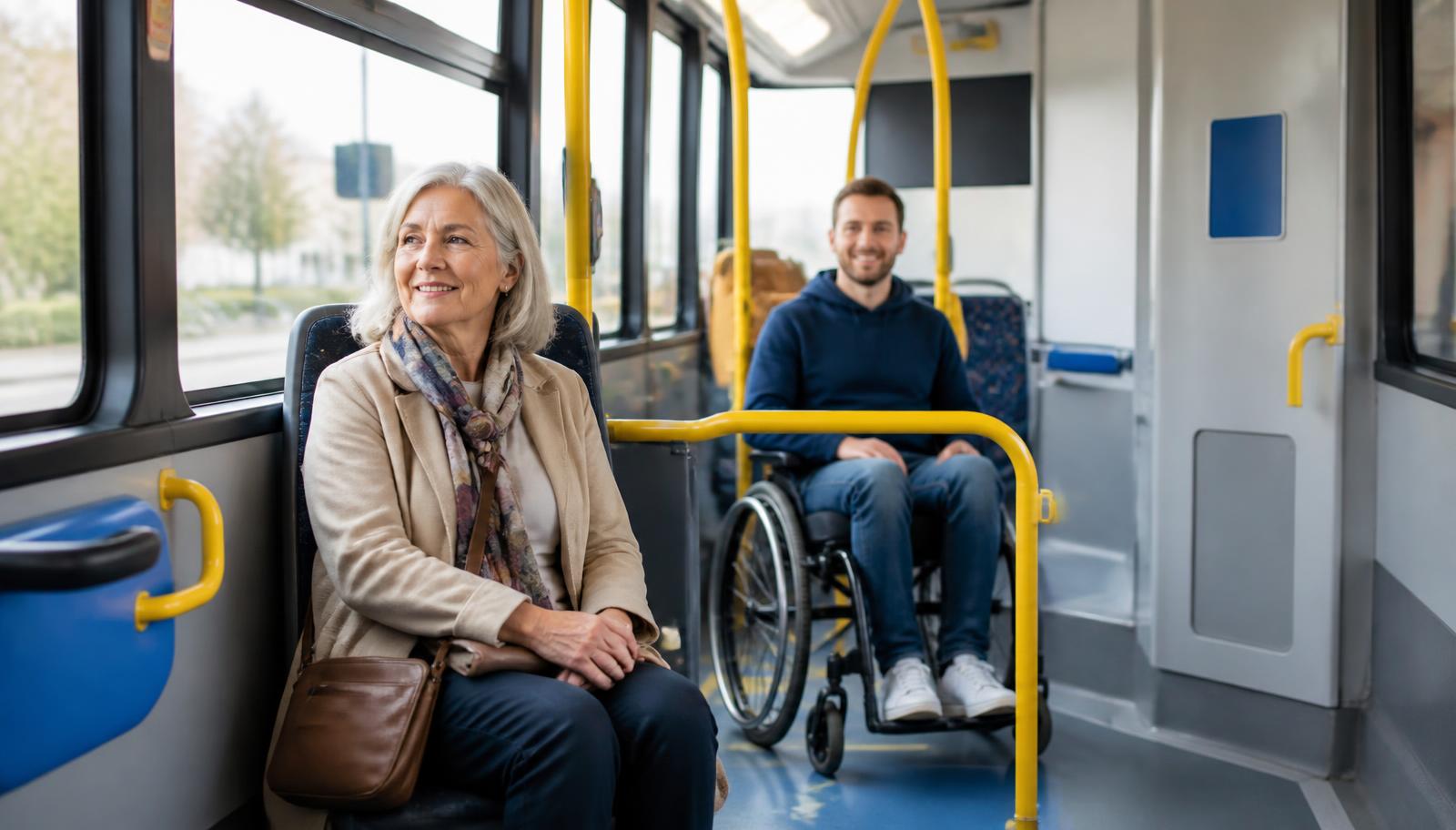
A plain-English United Kingdom guide to travelling by bus, coach, train and taxi — planning ahead, asking for assistance, wheelchairs and scooters, bus passes and railcards, and what to do when things go wrong.
Getting around by public transport
Buses, coaches, trains, trams, taxis and community transport can all help people stay independent — getting to appointments, work, shops, family and days out.
Accessibility varies a great deal between operators, vehicles, stations and stops. Some journeys are fully step-free; others are not. Rules on concessionary passes and fares are also different in England, Scotland, Wales and Northern Ireland.
This page explains what is usually available and how to ask for help. It is general information only — always confirm the arrangements for your own journey with the operator before you travel.
Key points
- Passenger Assist on the railway is free and you do not need a Disabled Persons Railcard to use it.
- Concessionary bus pass rules differ across the four nations — eligibility, age thresholds, travel times and companion passes are not the same everywhere.
- Accessibility information can change at short notice — lifts fail, ramps break and platforms alter.
- Statistics on bus travel are published separately for each nation. The Department for Transport's bus statistics cover England only — see reference 25 for the figures and their reporting year.
1. Planning a journey
- Check routes, times, connections and accessibility before leaving — including at every place you change.
- Allow extra time for unfamiliar journeys, and for connections where you may need help.
- Check for engineering work, diversions, replacement buses and lift closures. Replacement buses are not always accessible in the same way as the train.
- Save your journey details or take screenshots in case mobile internet or your battery fails.
- Carry essential medication, identification and emergency contact details where that is appropriate for you.
Accessibility information can change. A lift that was working last week may be out of service today. Where the journey matters, telephone or message the operator shortly before you travel and confirm.
2. Buses and coaches
- Most modern buses have a boarding ramp, at least one wheelchair space and priority seating.
- You can ask the driver for reasonable assistance — for example deploying the ramp, lowering the bus, waiting until you are seated, or telling you when your stop is coming.
- Reasonable assistance does not normally include physically lifting a passenger or lifting heavy mobility equipment. Drivers are not trained or insured to do this.
- For coach travel, ask about assistance at the time of booking — accessible coaches and boarding lifts often need to be arranged in advance.
- Many, but not all, buses have audio and visual next-stop information.
Please do not assume every vehicle, route or stop is fully accessible. Some rural routes, older vehicles and unmade stops are not.
Planning an intercity coach trip? See our dedicated guide to finding and booking coach journeys, with links to the main operators: Coach Journeys Across the UK.
If a ramp is broken, the wheelchair space is unavailable or assistance is refused: note the date, time, route number and, if visible, the vehicle number. Ask when the next accessible service is due, and report it to the operator. If the operator does not put things right, Bus Users UK can help — and in London, London TravelWatch.
3. Train travel and Passenger Assistance
Passenger Assist is free. It is available to disabled people, older people and people with a temporary mobility difficulty — for example after an operation or while using crutches. You do not need a Disabled Persons Railcard to book it.
Assistance can usually include:
- help boarding and leaving the train, including a ramp
- help changing platforms or making a connection
- help finding a reserved or suitable seat
- help with luggage, where the operator offers it
You can still ask for assistance without booking ahead — this is often called "turn up and go". Staff will do their best, but it can depend on station conditions and how many staff are on duty at the time.

Accessibility can vary by location. Check directly before travelling.
- Check station accessibility, lifts, step-free routes and any planned platform changes before you travel.
- If a station is not accessible to you, the operator's Accessible Travel Policy sets out what alternative accessible transport should be provided, usually to the nearest accessible station.
4. Wheelchairs and mobility scooters
- Check size and weight restrictions before travelling — buses, trains and coaches each set their own limits for the space and the ramp.
- Reserve a wheelchair space where the operator requires or offers reservations.
- Apply the brakes, or switch powered equipment off, while the vehicle is moving when staff instruct you to.
- Some operators run a scooter permit or assessment scheme. Where they do, you may need the permit before your first journey.
- Follow the boarding and securing arrangements staff describe — positions and anchor points differ between vehicles.
Policies differ between operators and even between vehicles on the same route. It is not the case that every mobility scooter must be accepted; some are too large or heavy for a particular vehicle.
5. Assistance dogs
Trained assistance dogs are generally permitted on public transport, including buses, trains, coaches, taxis and private hire vehicles. This is different from ordinary pets and from emotional-support animals, which are not covered by the same arrangements.
- Check the operator's arrangements before an unfamiliar journey, especially for coaches, ferries and airport transfers.
- Ask where there is space for the dog to settle safely and out of the gangway.
- Allow extra time at transfers, and check that replacement transport during disruption can carry the dog.
6. Bus passes and concessionary travel
Eligibility, how to apply, when you can travel and whether a companion can travel free all differ across England, Scotland, Wales and Northern Ireland. Please use the link for your own nation — England-only rules are not UK-wide rules.
- England: apply through the GOV.UK service, which asks for your postcode and directs you to your council.
- Scotland: the National Entitlement Card schemes for disabled and older people.
- Wales: the Transport for Wales concessionary travel card.
- Northern Ireland: free and concessionary bus and rail travel through nidirect.
Older person's passes exist across the UK, but the qualifying age is not the same everywhere — please check your nation's rules rather than assuming.
Local councils and transport authorities may add extra local concessions — for example earlier travel times, tram or rail add-ons, or companion passes. These are local decisions and are not guaranteed anywhere else.
7. Railcards and discounted fares
- Disabled Persons Railcard — discounts for the cardholder and an adult companion, subject to the eligibility criteria and evidence required.
- Senior Railcard — for people aged 60 and over.
- Other railcards exist for particular ages, regions and circumstances, such as 16–25, 26–30, Two Together, Family & Friends and Veterans.
- Some wheelchair users who stay in their wheelchair, and some blind or visually impaired passengers travelling with a companion, may be able to claim a discount without a railcard. Ask at the ticket office or check the operator's policy.
Eligibility rules and evidence requirements apply to every railcard. A railcard does not always produce the cheapest fare — compare advance, off-peak and split ticket options for your particular journey before buying.
8. Community and door-to-door transport
- Dial-a-Ride and community transport schemes offer bookable door-to-door journeys for people who cannot easily use ordinary buses.
- Councils and voluntary organisations may run accessible minibuses, shopper buses or volunteer car schemes.
- Availability, eligibility, how far ahead you must book and any charges vary a great deal locally. Some schemes have waiting lists or serve only certain postcodes.
Hospital and healthcare journeys — including non-emergency patient transport — are covered on our separate page rather than repeated here.
9. Taxis and private hire vehicles
- Ask for a wheelchair-accessible vehicle when you book, and say whether you will stay in your wheelchair.
- Explain your mobility and assistance needs at the time of booking — for example help with a folded wheelchair, a walking frame, or getting to the door.
- Where the legal duties apply, drivers must carry assistance dogs and provide reasonable mobility assistance, and must not add an extra charge because of a disability.
- Some drivers hold a valid medical exemption issued by the licensing authority; they should display an exemption notice.
If something goes wrong, note the vehicle and licence details and report it to the licensing council as well as the operator. We give general information only and cannot advise on an individual legal case.
11. When services are delayed or cancelled
- Check the operator's current live information first.
- Ask staff what accessible replacement transport is available — a rail replacement bus is not always suitable, and an accessible taxi may have to be arranged.
- Keep tickets, receipts, photographs and screenshots. They are often needed for a claim.
- On the railway, Delay Repay and other refund arrangements may apply.
Eligibility and claim deadlines vary between operators. Not every delay qualifies for compensation — thresholds, causes and time limits differ, so check the operator's own scheme.
12. If assistance fails
- Speak to staff at the time if it is safe and possible to do so — many problems can be put right there and then.
- Record the details: date, time, route or train number, station or stop, vehicle details, staff involved and exactly what happened.
- Contact the transport operator first. Almost every complaints process requires this step before anyone else will look at it.
- For unresolved rail complaints, the Rail Ombudsman provides a free, independent service once the operator has issued its final response or a set period has passed.
- For bus and coach matters, contact Bus Users UK, or London TravelWatch for London, or the relevant transport authority.
If you would find it hard to put a complaint into writing, our free letter service can help you set out what happened clearly.
Personal safety and becoming stranded
If you are stranded, or you feel unsafe while travelling:
- Move to a well-lit, busy or staffed place where you can — a staffed station concourse, a shop that is open, or a bus station office.
- Contact the operator, station staff, a trusted person or a licensed taxi firm you have used before.
- Call 101 for non-emergency police assistance where that is appropriate.
- Call 999 if someone is in immediate danger or a serious crime is taking place.
Please do not confront another passenger or a member of staff. Move away, keep yourself safe and report what happened afterwards. On the railway you can also text the British Transport Police discreetly on 61016.
13. Questions to ask before travelling
- Is the station or stop step-free?
- Are the lifts working today?
- Can my wheelchair or scooter be carried on this vehicle?
- Do I need a permit or a reservation?
- Can assistance be provided at each connection?
- Is an accessible toilet available on the vehicle or at the station?
- What happens if the service is cancelled?
- Can a companion or carer travel at a reduced fare?
- Who should I contact if assistance does not arrive?
Please check before you travel
Routes, fares, concessions, accessibility arrangements and passenger policies can change, sometimes at short notice. Please confirm important arrangements with the relevant transport operator before travelling. Sixpence Support UK provides general information only and does not give individual legal advice.
- [1] GOV.UK. Transport and travel support if you're disabled · 2026
- [2] GOV.UK. Rights of disabled passengers on transport · 2026
- [3] GOV.UK. Apply for a disabled person's bus pass (England) · 2026
- [4] GOV.UK. Apply for an older person's bus pass (England) · 2026
- [5] mygov.scot. Disabled person's bus pass (Scotland) · 2026
- [6] mygov.scot. Older person's bus pass (Scotland) · 2026
- [7] Transport for Wales. Concessionary travel card (Wales) · 2026
- [8] nidirect. Free and concessionary bus and rail travel (Northern Ireland) · 2026
- [9] National Rail. Passenger Assist · 2026
- [10] National Rail. Accessible train travel and facilities · 2026
- [11] National Rail. Compensation and refunds · 2026
- [12] Passenger Assistance. Booking assistance online or by app · 2026
- [13] Disabled Persons Railcard. Eligibility and applications · 2026
- [14] Senior Railcard. Eligibility and applications · 2026
- [15] Railcard. All National Rail railcards · 2026
- [16] Office of Rail and Road. Rail regulation and accessible travel policies · 2026
- [17] Rail Ombudsman. Unresolved rail complaints · 2026
- [18] Bus Users UK. Bus and coach passenger complaints · 2026
- [19] Transport Focus. Independent transport user watchdog · 2026
- [20] London TravelWatch. Transport watchdog for London · 2026
- [21] Community Transport Association. Community and door-to-door transport · 2026
- [22] Assistance Dogs UK. Assistance dogs and access · 2026
- [23] Hidden Disabilities Sunflower. Sunflower scheme (UK) · 2026
- [24] GOV.UK. Access for wheelchair users to taxis and private hire vehicles · 2026
- [25] Department for Transport. Bus statistics collection · 2026