
Yoga and Pilates: Beginners, Benefits and Staying Safe
A plain-English United Kingdom guide for anyone thinking about starting Yoga or Pilates — what each activity involves, how they differ, chair-based and accessible options, how to begin safely, what to ask before booking and where to find lower-cost classes.
What Yoga and Pilates are
Yoga commonly combines physical postures, controlled movement, breathing and relaxation. Styles and class intensity vary considerably — some classes are slow and gentle, others are physically demanding.
Pilates focuses on controlled movement, posture, balance, flexibility and muscle strength, usually working through a set sequence of precise exercises.
The two share some features — controlled movement, attention to breathing, working at your own level — but they are not the same activity, and a class in one will not feel like a class in the other.
You do not need to be flexible, slim, young or experienced before beginning an appropriate beginners' class. Everybody in the room started somewhere, and a good instructor expects complete beginners.
- 150 minutes
of moderate activity a week is the NHS guideline for adults aged 19 to 64, spread across the week.
- 2 days a week
of activities that strengthen muscles are also recommended for adults — Pilates and some Yoga can contribute.
- Balance too
older adults at risk of falls are advised to include activities that improve balance and strength on at least 2 days a week.
1. Possible benefits
People who take up Yoga or Pilates commonly do so hoping to:
- improve strength, flexibility, balance, posture and body awareness
- support relaxation and general wellbeing
- help themselves stay active, in a setting that feels manageable
- meet other people locally and build a routine
Benefits vary from person to person. Neither activity is a cure for pain, disability or a medical condition, and this page does not claim that Yoga or Pilates treats anxiety, depression, arthritis, back pain or any other illness. They are forms of physical activity that some people find helpful and enjoyable — no more and no less.
2. Choosing between Yoga and Pilates
Broadly speaking:
- Yoga classes often move between held postures, with breathing and a period of relaxation. Pace ranges from very slow to fast and physically hard, depending on the style.
- Pilates classes tend to work through repeated, controlled exercises with attention to alignment and core muscles, often lying, sitting or standing rather than holding long postures.
Neither is automatically safer or better than the other. What matters far more is the level of the class, the instructor, and whether movements can be adapted for you.
Beginner-friendly options worth asking about include:
- Beginners' Yoga and gentle Yoga
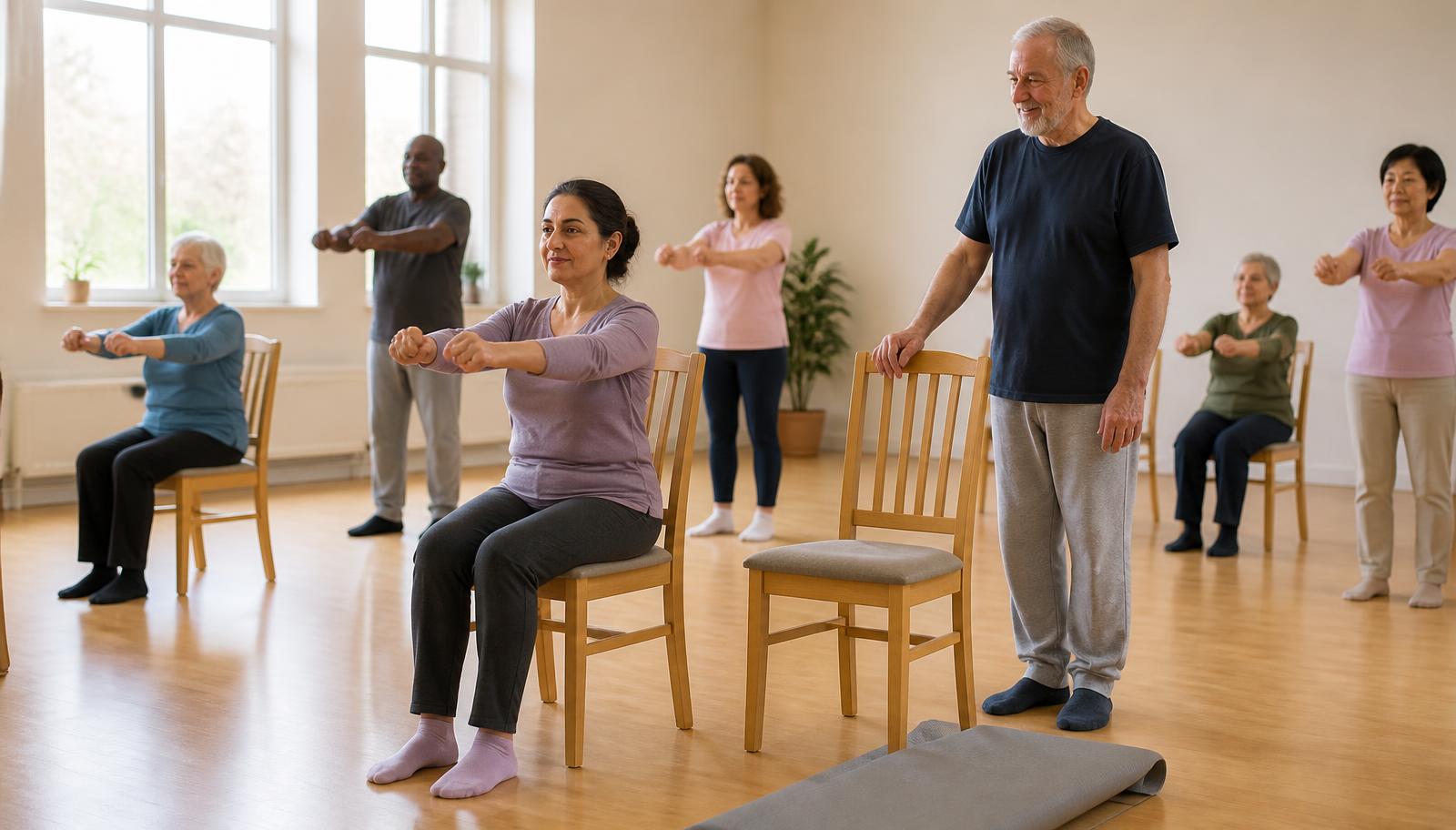
- Chair Yoga
- Restorative Yoga, which is slow and supported
- Mat Pilates
- Standing Pilates
- Chair-based Pilates
Choose according to your own interests, mobility, health and the adaptations available — not according to what someone else enjoys.
3. Getting started safely
- Choose a beginners' or gentle class rather than a general or advanced one.
- Tell the instructor before you start about relevant health conditions, injuries, pain, balance problems or mobility needs.
- Begin gradually and allow time to learn safe technique — progress comes from repetition, not from pushing hard early on.
- Wear comfortable clothing you can move in, and use suitable equipment.
- Keep a stable chair or other support nearby if you need it.
- Do not force a joint, hold a painful position, or compete with other people in the room.
- Avoid holding your breath unless a suitably qualified instructor has given you safe guidance about a specific breathing technique.
4. Chair-based and disability-friendly options
Many movements can be adapted for people who cannot easily stand, kneel or get down onto the floor. Chair-based Yoga and Pilates are well established, and some sessions are run so that wheelchair users can take part.
The word "accessible" means different things to different providers. Please ask exactly what support and adaptations are available before you book, including:
- step-free access into the building and the room
- accessible toilets and changing space
- room for a wheelchair, walking frame or other mobility equipment
- whether floor work is required, or whether everything can be done seated or standing
- quieter or smaller sessions, if noise or crowds are difficult
- whether a carer or support person may attend, and whether they pay
Not every class can accommodate every disability, and it is fair for a provider to say so honestly. If one class cannot meet your needs, another may — ask what else is running locally.
5. Older people and anyone worried about falls
- Choose a class pitched at the right level, on a stable, non-slip surface, with support such as a chair or wall available.
- Avoid difficult balance positions without supervision, particularly at home alone.
- Get professional advice first if there is a history of falls, dizziness, fainting or serious balance difficulty. A GP may be able to refer to a falls service or physiotherapy.
- Balance and strength work is recommended for older adults — but it should be built up carefully, with support to hand.
6. Health conditions, injuries and recent treatment
Please get guidance from a GP, physiotherapist or another appropriate healthcare professional before starting if you:
- have an injury or unexplained pain
- have recently had surgery, a heart attack or another significant medical event
- have a heart, breathing, neurological, joint or balance condition
- have osteoporosis or a high fracture risk
- are pregnant or have recently given birth
- are simply unsure whether the exercises are appropriate for you
This page deliberately does not give condition-specific exercise prescriptions. Which movements are safe for you depends on your own diagnosis, history and current condition, and that judgement belongs to a qualified professional who can assess you.
Stop exercising and get help if these happen
Call 999 for chest pain, severe difficulty breathing, collapse, or any other life-threatening emergency.
Stop straight away and get medical advice if, during or after a class, there is:
- new or severe pain
- chest pain or tightness
- unusual breathlessness
- faintness, dizziness or feeling that you may collapse
- numbness or sudden weakness
- feeling seriously unwell
For urgent concerns that are not immediately life-threatening, use NHS 111.
Normal effort or a warning sign?
Working muscles may feel warm, tired or mildly achy, and you may be a little breathless but still able to talk. That is ordinary effort, and mild stiffness a day or two later is common when you are new to an activity.
A warning symptom is different: sharp or severe pain, chest pain, breathlessness out of proportion to what you are doing, dizziness, numbness or weakness. Please do not push through those to finish a class. Stopping is always the right choice, and no reasonable instructor will mind.
7. Pregnancy and after giving birth
Specialist prenatal or postnatal classes are often more appropriate than a general class, because some movements are not suitable during or soon after pregnancy.
The instructor should have suitable experience and training for working with pregnant and postnatal participants — please ask directly.
Follow the guidance you are given by your midwife, GP, physiotherapist or maternity team. This page does not set out pregnancy poses or exercises, because what is right depends entirely on your own pregnancy, birth and recovery.
8. Finding a suitable instructor
Before committing to a course, it is reasonable to ask:
- what recognised training and qualifications they hold
- whether they hold current insurance
- how much experience they have adapting sessions for disability, pain, pregnancy, older people or a specific health condition
- how large the class is, and whether individual help is realistically available
- whether they ask about health conditions before the first session — a good instructor will
Sixpence Support UK does not endorse or recommend any commercial instructor, studio or class. A title, certificate or impressive website does not by itself guarantee competence — the questions above, and how openly they are answered, tell you more.
9. Trying a class from home
- Use reputable beginner material, including the free NHS exercise videos linked on this page.
- Make enough clear space and remove trip hazards, rugs and cables.
- Use a stable chair with four legs — never one with wheels or castors.
- Keep a telephone within reach if you are exercising alone and have health or mobility concerns.
- Stop if anything hurts, and do not try to copy a movement that looks risky for you.
Please remember that a recorded video cannot see you. It cannot check your posture, notice that you are compensating for an injury, or know anything about your medical needs. For many people a taught class, at least to begin with, is safer.
10. Costs and lower-cost options
Places worth trying if cost is a barrier:
- Council leisure centres, which often run beginners' and seated classes
- Community centres, village halls, libraries and faith venues
- Disability and older-person organisations, which sometimes run adapted sessions
- Social prescribing or local wellbeing services — ask your GP practice whether there is a social prescribing link worker
- Free NHS exercise videos, which cost nothing to try at home
It is always worth asking about introductory or taster sessions, concessions (for example for people on certain benefits, carers or over-60s) and pay-as-you-go classes rather than committing to a block booking.
We cannot promise that free or low-cost classes will be available in every area — provision varies a great deal across the UK.
11. Questions to ask before booking
- Is this class genuinely suitable for beginners?
- Can movements be adapted for me?
- Do I need to get onto the floor?
- Is a chair-based option available?
- What qualifications and insurance does the instructor have?
- How many people usually attend?
- Is the venue accessible, including the entrance and toilets?
- What equipment should I bring, and what is provided?
- May a carer or support person attend, and do they pay?
- What is the cancellation policy if I am unwell?
If a venue or provider does not answer reasonable access questions, or you have had a poor experience you want to raise in writing, we may be able to help.
12. Related Sixpence Support UK pages
13. Reliable information and videos
Please use the official sources below, and always check the organisation's own website for the latest information.
Urgent NHS advice differs across the UK:
- England: contact NHS 111 by phone on 111, or use NHS 111 online.
- Scotland: contact your GP practice, or phone 111 when the practice is closed.
- Wales: contact NHS 111 Wales by phone on 111.
- Northern Ireland: contact your GP practice, or the GP out-of-hours service when the practice is closed.
In an emergency — including chest pain, severe breathing difficulty or collapse — call 999.
Please speak to a healthcare professional
Sixpence Support UK provides general information only. This page is not a personal exercise programme, a diagnosis, or a substitute for advice from a qualified healthcare professional. We cannot say which movements are safe for you, cannot assess an injury or condition, and do not endorse any particular class, studio or instructor. If you are unsure whether Yoga or Pilates is right for you, please speak to a GP, physiotherapist or another appropriate professional first.
- [1] NHS. Pilates and yoga exercise videos · 2026
- [2] NHS. Pilates for beginners · 2026
- [3] NHS. Chair-based Pilates exercise video · 2026
- [4] NHS. Arthritis Pilates exercise video · 2026
- [5] NHS. Osteoporosis Pilates exercise video · 2026
- [6] NHS. Yoga with LJ — exercise video · 2026
- [7] NHS. A guide to yoga (this page is no longer available online) · 2026
- [8] NHS. Prenatal and postnatal exercise · 2026
- [9] NHS. Physical activity guidelines for adults aged 19 to 64 · 2026
- [10] NHS. Physical activity guidelines for older adults · 2026
- [11] NHS. Free fitness ideas (this page is no longer available online) · 2026
- [12] NHS. Falls · 2026
- [13] NHS. Exercise in pregnancy · 2026
- [14] NHS 111. Get help for your symptoms (England) · 2026